
A pickleball paddle face is often described with one headline material: fiberglass, carbon fiber, Kevlar, titanium carbon, 3K carbon, 18K carbon, or another commercial name. That label is useful, but it is not a complete engineering description.
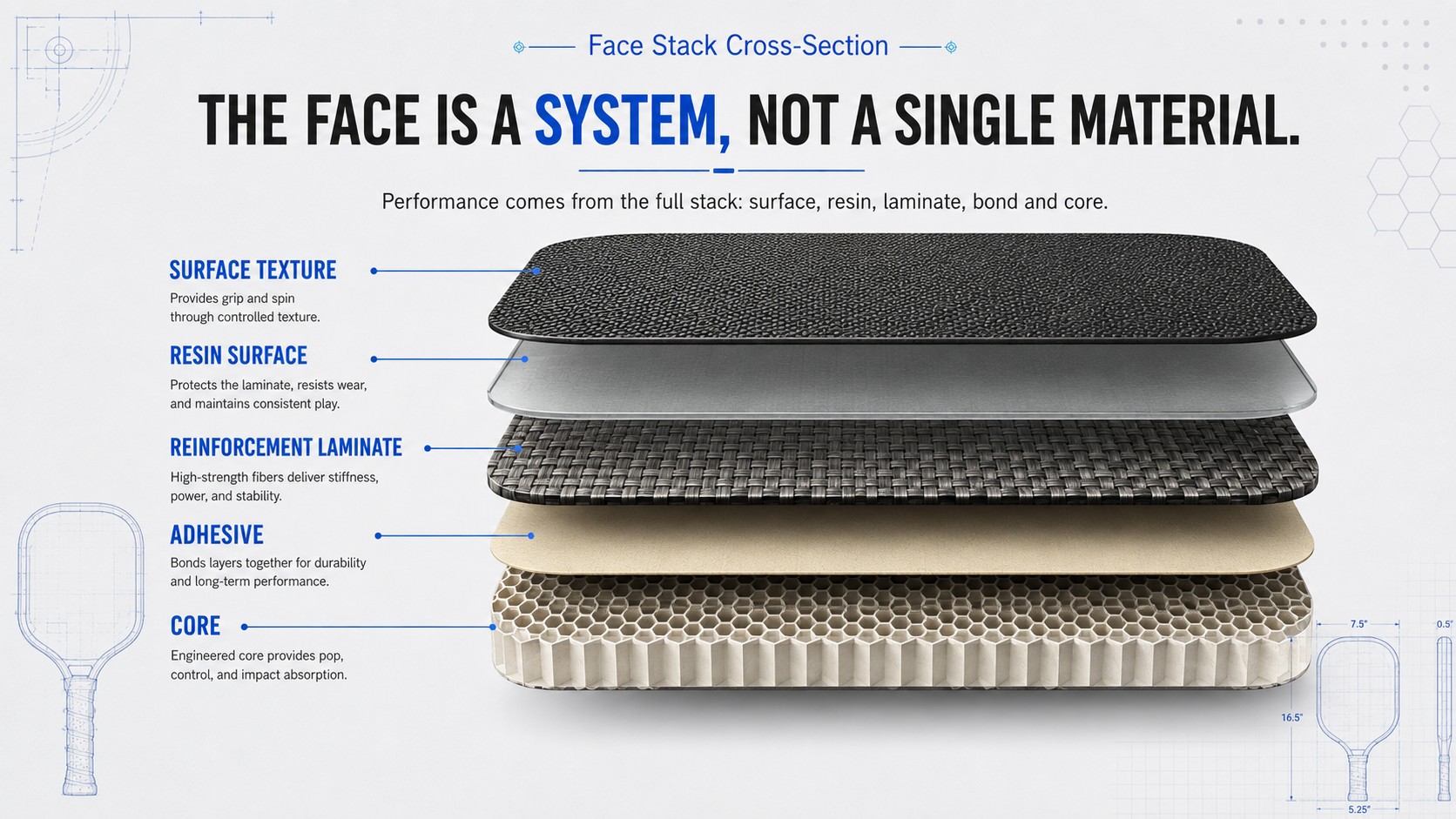
The face is a laminate system. Its behavior depends on the reinforcement fiber, resin matrix, fabric architecture, layer orientation, areal weight, bonding method, surface finish, and how that laminate interacts with the core and the rest of the paddle. A good material guide therefore should not rank face materials from “worst” to “best.” It should help the reader understand what each label means, which variables still need to be specified, and which deeper question to investigate next.
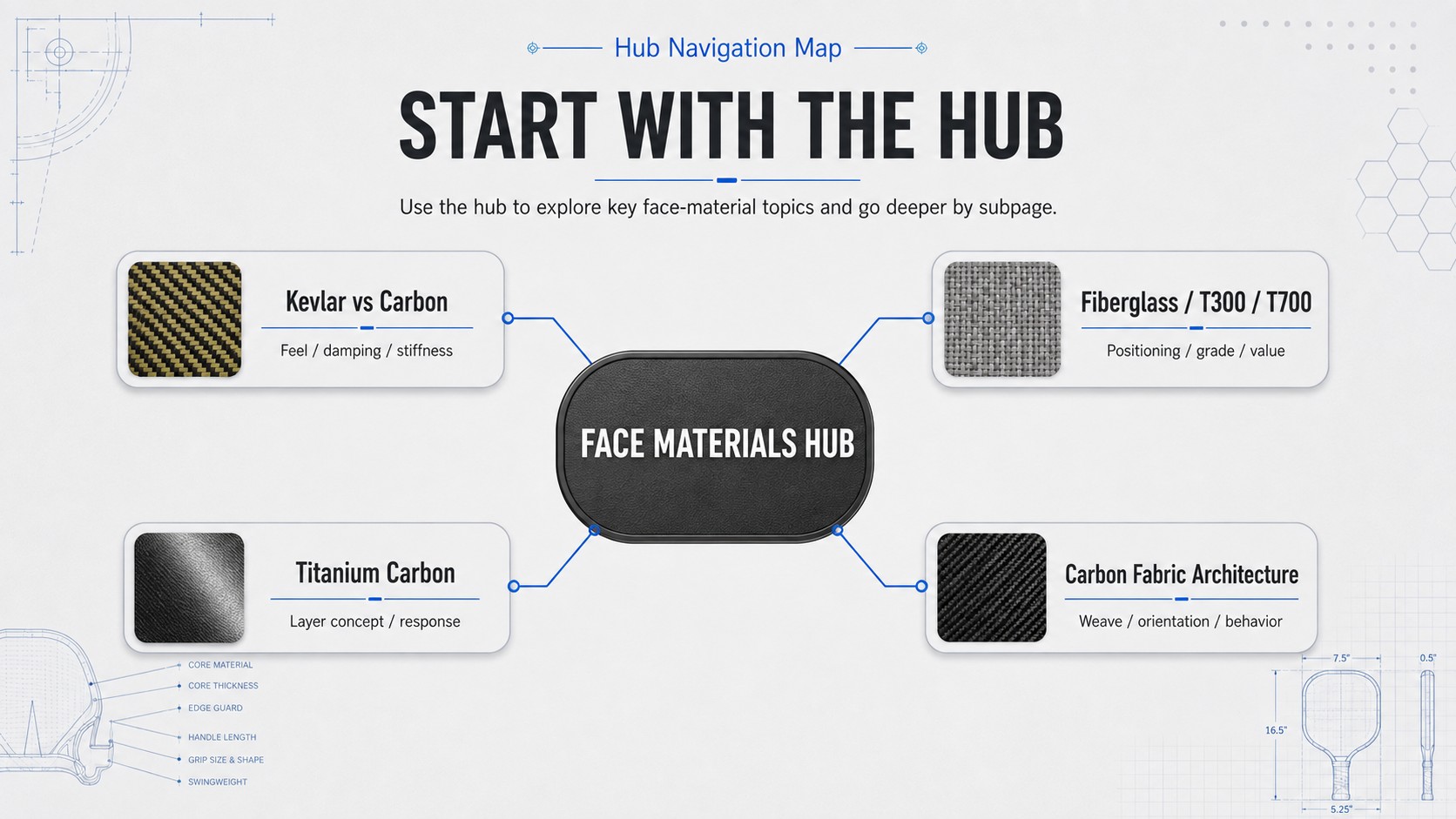
This page is the face-material hub for that job. It explains the main material families and directs readers to focused articles when they need a true comparison.
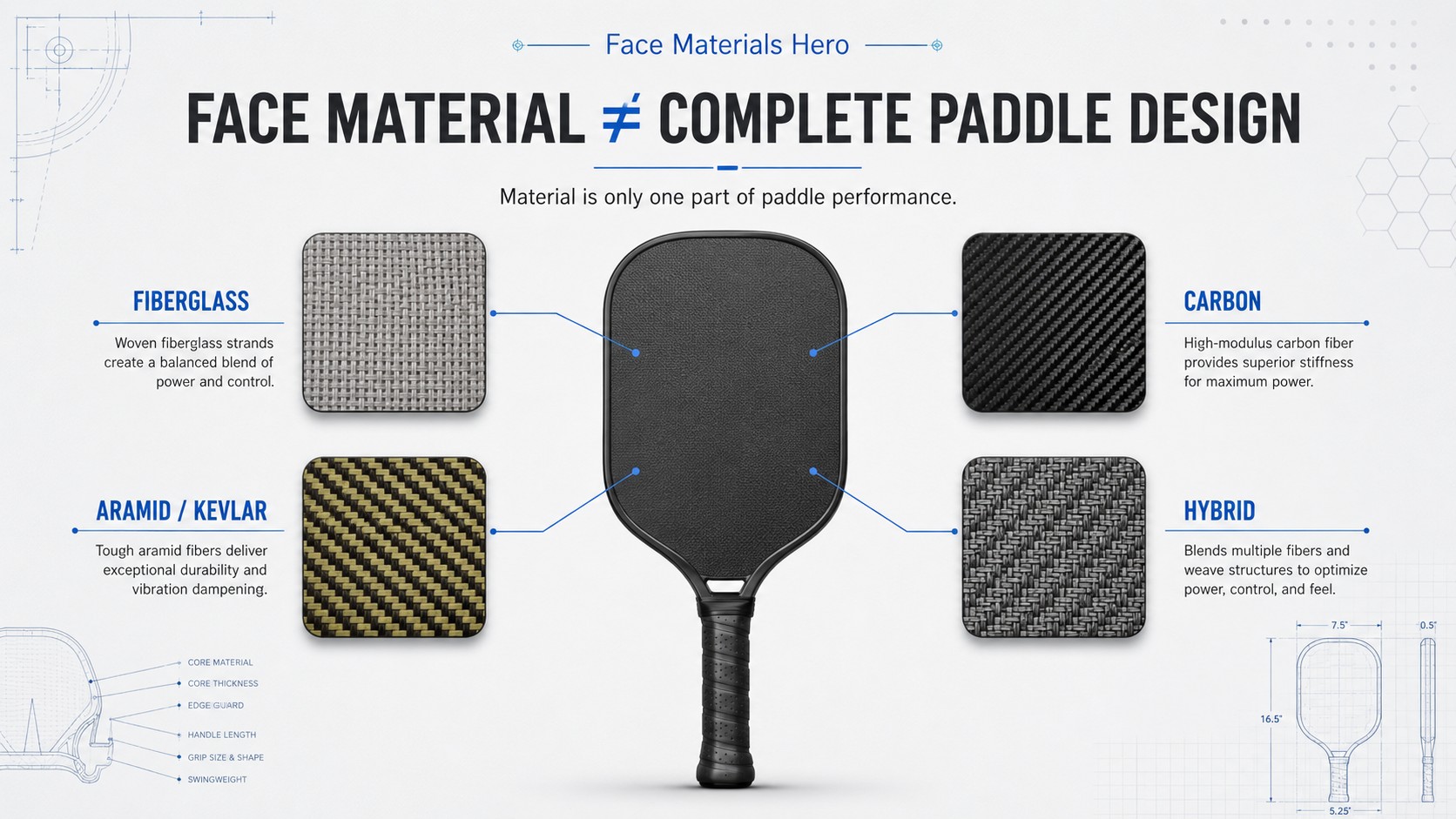
What the Paddle Face Actually Does
The face carries impact load into the core, contributes to local stiffness, helps control deformation, provides the surface on which texture is created, and must survive repeated impact without unacceptable cracking, delamination, cosmetic failure, or loss of surface consistency.
Those functions are shared by all face materials. What changes is how the laminate achieves them. A relatively compliant laminate can still become stiff if it is thick, heavily reinforced, or paired with a stiff core. A high-strength fiber can still produce a disappointing paddle if resin content, bonding, surface processing, or manufacturing consistency is poor.
For that reason, a face material should always be evaluated as part of a complete stack rather than as a marketing label.
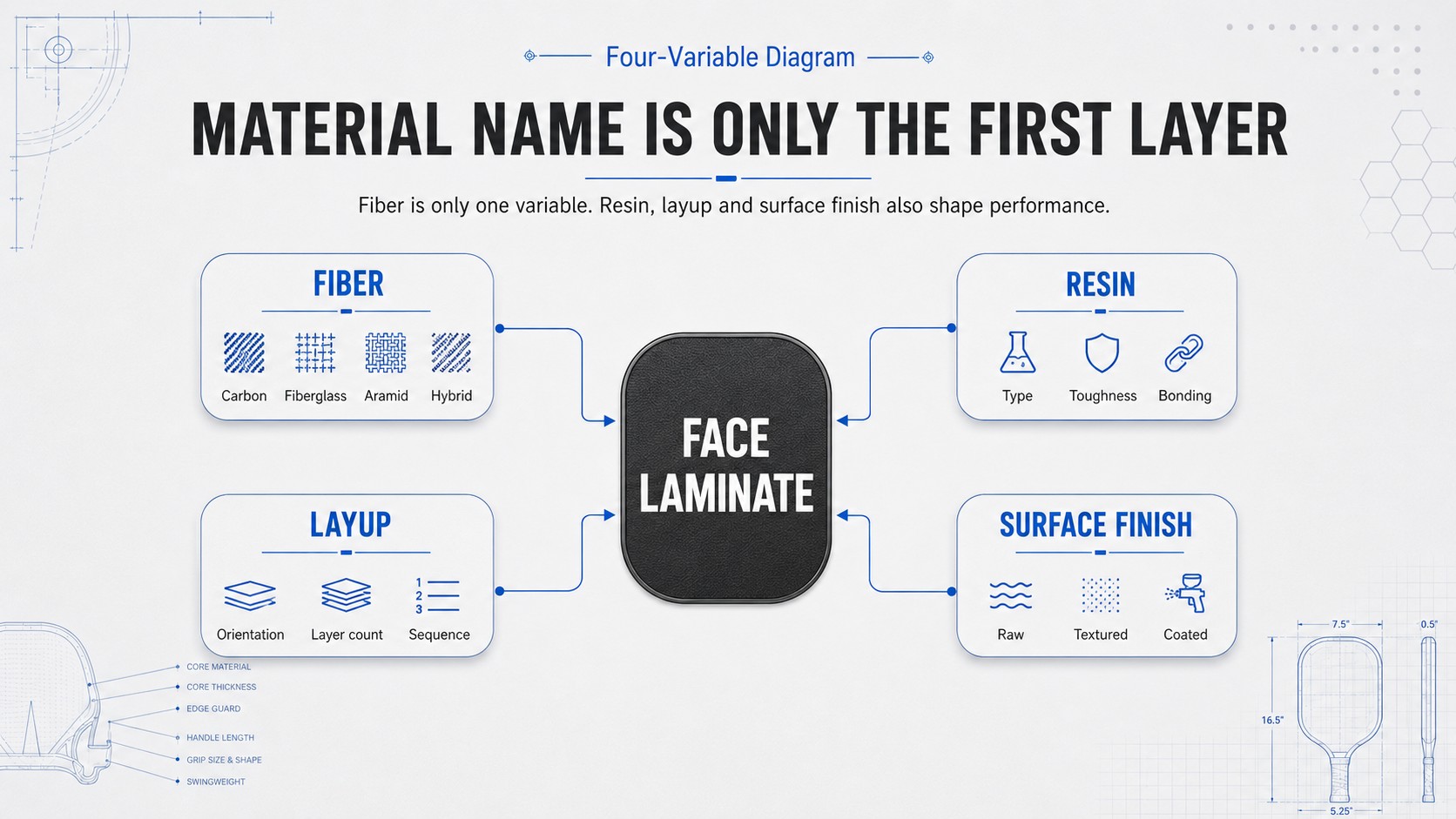
Four Variables to Separate Before Comparing Materials
When a supplier says “T700 carbon face” or “Kevlar face,” ask four separate questions.
First, what is the reinforcement fiber or material family? Second, what resin system holds that reinforcement together? Third, what is the fabric architecture and layup—woven, unidirectional, tow size, GSM, orientation, and layer count? Fourth, what surface process creates the final texture?
These variables are often mixed together in product marketing. They should not be. A carbon fiber grade does not tell you the weave. A weave does not tell you the resin content. A face material does not tell you whether the surface is peel-ply, grit-coated, printed, or otherwise textured. Keeping those layers separate prevents false conclusions.
Fiberglass Faces
Fiberglass remains useful because it is widely available, process-friendly, and compatible with many paddle constructions. It can support entry-level, recreational, control-oriented, or price-sensitive products depending on the total laminate and core design.
Its commercial advantage is often not that it creates one universal playing characteristic. It is that it gives developers a familiar reinforcement family with broad processing options and a relatively accessible cost structure.
When comparing fiberglass with carbon, do not change the face material, resin, layer count, surface process, and core at the same time. Otherwise the resulting “fiberglass versus carbon” conclusion is not controlled.
Carbon Fiber Faces
Carbon fiber is a family, not a single material. T300, T700, T800 and other grades refer to fiber products with different published properties. Fabric architecture then creates another layer of variation: UD, woven cloth, tow size, GSM, orientation, and stack sequence.
For paddle development, the most important discipline is to distinguish fiber grade from finished laminate. A supplier should be able to state which carbon fiber or fabric is being used, how it is supplied, how many layers are included, what orientation is used, and which surface treatment is applied.
Carbon can support many different product positions, but the material name alone does not prove more power, control, spin, durability, or “professional” performance.
Aramid / Kevlar Faces
Kevlar is a well-known trade name associated with para-aramid fiber. In a paddle face, aramid reinforcement can be used alone or in a hybrid laminate with carbon or other fibers.
The practical development questions are the same as with carbon: what exact material is being used, in what fabric form, at what areal weight, in which orientation, with what resin, and at what layer position? Brands should also evaluate edge finishing, bonding, cosmetic consistency, and durability because an attractive fabric story does not eliminate process requirements.
A proper Kevlar-versus-carbon article should compare controlled prototypes rather than generalizing from material reputation.
Titanium-Related and Metallic Hybrid Constructions
“Titanium carbon” is not a sufficiently precise engineering specification. Depending on the supplier or product, the phrase may refer to a visual film, a coating, a metallic-containing layer, a hybrid reinforcement concept, or another commercial construction.
Before discussing performance, identify where the titanium-related component is located and what physical form it takes. If the supplier cannot define that, the brand does not yet have a repeatable specification.
This is especially important for marketing claims. A construction fact—such as the presence of a defined layer—is different from a measured performance result. The two should be documented separately.
Hybrid Laminates
Hybrid faces combine materials or architectures to target a particular balance of stiffness, damping, durability, processing behavior, appearance, or cost.
The strongest way to evaluate a hybrid is to define the role of each layer. For example, one layer may primarily provide structural reinforcement while another controls surface appearance or local toughness. If every layer is simply described as “for more power and spin,” the specification is not useful.
Hybrid development also increases change-control needs. Substituting one fabric, resin, film, or adhesive can alter both processing and final behavior.
How to Choose the Right Deep-Dive Article
Use this page as a routing map rather than a final material ranking.
Read the Kevlar-versus-carbon guide when the decision is between aramid and carbon face concepts. Read the fiberglass-versus-T300/T700 guide when comparing mainstream reinforcement options. Read the carbon fabric architecture guide when the supplier is using terms such as UD, 3K, 18K, GSM, or multi-angle layup. Read the titanium-carbon guide when the commercial material name is ambiguous. Read the grit and peel-ply guides when the real question is surface texture rather than reinforcement.
This structure keeps each page focused and reduces internal keyword cannibalization.
OEM Face-Material Specification Checklist
Before approving a face construction for mass production, freeze the material supplier or approved equivalent, reinforcement family, fabric code when available, areal weight or thickness target, orientation, layer count, resin or prepreg system, bonding method, surface process, cosmetic standard, and inspection criteria.
Keep an approved golden sample and retained production samples. If a critical material changes, require review before the change enters normal production.
That system is more valuable than a product page that only says “premium carbon,” because it converts a marketing description into a reproducible manufacturing specification.
Frequently Asked Questions
Is carbon fiber always better than fiberglass?
No. The finished paddle depends on laminate design, core, geometry, surface, process and target use. A fiber family alone does not rank the entire paddle.
Is Kevlar automatically softer than carbon fiber?
Not automatically at paddle level. Fiber type can influence laminate behavior, but fabric, resin, thickness, orientation, core and geometry also matter.
Does 18K carbon mean higher performance than 3K?
No. K-count describes tow size, not a universal paddle-performance grade. Architecture, GSM, orientation and resin must also be considered.
Is titanium carbon a standardized paddle material?
No single standardized construction is implied by that commercial phrase. Ask the supplier to define the exact material form and layer position.
Should surface texture be treated as part of the face material?
It should be documented separately. The structural face laminate and the final texture process may use different materials and controls.
The End about Mayvoci
1)Design:Over 100 paddle designs and photography service to assist start-up.
2)Professional:Focus on various of paddles manufacturing for 6 years
3)Quality:Strict quality management system to provide safety and satisfaction for customers
4)Amazon:Flexible comprehensive solution to make sure each Amazon seller is well cared.
5)Excellent Team:Experienced paddle experts & dynamic sales team give you 5-star service

If you work on this topic from the brand, sourcing, engineering or manufacturing side, I’d be interested in your experience: When comparing paddle faces, which detail do you think buyers overlook most: resin, GSM, orientation, layer count or surface finish?