A customer sends an email saying:

“My paddle doesn’t feel the same anymore.”

Another writes:

“The sweet spot seems smaller.”

A third claims:

“The paddle has lost power after only three months.”

For pickleball brands, these complaints are common—but they are also some of the most difficult to evaluate.

Unlike a cracked frame or a broken handle, changes in paddle performance are often subjective. Two players may use the same paddle under completely different conditions, making it challenging to determine whether the issue is caused by normal wear, player usage, or a manufacturing defect.

Approving every warranty claim increases replacement costs and may encourage misuse. Rejecting legitimate claims, however, can damage customer trust and brand reputation.

The real challenge is not simply deciding whether a paddle should be replaced. It is identifying the root cause based on objective evidence.

This article explains how pickleball brands can distinguish normal product aging from potential manufacturing issues, what information should be collected from customers, how warranty decisions should be made, and why quality control (QC) traceability plays a critical role in the process.

Why Warranty Claims Are More Complicated Than They Appear

Modern pickleball paddles are highly engineered composite products.

A typical paddle may include:

  • Carbon fiber or fiberglass face materials
  • Polypropylene honeycomb or foam-based core structures
  • Edge reinforcement systems
  • Structural adhesives
  • Thermoformed or cold-pressed construction
  • Protective edge guards

Each component contributes to the paddle’s overall performance.

After hundreds—or even thousands—of games, these materials naturally experience stress. Some changes are expected throughout the product’s life cycle, while others may indicate an abnormal manufacturing issue.

The difficulty is that many customer complaints describe symptoms rather than causes.

For example:

  • “The paddle feels softer.”
  • “The sound has changed.”
  • “The paddle doesn’t hit as hard.”

These observations may be accurate, but they do not automatically identify what happened inside the paddle.

The same symptom may result from several completely different causes.

For example, reduced power may be related to:

  • Normal core fatigue after extensive use
  • Internal delamination
  • Adhesive failure
  • Heat exposure
  • Excessive impact
  • Manufacturing inconsistency

Without sufficient evidence, no responsible manufacturer should immediately classify the problem as either a warranty defect or normal wear.

The investigation should begin before any conclusion is reached.

Normal Wear vs. Manufacturing Defects: Understanding the Difference

One of the biggest mistakes brands make is treating every performance complaint as a quality issue.

In reality, every paddle has a finite service life.

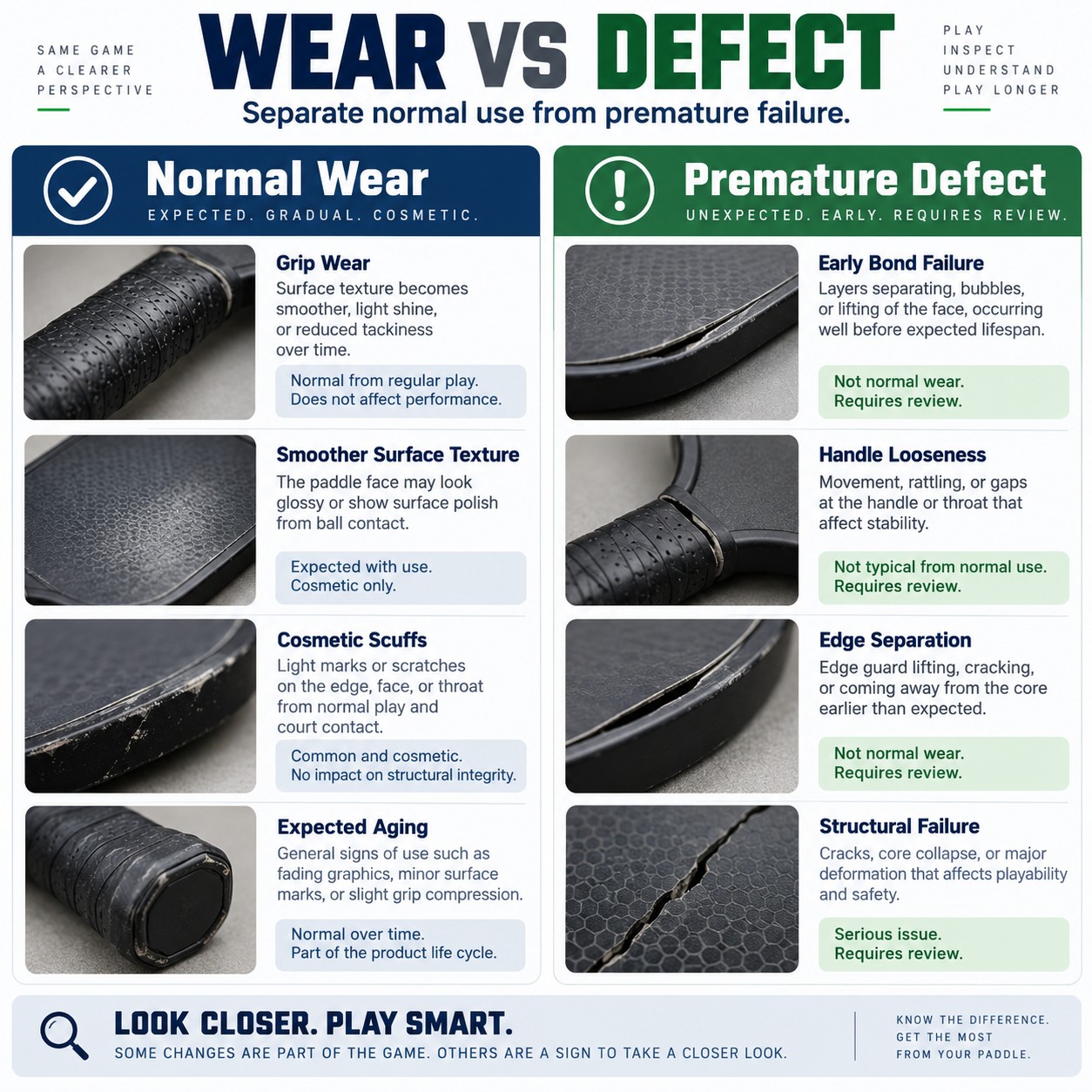
Composite materials gradually change under repeated impact. Small cosmetic damage accumulates during regular play. Surface textures wear down. Grip materials become smoother. These changes are considered normal product aging.

Manufacturing defects are different.

They originate from problems that existed during production, material selection, assembly, or bonding, even if the symptoms do not appear until later.

Understanding this distinction helps customer service teams make consistent warranty decisions.

What Is Usually Considered Normal Wear?

Normal wear develops gradually through expected use.

Examples include:

  • Cosmetic scratches on the paddle face
  • Small paint chips
  • Grip wear from frequent play
  • Reduced surface texture over time
  • Minor edge guard scuffs
  • Gradual changes in paddle feel after extensive use

These changes are part of the normal life cycle of sports equipment and generally do not indicate that the paddle was manufactured incorrectly.

A player who competes several times each week will naturally wear a paddle faster than someone who plays only a few times each month.

Usage frequency matters just as much as calendar age.

What May Indicate a Manufacturing Defect?

Some problems deserve closer investigation because they may result from production or material issues.

Potential examples include:

  • Premature delamination
  • Structural cracking without impact damage
  • Edge guard separation caused by bonding failure
  • Abnormal adhesive failure
  • Loose internal components
  • Surface separation
  • Significant dimensional inconsistency
  • Premature handle failure

These situations do not automatically qualify for warranty replacement.

Instead, they should trigger a structured technical review supported by evidence.

Good brands investigate before making assumptions.

Likewise, responsible manufacturers avoid rejecting claims without understanding the underlying cause.

Why “Loss of Power” Does Not Automatically Mean a Defective Paddle

Among all warranty requests, “my paddle has lost power” is one of the most common—and one of the hardest to verify.

Power is influenced by many variables beyond the paddle itself.

For example:

  • Player technique evolves over time.
  • Different pickleball models produce different rebound characteristics.
  • Outdoor temperatures affect both balls and composite materials.
  • Fatigue and physical condition influence swing speed.
  • Opponents may simply be hitting harder than before.

Even when the paddle is responsible, the cause may still vary.

Some performance changes result from normal material fatigue after hundreds of hours of play.

Others may indicate localized structural problems inside the paddle.

This is why experienced warranty teams avoid making decisions based solely on subjective descriptions.

Instead, they ask a more useful question:

What objective evidence supports the customer’s observation?

The answer to that question determines the next step in the investigation—not the complaint itself.

What Evidence Should Customers Provide for a Warranty Claim?

One of the most common reasons warranty cases become difficult is that the customer provides too little information.

Statements such as:

  • “The paddle feels different.”
  • “It doesn’t have the same pop.”
  • “The sweet spot is gone.”

describe the player’s experience, but they do not explain what caused the problem.

For brands, collecting complete and standardized evidence is the first step toward making a fair and technically sound decision.

Rather than evaluating claims on a case-by-case basis with different standards, many manufacturers use a structured evidence checklist.

1. Proof of Purchase

Warranty eligibility typically begins on the purchase or delivery date, depending on the manufacturer’s policy.

Customers should provide:

  • Purchase receipt
  • Order number
  • Invoice
  • Dealer information

This helps verify:

  • Warranty period
  • Product authenticity
  • Sales channel

It also prevents duplicate or fraudulent claims.

2. Product Identification

Accurate product identification allows both the brand and the factory to trace production records.

Useful information includes:

  • Paddle model
  • Color or version
  • Serial number (if available)
  • Production batch or lot number
  • Date code

The more precise the identification, the easier it becomes to determine whether similar issues have occurred in the same production batch.

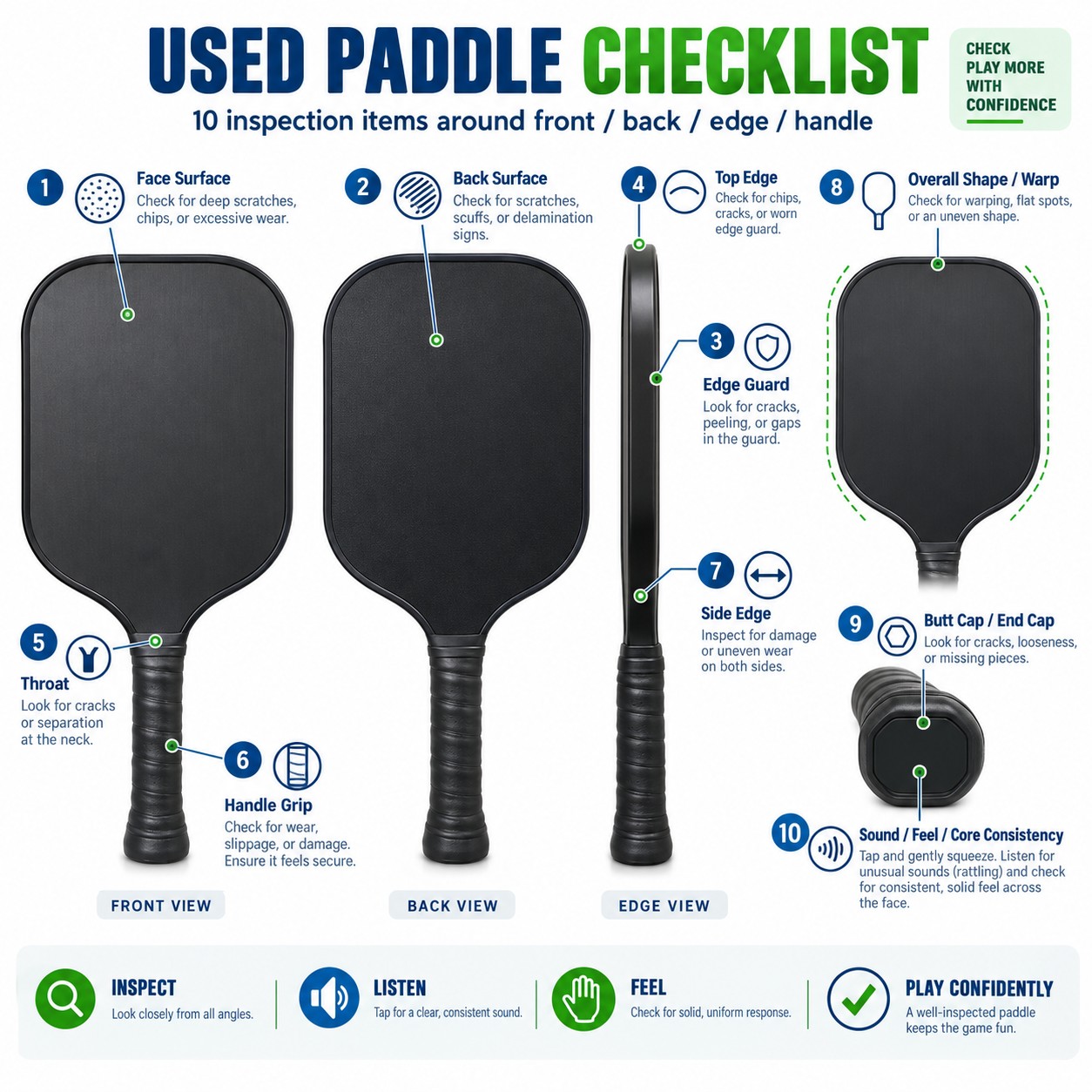
3. Photos and Videos

Visual evidence often provides valuable information before the product is physically inspected.

Customers should be encouraged to provide:

  • Front and back photos of the paddle
  • Close-up images of the suspected defect
  • Edge guard photos
  • Handle photos
  • Side profile images
  • Short videos demonstrating unusual movement or sound

For example, if a customer believes the paddle has delaminated, photos showing bubbles, surface lifting, or localized deformation can help engineers perform an initial assessment.

Likewise, a short tapping video may reveal abnormal internal sounds that deserve further investigation.

4. Usage Information

Understanding how the paddle has been used is just as important as inspecting the product itself.

Brands may ask questions such as:

  • When was the issue first noticed?
  • Approximately how many hours has the paddle been used?
  • Is it primarily used indoors or outdoors?
  • Is it used recreationally or in tournament play?
  • Has the paddle experienced any accidental impacts?

The goal is not to challenge the customer’s claim but to better understand the product’s service history.

5. Storage and Modification History

Environmental conditions can significantly affect composite sports equipment.

Customers should also disclose whether the paddle has been:

  • Left inside a hot vehicle
  • Stored in freezing temperatures
  • Exposed to excessive moisture
  • Modified with lead tape or weighted accessories
  • Repaired or altered after purchase

Many manufacturers specify acceptable usage and storage conditions within their warranty policies.

Understanding these factors helps distinguish product defects from external influences.

How Brands Should Evaluate a Warranty Claim

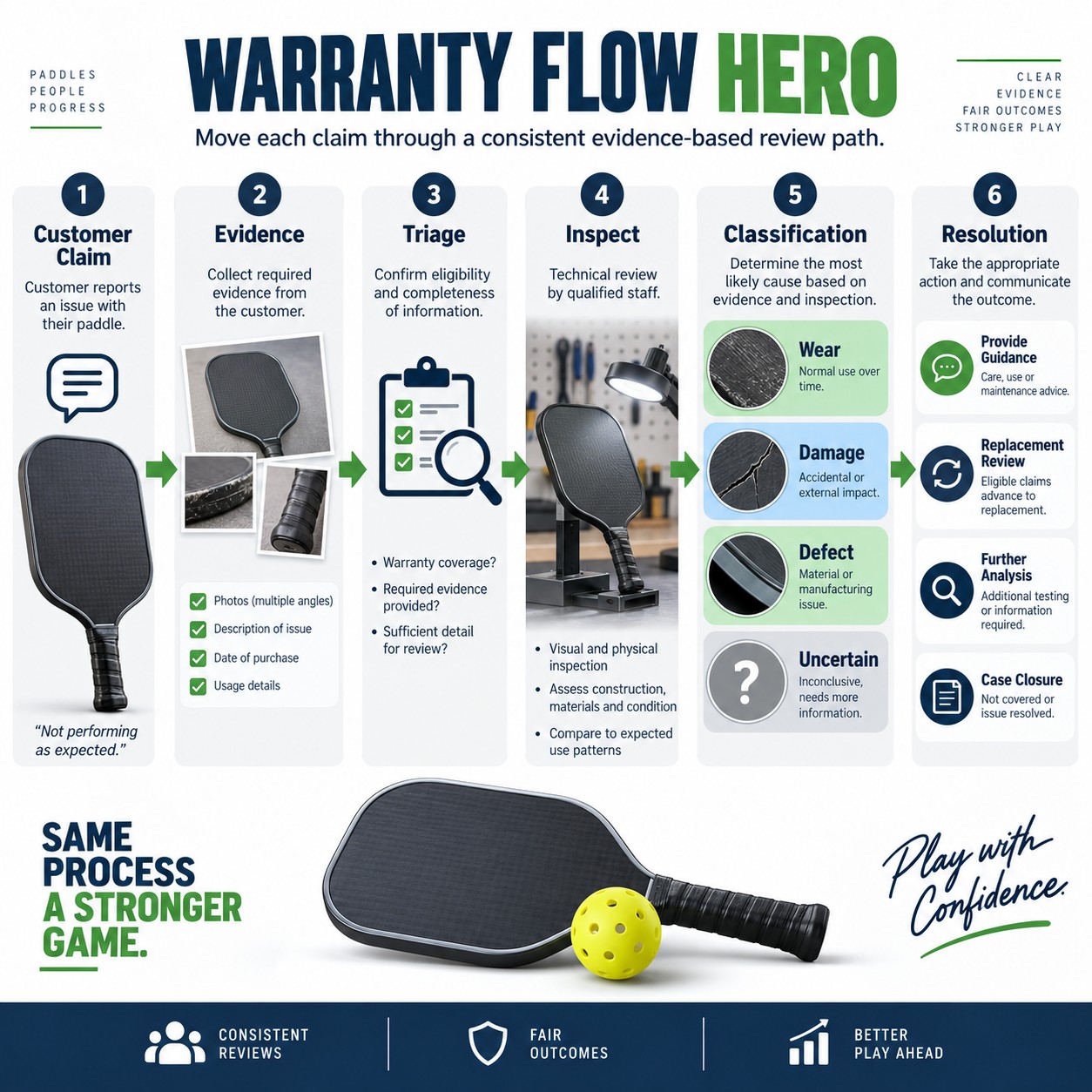
Once sufficient information has been collected, the evaluation process should follow a consistent workflow rather than relying on subjective judgment.

An effective warranty review generally consists of five stages.

Step 1: Verify Warranty Eligibility

Before analyzing the defect itself, confirm that the product meets the basic warranty requirements.

This typically includes:

  • Warranty period
  • Authorized purchase channel
  • Product authenticity
  • Applicable warranty policy

If these requirements are not met, the claim may be declined before technical inspection begins.

Step 2: Classify the Reported Problem

Next, identify the type of issue being reported.

Common categories include:

  • Structural failure
  • Delamination
  • Edge guard separation
  • Handle damage
  • Surface damage
  • Performance concerns
  • Cosmetic defects

Proper classification helps determine which technical specialists should review the case and what additional evidence may be required.

Step 3: Review Supporting Evidence

Customer service teams should compare the submitted information with known product characteristics and previous warranty records.

Questions to consider include:

  • Does the damage pattern match normal wear?
  • Are there signs of impact damage?
  • Have similar cases been reported previously?
  • Does the failure location suggest a manufacturing issue?

At this stage, conclusions should remain preliminary until sufficient technical evidence is available.

Step 4: Request Factory Technical Review When Necessary

Not every warranty decision should be made by the customer service department alone.

Cases involving potential structural failures should be reviewed by the manufacturer’s engineering or quality team.

Technical specialists may evaluate:

  • Failure location
  • Bonding quality
  • Material consistency
  • Production records
  • Similar historical cases
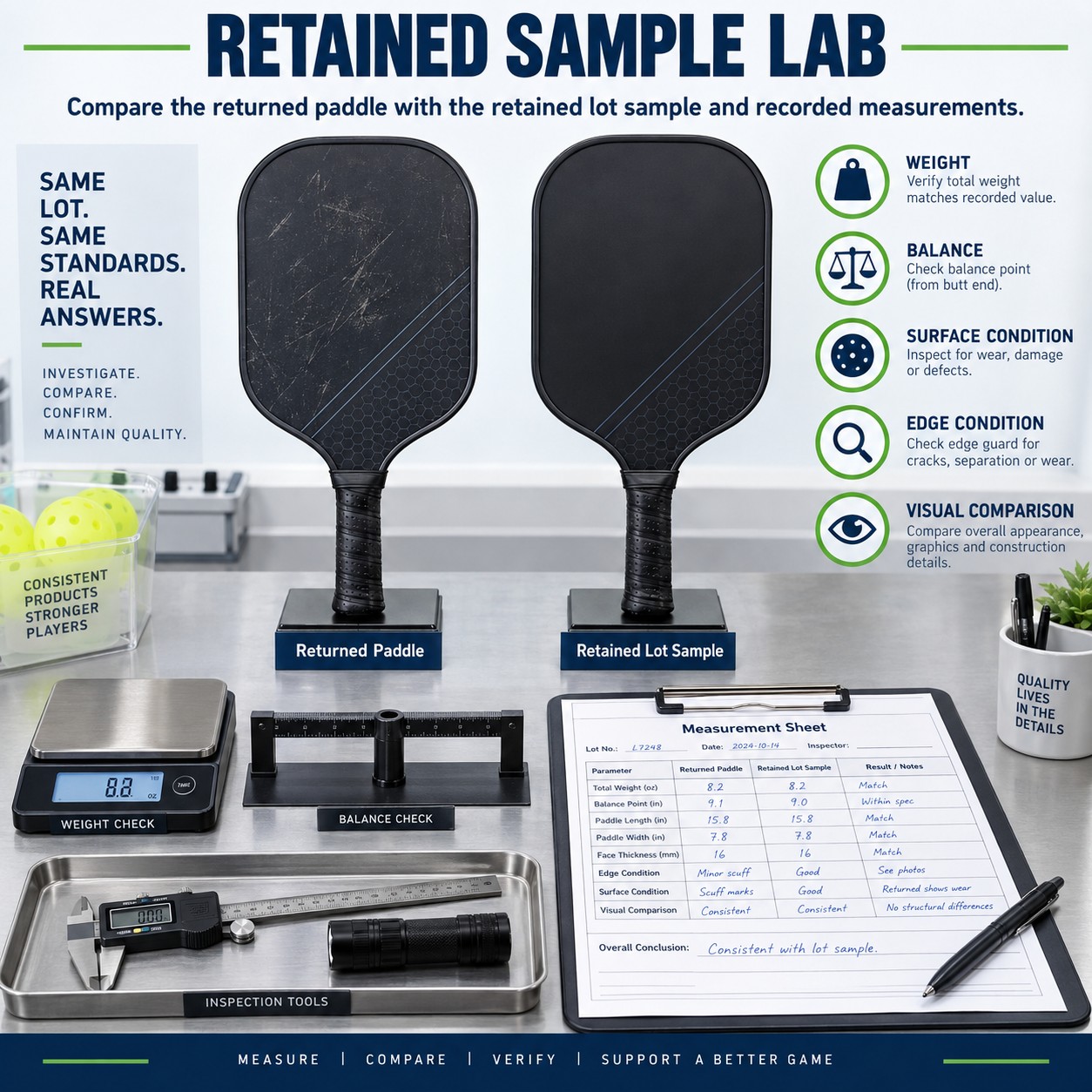
  • Retained production samples

This collaboration helps reduce both unnecessary replacements and incorrect warranty rejections.

Step 5: Make a Consistent Warranty Decision

Finally, the brand should communicate a clear decision supported by objective findings.

Whether the claim is approved or declined, the explanation should reference the investigation rather than relying on assumptions.

A transparent review process builds long-term customer confidence—even when the warranty request cannot be approved.

When Should a Warranty Claim Be Approved?

Not every complaint falls into a simple “approved” or “rejected” category.

Many experienced brands classify warranty cases according to the level of technical confidence.

Category 1: Strong Indicators of Manufacturing Issues

These situations often justify warranty consideration after verification:

  • Premature structural delamination
  • Bonding failure without external impact
  • Abnormal edge guard separation
  • Internal structural separation
  • Manufacturing dimensional errors
  • Material defects identified through inspection

These failures may indicate problems introduced during manufacturing rather than through normal use.

Category 2: Requires Further Investigation

Some issues cannot be confirmed immediately.

Examples include:

  • Reduced power
  • Changed impact sound
  • Increased vibration
  • Smaller sweet spot
  • Localized soft areas

Additional photos, videos, laboratory inspection, or factory review may be required before making a decision.

Category 3: Most Likely Normal Wear or User Damage

Certain situations are generally outside the scope of manufacturing warranties.

Typical examples include:

  • Cosmetic scratches
  • Grip wear
  • Surface texture reduction after extensive use
  • Ground impact damage
  • Damage caused by improper storage
  • Unauthorized repairs or modifications

These conditions are usually considered part of normal product ownership rather than evidence of defective manufacturing.

Importantly, every case should still be reviewed individually. A symptom alone should never determine the outcome.

How QC Traceability Helps Identify the Real Root Cause

For many brands, a warranty claim ends once a replacement paddle is shipped.

However, for manufacturers, the investigation should only be beginning.

A single customer complaint can reveal valuable information about production quality, material consistency, or process control. Without a traceability system, brands can only solve the immediate problem. With proper QC records, they can identify the root cause and prevent the same issue from happening again.

This is why leading OEM and ODM manufacturers invest heavily in production traceability.

The goal is not only to decide whether one paddle qualifies for warranty—it is to determine whether the issue is isolated or part of a larger production trend.

How QC Traceability Helps Identify the Real Root Cause

For many brands, a warranty claim ends once a replacement paddle is shipped.

However, for manufacturers, the investigation should only be beginning.

A single customer complaint can reveal valuable information about production quality, material consistency, or process control. Without a traceability system, brands can only solve the immediate problem. With proper QC records, they can identify the root cause and prevent the same issue from happening again.

This is why leading OEM and ODM manufacturers invest heavily in production traceability.

The goal is not only to decide whether one paddle qualifies for warranty—it is to determine whether the issue is isolated or part of a larger production trend.

What Information Should Be Traceable?

An effective quality management system should allow every finished paddle to be traced back through the manufacturing process.

Typical records include:

Raw Material Information

  • Carbon fiber supplier and batch number
  • Fiberglass batch
  • Core material batch
  • Foam material batch (if applicable)
  • Adhesive batch number
  • Edge guard material batch

If a material supplier experiences a quality issue, manufacturers can quickly identify which production batches may be affected.

Production Process Records

Manufacturing consistency depends on process control.

Factories should record key production parameters such as:

  • Pressing temperature
  • Pressing pressure
  • Pressing time
  • Curing time
  • Surface bonding conditions
  • Edge guard installation process
  • Foam injection parameters (if applicable)

Even small process variations can influence long-term paddle durability.

Final QC Inspection Data

Every finished paddle should pass standardized quality inspections before shipment.

Typical inspection items include:

  • Weight
  • Thickness
  • Balance point
  • Overall dimensions
  • Surface appearance
  • Bonding quality
  • Edge guard inspection
  • Handle inspection
  • Cosmetic quality

Maintaining these records allows manufacturers to compare warranty returns with the original inspection results.

From One Warranty Claim to Batch-Level Investigation

One customer complaint may appear to be an isolated incident.

Sometimes it is.

Sometimes it is not.

Imagine a brand receives a warranty request involving edge guard separation.

At first glance, replacing the paddle may seem like the quickest solution.

However, after reviewing internal records, the quality team discovers:

  • Three customers reported similar failures.
  • All paddles were produced within the same production week.
  • All used the same adhesive batch.
  • All were manufactured on the same production line.

The issue is no longer a single warranty case.

It becomes a potential batch-level quality concern.

Instead of asking:

“Should we replace this paddle?”

the better question becomes:

“Could other customers experience the same issue?”

This shift in thinking separates reactive customer service from proactive quality management.

A Typical QC Investigation Process

When multiple warranty claims show similar characteristics, manufacturers often follow a structured investigation process.

A simplified workflow may include:

  1. Confirm the reported defect.
  2. Review customer evidence.
  3. Verify production batch information.
  4. Check retained production samples.
  5. Review raw material records.
  6. Analyze production parameters.
  7. Compare with previous warranty cases.
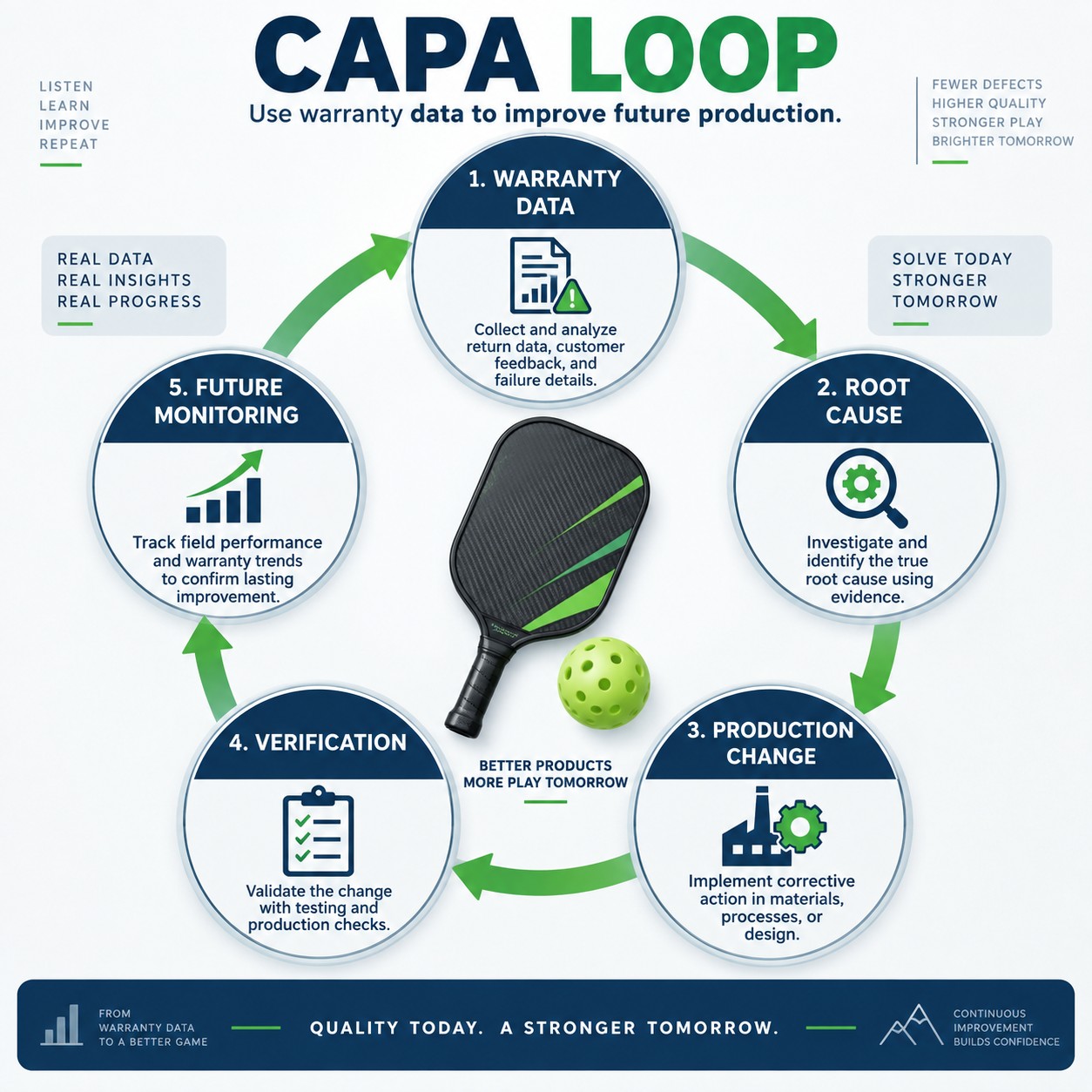
  8. Determine the root cause.
  9. Decide whether corrective action is required.

Corrective actions may include:

  • Process adjustments
  • Material changes
  • Additional inspections
  • Supplier reviews
  • Production retraining
  • Increased sampling frequency

The objective is not simply to resolve today’s warranty claim, but to reduce tomorrow’s warranty rate.

How Better QC Reduces Warranty Costs

Many companies think warranty costs are controlled by rejecting more claims.

In reality, the opposite is often true.

The most effective way to reduce warranty expenses is to prevent defects before products reach customers.

Strong quality control creates benefits throughout the supply chain.

For brands, it means:

  • Fewer customer complaints
  • Higher customer satisfaction
  • Lower replacement costs
  • Stronger brand reputation

For distributors and retailers, it means:

  • Fewer product returns
  • Less after-sales administration
  • Greater customer confidence

For manufacturers, it means:

  • Lower rework rates
  • Better production consistency
  • More stable product quality
  • Long-term partnerships with global brands

Quality control is therefore not simply a manufacturing expense—it is an investment that reduces risk across the entire business.

Building a Practical Warranty Decision Framework

Every pickleball brand should establish a consistent process for evaluating warranty claims.

Rather than relying on personal judgment, the decision should follow a standardized framework.

A practical approach includes five questions:

1. Is the Product Eligible for Warranty?

Confirm:

  • Purchase date
  • Warranty period
  • Authorized sales channel
  • Product authenticity

2. Is There Sufficient Evidence?

Review:

  • Photos
  • Videos
  • Purchase records
  • Product identification
  • Usage history

Without sufficient evidence, it is difficult to reach a reliable conclusion.

3. Does the Damage Match Normal Wear or a Potential Manufacturing Issue?

Evaluate:

  • Failure location
  • Damage pattern
  • Service life
  • Usage conditions
  • Previous warranty history

Avoid making decisions based solely on customer descriptions.

4. Can the Factory Trace the Production Records?

If the issue may relate to manufacturing, review:

  • Material batches
  • Production parameters
  • QC inspection records
  • Similar cases from the same batch

Traceability transforms assumptions into evidence.

5. What Is the Root Cause?

Only after completing the investigation should the warranty decision be made.

Possible conclusions include:

  • Manufacturing defect
  • Normal wear
  • User damage
  • Environmental influence
  • Insufficient evidence

A structured process leads to more consistent decisions and stronger customer confidence.

Final Thoughts: Warranty Decisions Should Be Based on Evidence, Not Assumptions

Every pickleball brand should establish a consistent process for evaluating warranty claims.

Rather than relying on personal judgment, the decision should follow a standardized framework.

A practical approach includes five questions:

1. Is the Product Eligible for Warranty?

Confirm:

  • Purchase date
  • Warranty period
  • Authorized sales channel
  • Product authenticity

2. Is There Sufficient Evidence?

Review:

  • Photos
  • Videos
  • Purchase records
  • Product identification
  • Usage history

Without sufficient evidence, it is difficult to reach a reliable conclusion.

3. Does the Damage Match Normal Wear or a Potential Manufacturing Issue?

Evaluate:

  • Failure location
  • Damage pattern
  • Service life
  • Usage conditions
  • Previous warranty history

Avoid making decisions based solely on customer descriptions.

4. Can the Factory Trace the Production Records?

If the issue may relate to manufacturing, review:

  • Material batches
  • Production parameters
  • QC inspection records
  • Similar cases from the same batch

Traceability transforms assumptions into evidence.

5. What Is the Root Cause?

Only after completing the investigation should the warranty decision be made.

Possible conclusions include:

  • Manufacturing defect
  • Normal wear
  • User damage
  • Environmental influence
  • Insufficient evidence

A structured process leads to more consistent decisions and stronger customer confidence.

FAQ

1. Is every pickleball paddle performance issue covered under warranty?

No. Warranty coverage generally applies to manufacturing defects rather than normal wear, accidental damage, or product modifications. Each claim should be evaluated individually based on evidence.

2. What is the difference between normal wear and a manufacturing defect?

Normal wear develops gradually through regular use, such as grip wear or cosmetic scratches. Manufacturing defects originate from problems in materials, production, bonding, or assembly that affect product performance or structural integrity.

3. What evidence should customers provide when submitting a warranty claim?

The most helpful information includes:

  • Proof of purchase
  • Paddle model and serial number (if available)
  • Photos of the entire paddle
  • Close-up images of the suspected defect
  • Videos demonstrating unusual sounds or movement
  • Description of usage frequency and storage conditions

Providing complete evidence allows brands to make faster and more accurate warranty decisions.

4. Why is QC traceability important for pickleball manufacturers?

QC traceability helps manufacturers identify whether a problem is an isolated case or part of a larger production issue. It also supports root cause analysis and continuous quality improvement.

5. Can one warranty claim reveal a larger manufacturing problem?

Yes. If multiple warranty claims involve the same production batch, material lot, or manufacturing process, they may indicate a batch-level quality issue that requires corrective action.

6. How can brands reduce future warranty claims?

Brands can reduce warranty costs by working with manufacturers that maintain strict process control, comprehensive inspection standards, and complete production traceability. Preventing defects is generally more effective than managing returns after products reach customers.

Call to Action

For Pickleball Brands and Distributors

Every warranty claim is an opportunity to learn more about your products—not just to replace them.

A structured warranty process, supported by reliable QC records and manufacturing traceability, helps brands reduce unnecessary costs while strengthening customer confidence.

At Mayvoci Sport, we work closely with pickleball brands worldwide to develop durable OEM and ODM paddles backed by consistent production control, comprehensive quality inspections, and batch traceability.

Whether you’re launching a new paddle line or looking to improve long-term product reliability, our engineering and manufacturing teams are ready to support your next project.

Looking for a manufacturing partner that prioritizes quality, consistency, and long-term performance? Contact Mayvoci Sport to discuss your next pickleball paddle project.

The End about Mayvoci

Mayvoci is a leading 6 years pickleball paddle supplier based in China. Below is our main 5 values. If you are interested in importing pickleball paddle, feel free to CONTACT us.

1)Design:Over 100 paddle designs and photography service to assist start-up.

2)Professional:Focus on various of paddles manufacturing for 6 years

3)Quality:Strict quality management system to provide safety and satisfaction for customers

4)Amazon:Flexible comprehensive solution to make sure each Amazon seller is well cared.

5)Excellent Team:Experienced paddle experts & dynamic sales team give you 5-star service
0 0 votes
文章评分
Subscribe
Notify of
guest
0 评论
Oldest
Newest Most Voted