
“Foam core” is not one paddle technology. EVA, EPP, TPE-based foams, PEBA and other engineered foams can have very different cell structures, densities, hardness levels, resilience, damping, temperature behavior and bonding characteristics.
The first engineering question should be where the foam is used and what job it must perform. A perimeter support material has different requirements from a full structural core or a handle damping insert.
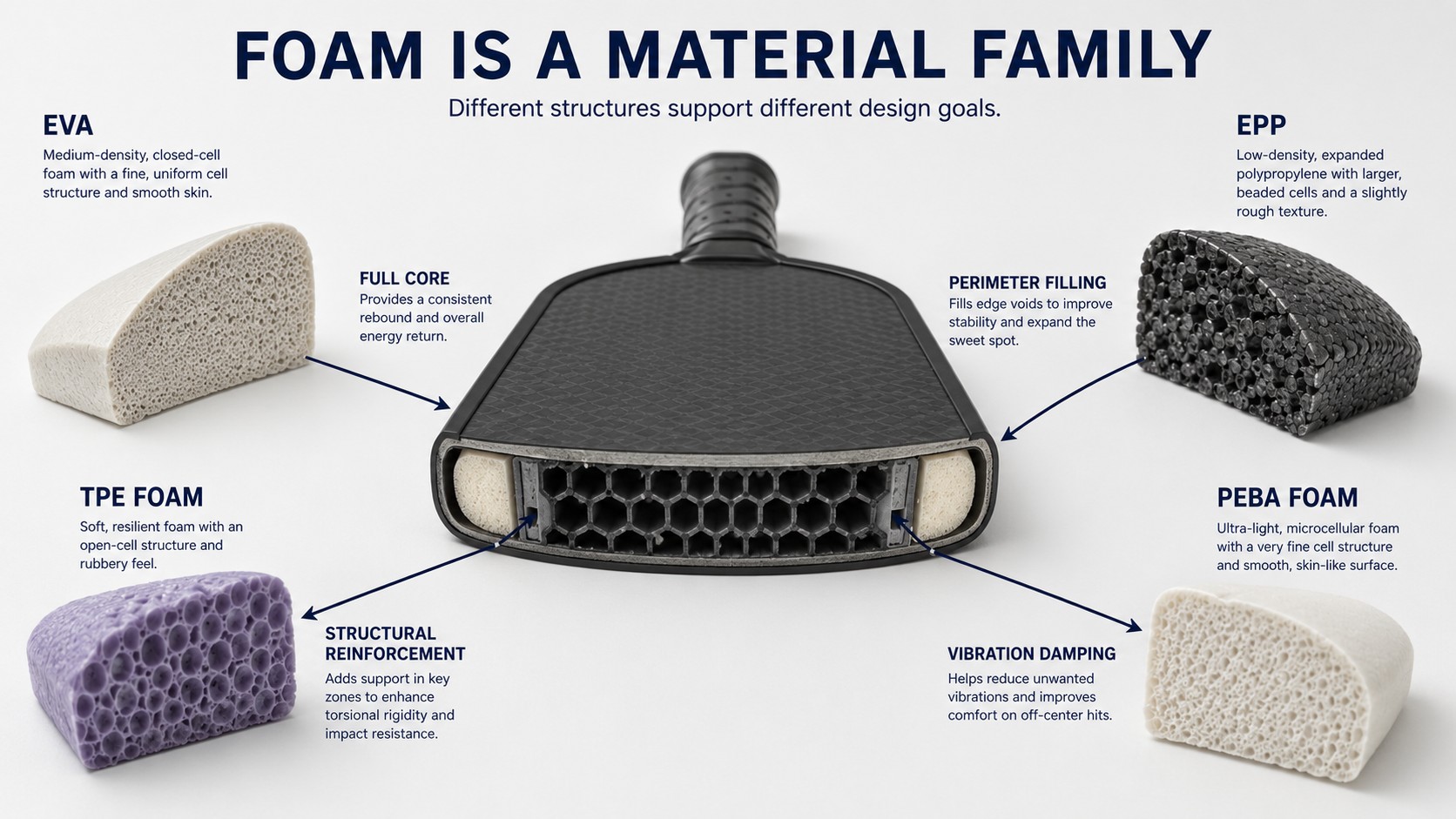
Choose Foam by Its Job in the Paddle
- Full structural core
- Perimeter support around honeycomb
- Local edge or throat reinforcement
- Handle filling or damping
- Intermediate layer in a hybrid architecture
Each role creates different priorities. A full core must support the face across a large area. A perimeter foam may prioritize edge support, bonding and mass distribution. A handle foam may prioritize damping and manufacturability.
EVA, EPP, TPE and PEBA Are Different Material Families
EVA can be formulated across a broad range of densities and hardness levels. The word “EVA” tells an engineer very little by itself.
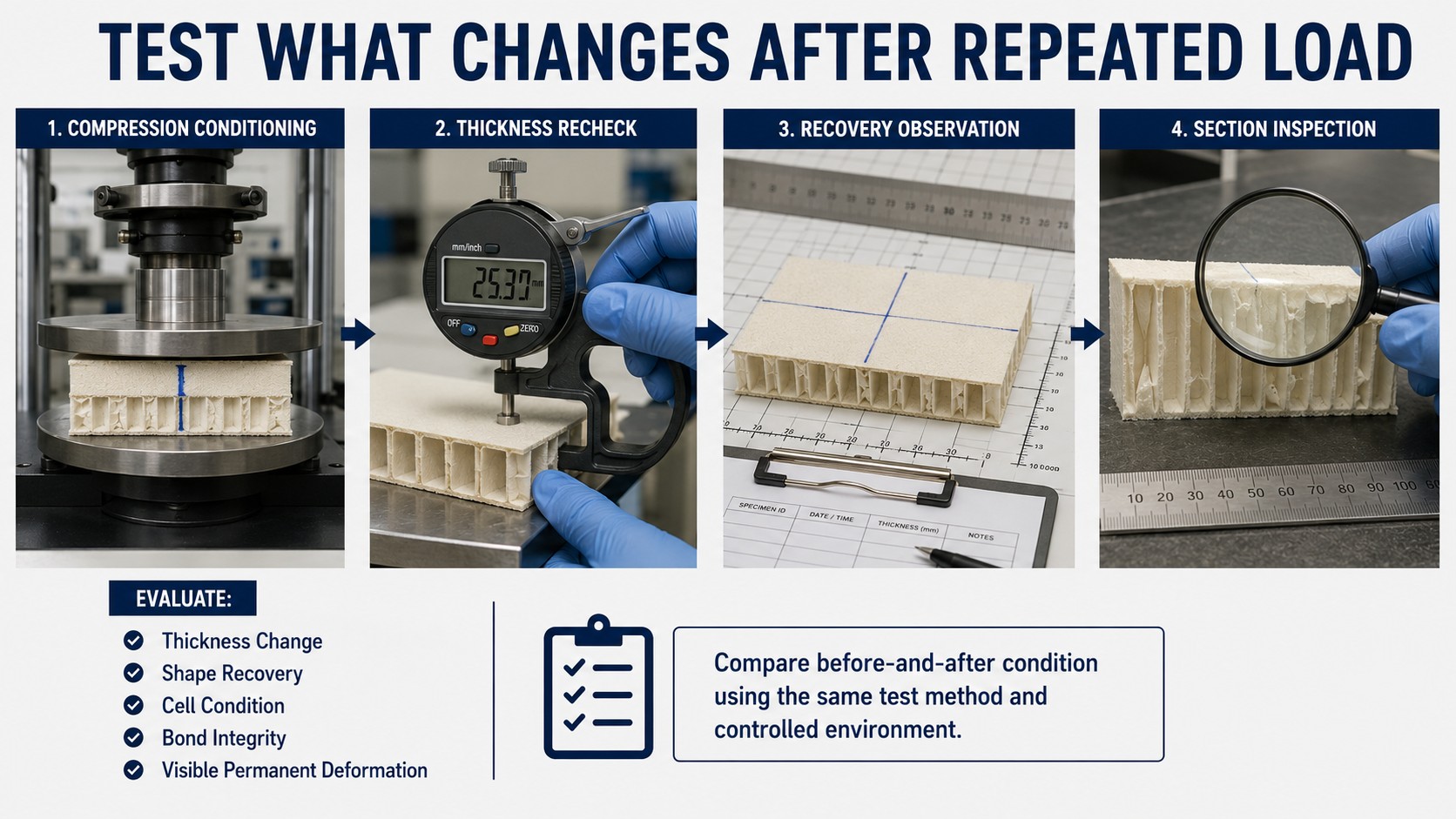
Specify grade or supplier, density, hardness test method where relevant, thickness, cell structure, bonding surface and intended role. Compare compression response and recovery after repeated loading rather than evaluating only a fresh sample by hand.
Expanded polypropylene can be engineered for low density and energy-management applications. EPP bead structure and molding conditions can influence local consistency and surface characteristics.
In a paddle, ask whether the selected grade can be supplied in the required geometry, whether the surface bonds reliably, how density affects target weight, and how the structure changes under repeated impact.
Thermoplastic elastomer foams can be formulated for flexibility, damping and resilience, but “TPE” covers many chemistries and formulations. The term should never be treated as one fixed performance profile.
Ask for the actual material family, density, hardness, processing temperature, surface condition and bonding recommendation.
PEBA can offer attractive combinations of low density, flexibility and resilience in some formulations, which is why it appears in high-performance sporting applications. That makes it an interesting development candidate—not an automatic upgrade for a pickleball paddle.
A paddle program still needs to answer cost, supply form, density range, bonding, processing temperature, dimensional stability and fatigue questions. Evaluate PEBA inside the same test matrix as other candidate foams.
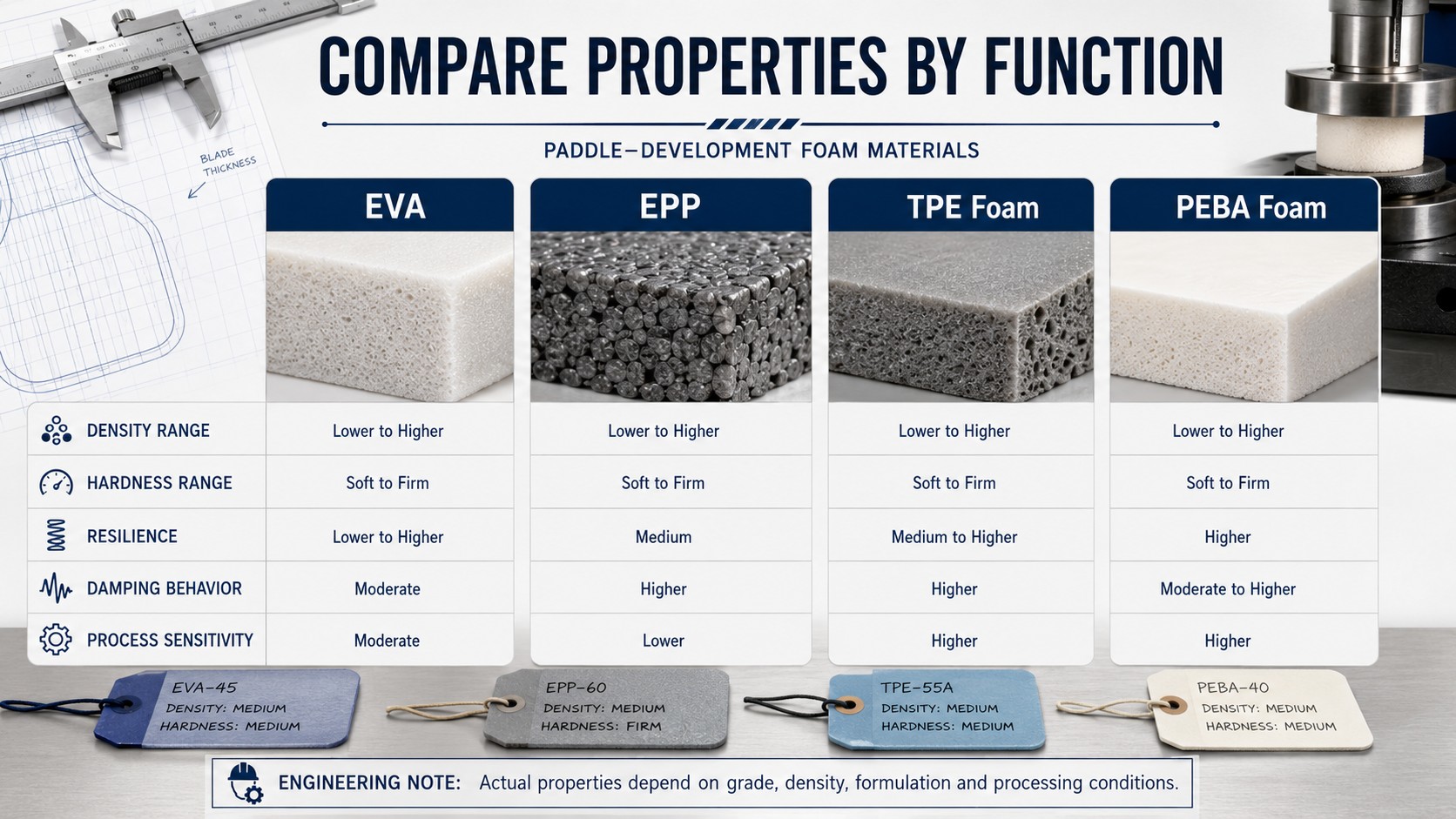
Compare Density, Hardness, Resilience and Damping With the Test Method Attached
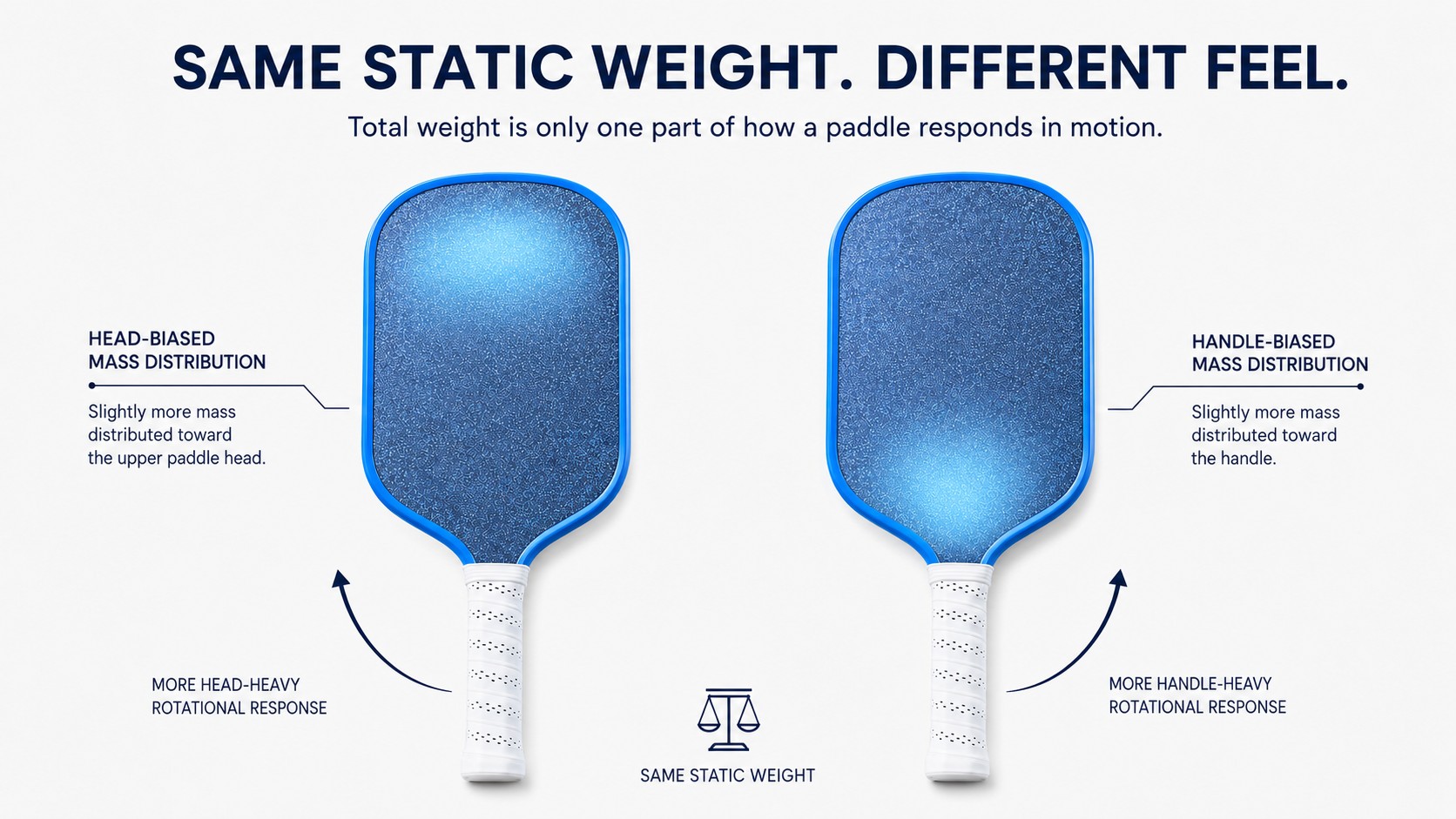
Lower density can reduce core mass, but density is also connected to the amount of polymer structure carrying load. A designer may need to change geometry, thickness, local reinforcement or face architecture.
A “lighter foam” that requires extra reinforcement elsewhere may not create a lighter paddle.
Foam hardness values are meaningful only when the method and sample conditions are understood. Different hardness scales, thicknesses and test setups can produce values that are not directly comparable.
Resilience relates to how a material returns energy after deformation. Damping relates to how mechanical energy is dissipated. A foam can be resilient and still have a particular vibration or acoustic response.
Do not reduce these properties to “more power” or “more control.”
Foam Material Selection Matrix
| Question | Full Structural Core | Perimeter / Local Foam | Why It Changes the Specification |
|---|---|---|---|
| Primary role | Support face over large area | Local edge/support/damping | The same foam property does not solve both jobs |
| Density | Strong effect on overall mass | Strong effect on perimeter mass distribution | Mass location matters |
| Bonding | Large-area interface | Localized interfaces and placement | Acceptance method should match the geometry |
| Fatigue / compression | Whole-core lifecycle | Local support stability | Conditioned behavior matters |
| Supplier data sheet | Candidate selection only | Candidate selection only | Validate the bonded paddle, not free material alone |
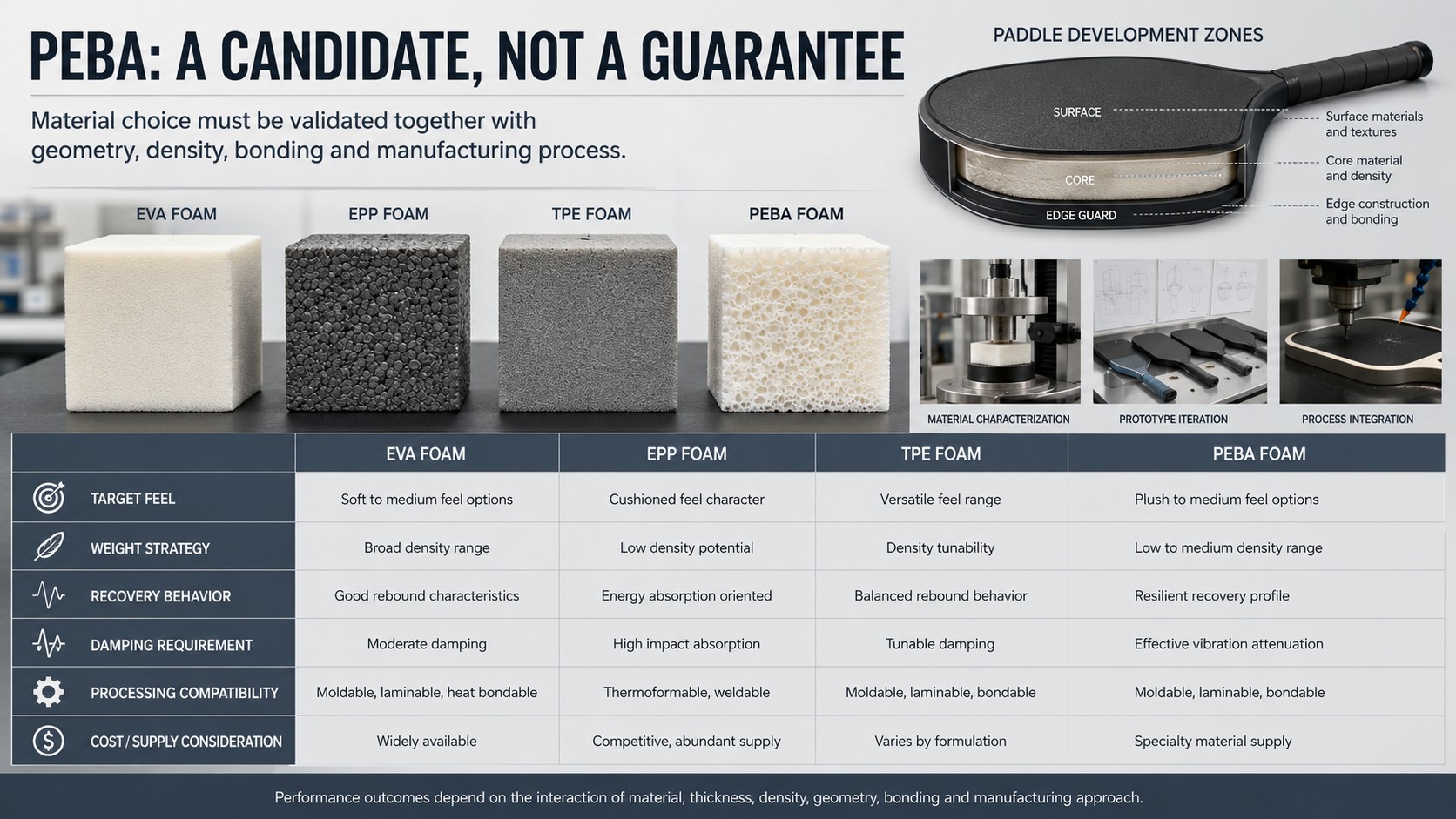
Bonding, Fatigue, Compression Set and Temperature Decide Lifecycle Performance
Foam surfaces differ in chemistry, cell openness, texture and thermal sensitivity. Adhesive compatibility and surface preparation should be validated with the intended process.
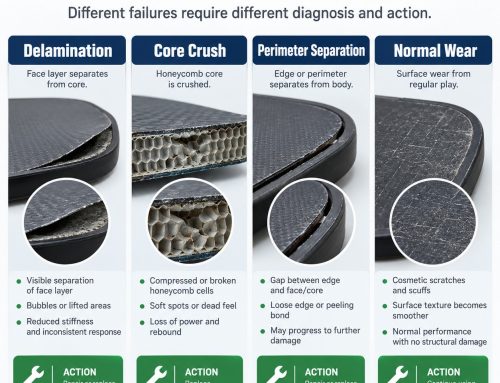
Cut development samples after curing and determine whether failure occurs inside the foam, in the adhesive, or at the interface.
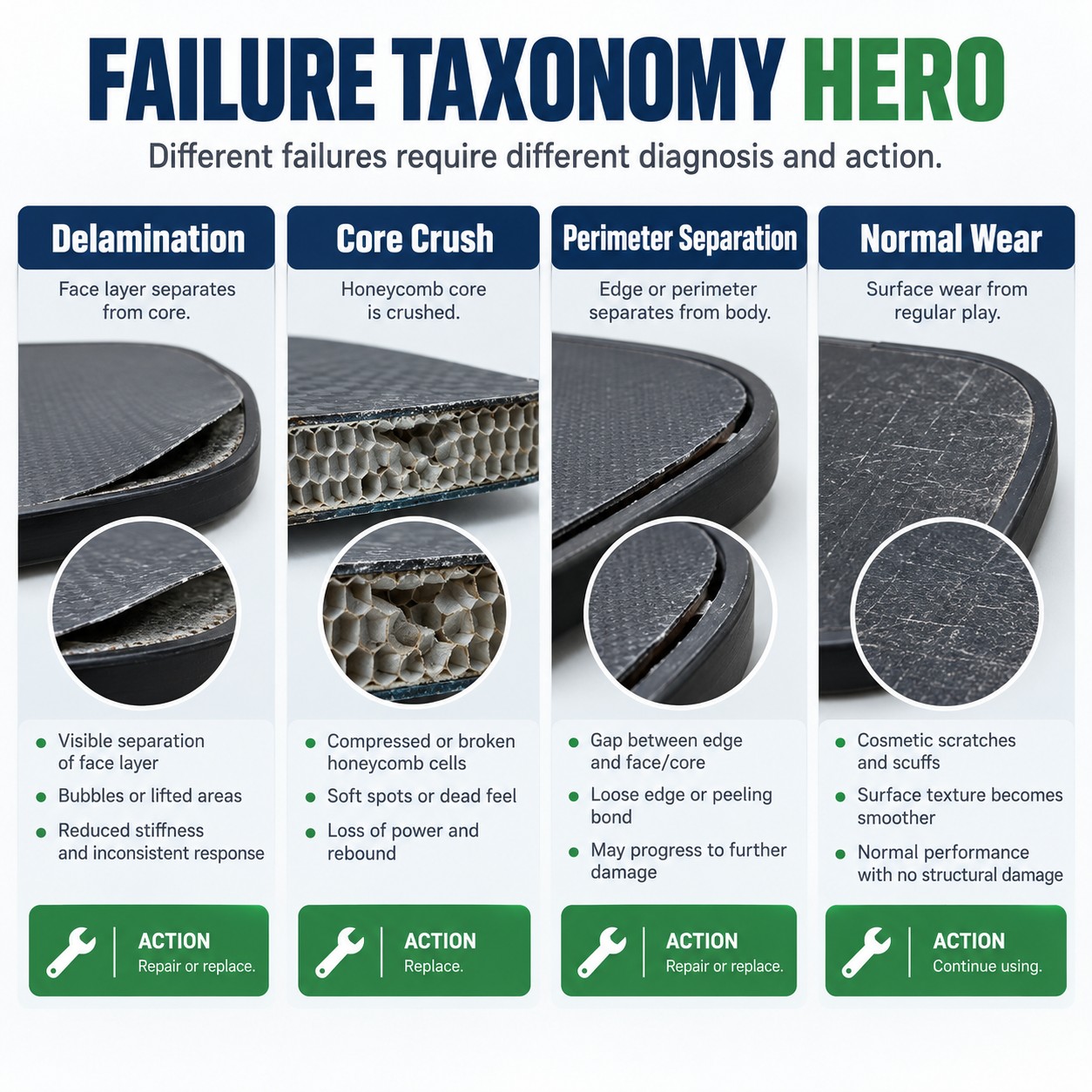
A material that feels excellent on day one may change after repeated loading. Evaluate thickness recovery, permanent compression, local collapse, delamination risk and any shift in finished paddle behavior after conditioning.
Some foams are sensitive to temperature, humidity or recovery time after compression. When comparing samples, condition them in a consistent environment and use the same test sequence. Otherwise a supplier can appear inconsistent when the real difference is sample history.
Full-Core Foam and Perimeter Foam Need Different Acceptance Logic
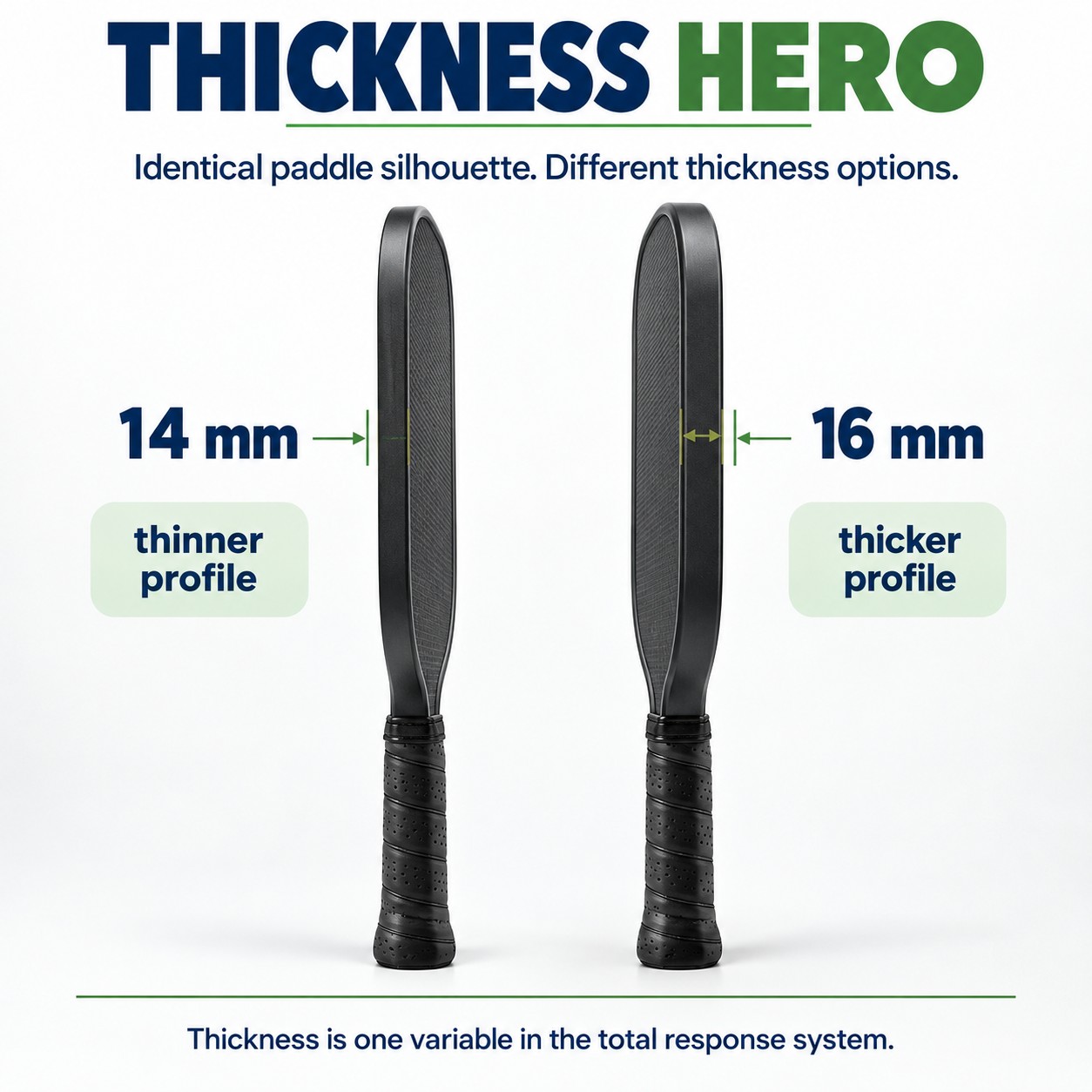
A full-core material affects a large part of the face support, so thickness uniformity, density and compression behavior can matter across the entire paddle. Perimeter foam is localized; placement, bond continuity and amount can become more important than properties measured on a large free foam block.
Write separate inspection criteria for separate roles. Calling both “foam” in the BOM creates ambiguity.
Build a Controlled Development Matrix Before Commercializing a Foam
Keep paddle geometry constant and compare a small number of foam conditions at a time. Record supplier, grade, density, hardness method, thickness, location, adhesive, process conditions, finished weight, balance and observed results.
A new foam is commercially useful only if the product team can describe the player or manufacturing benefit in a defensible way. If the development advantage is too small to measure or explain, the material may add BOM complexity without creating a meaningful product story.
Material data sheets can help compare nominal density, hardness or processing recommendations, but they do not reproduce the constraints of a finished paddle. The same foam can behave differently when bonded between rigid skins, cut into a perimeter strip or molded into a full core.
Use supplier data to choose candidates, then validate the actual paddle construction.
Choose foam by role, measurable property, bondability and lifecycle behavior. The winning material is the one that performs the required job and can be reproduced in production—not the one with the most fashionable polymer name.
FAQ
Is PEBA automatically better than EVA or EPP?
No. Suitability depends on role, density, bonding, process, fatigue, cost and the complete paddle architecture.
Can foam be used only as a full core?
No. Foam can also be used around a honeycomb perimeter, in local reinforcements or in the handle.
Does lower-density foam always make a lighter paddle?
Not necessarily. Other reinforcements or component changes may offset the density reduction.
What should an OEM buyer specify for foam?
Supplier/grade, application location, density, thickness, hardness method where relevant, bonding requirements and change-control rules.
How should foam durability be evaluated?
Use repeatable conditioning and inspect recovery, compression set, local damage and bond integrity.
The End about Mayvoci
1)Design:Over 100 paddle designs and photography service to assist start-up.
2)Professional:Focus on various of paddles manufacturing for 6 years
3)Quality:Strict quality management system to provide safety and satisfaction for customers
4)Amazon:Flexible comprehensive solution to make sure each Amazon seller is well cared.
5)Excellent Team:Experienced paddle experts & dynamic sales team give you 5-star service

What’s been your biggest challenge when evaluating foam materials for paddle development? Bonding failures, inconsistent density, or fatigue testing? Share your experience below—let’s help the community build better material selection processes! 👇