
Fiberglass, T300 carbon and T700 carbon are often placed in a simple ladder: entry, better, best. That is convenient marketing, but it is poor engineering.
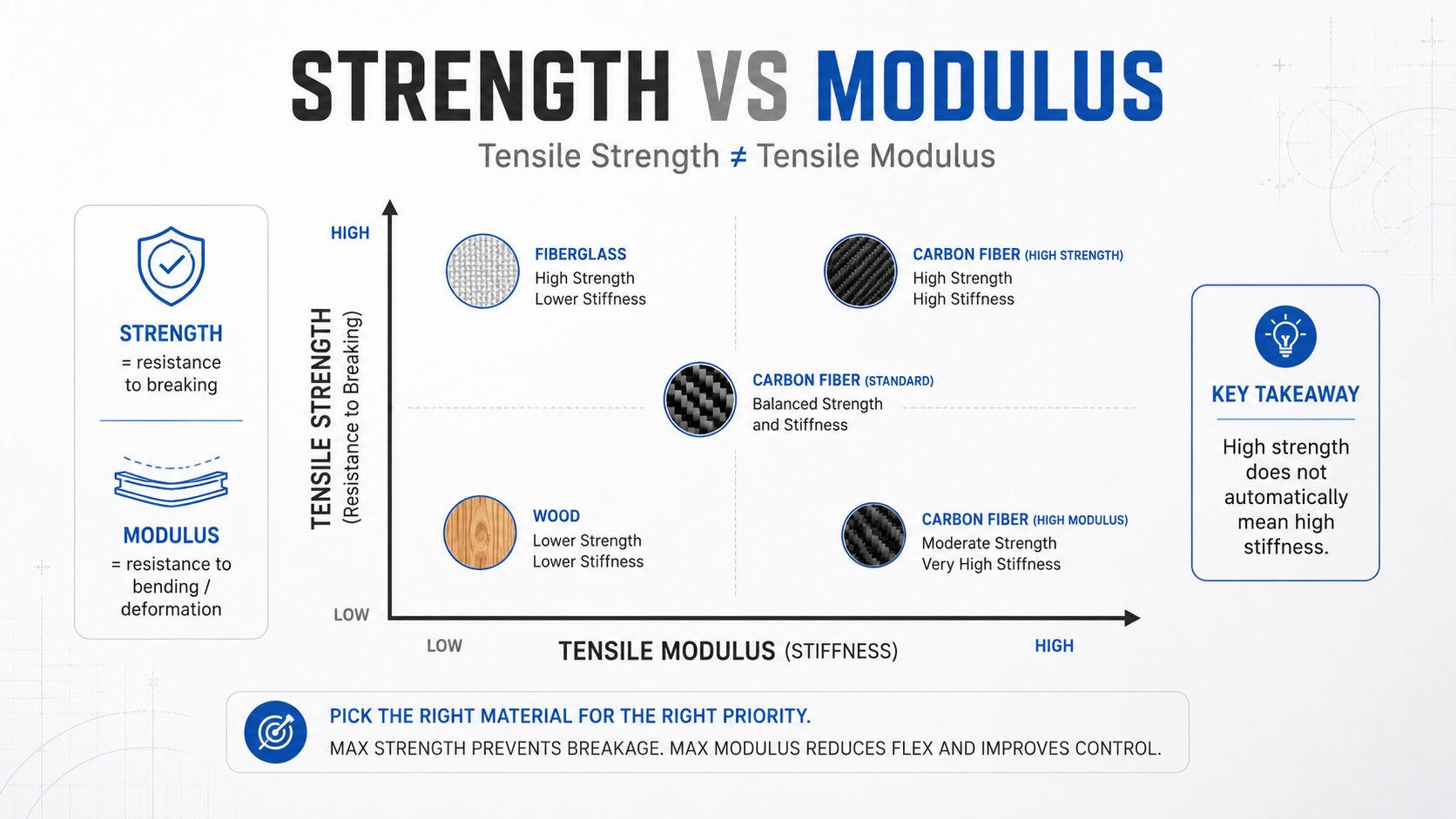
Toray classifies both T300 and T700S as standard-modulus carbon fibers. Its published data shows the same listed tensile modulus for T300 and T700S, while T700S has a higher published tensile strength. That alone is enough to show why “T700 means stiffer” is not a safe universal statement.
A finished paddle adds many other variables—fabric architecture, GSM, resin, layer count, surface process, core, thickness and geometry. This guide compares the three reinforcement directions without turning fiber grade into a complete paddle specification.
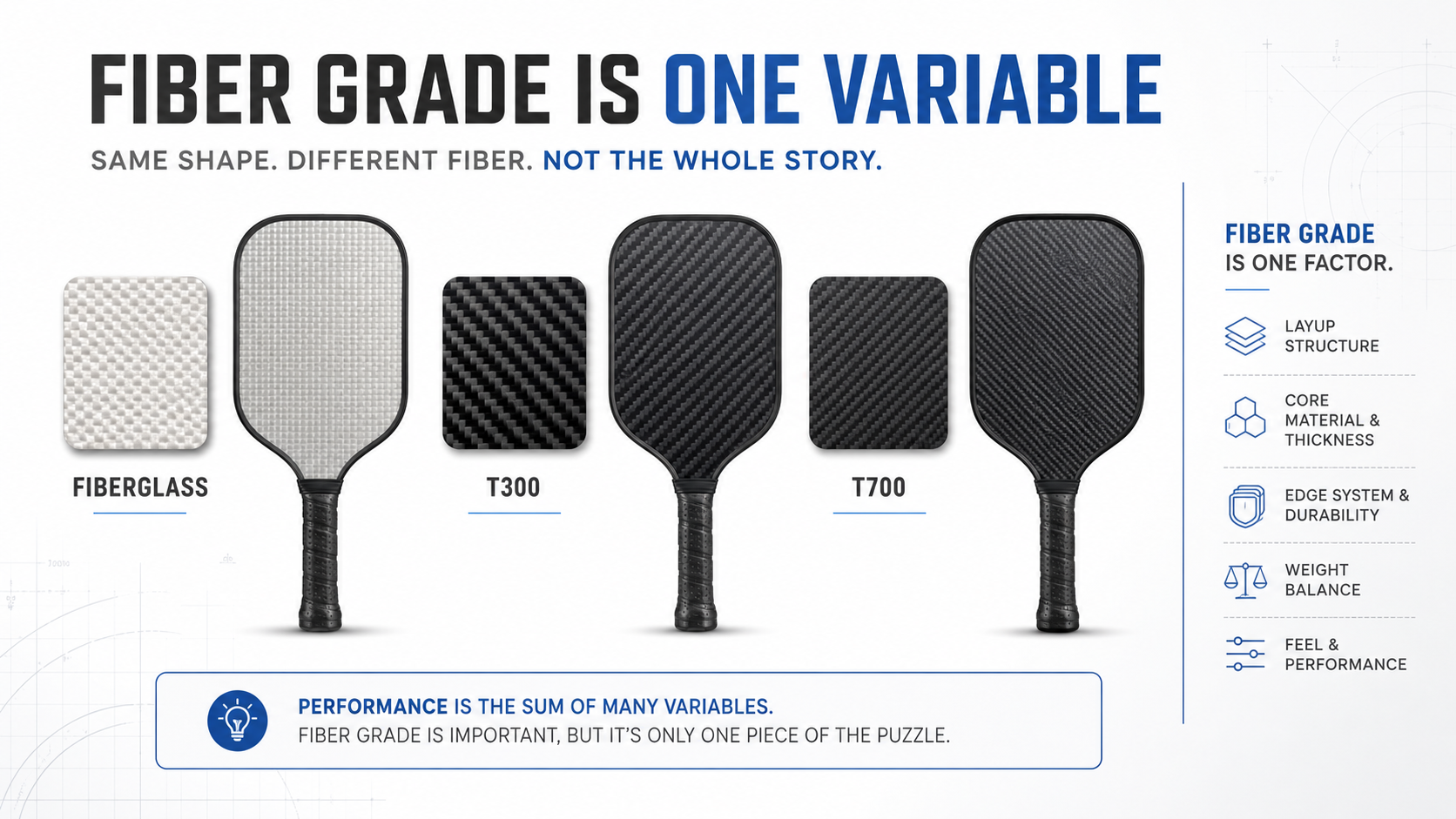
What Fiberglass, T300 and T700 Actually Describe
Fiberglass identifies a reinforcement family. T300 and T700 identify specific carbon-fiber product families, but a paddle manufacturer may buy those fibers in different fabric formats or prepreg constructions.
The first OEM question is therefore not “Do you have T700?” It is “What fabric or prepreg are you using, from which supplier, at what areal weight, with what orientation and resin system?”
If the supplier only knows a marketing name, the specification is not yet mature enough for repeatable mass production.
Do Not Confuse Strength with Stiffness
Strength and modulus are different properties. A fiber can have higher tensile strength without having higher tensile modulus.
This distinction matters because paddle marketing often uses “higher grade carbon” as a shorthand for “stiffer and more powerful.” The published fiber data does not justify that shortcut. The laminate architecture and the rest of the paddle determine how the material is used.
For brands, the practical lesson is to stop asking for a grade in isolation and start asking for the entire face construction.
Fiberglass in Product Development
Fiberglass is widely used because it is familiar to composite manufacturing and can support cost-sensitive or highly tunable laminates.
Its final behavior depends on thickness, weave, resin, orientation and core interaction. A fiberglass face can be designed to feel very different from another fiberglass face.
Use fiberglass when it serves the product brief and production economics. Do not automatically treat it as a “low-end” material if the construction and customer target justify it.
T300 Carbon
T300 is a long-established standard-modulus carbon-fiber family with multiple tow-size options. That makes it a useful reference point for carbon reinforcement, but the finished fabric still needs to be defined.
A T300 woven cloth and a T300 UD construction are not equivalent. Nor are two fabrics with different GSM and resin systems.
In OEM selection, T300 can be a rational choice where cost, availability, known processing behavior and a particular laminate target align.
T700 Carbon
T700S is also a standard-modulus carbon fiber in Toray’s published range and is positioned for high tensile strength. Again, that does not automatically convert into a specific paddle feel.
If a supplier proposes T700 as an upgrade, ask what else changes. Is the GSM different? Is the layer count reduced? Does the surface process change? Is the resin the same? Are tolerances and weight targets unchanged?
Only then can the development team understand whether the improvement comes from fiber grade, laminate architecture, or a combination.
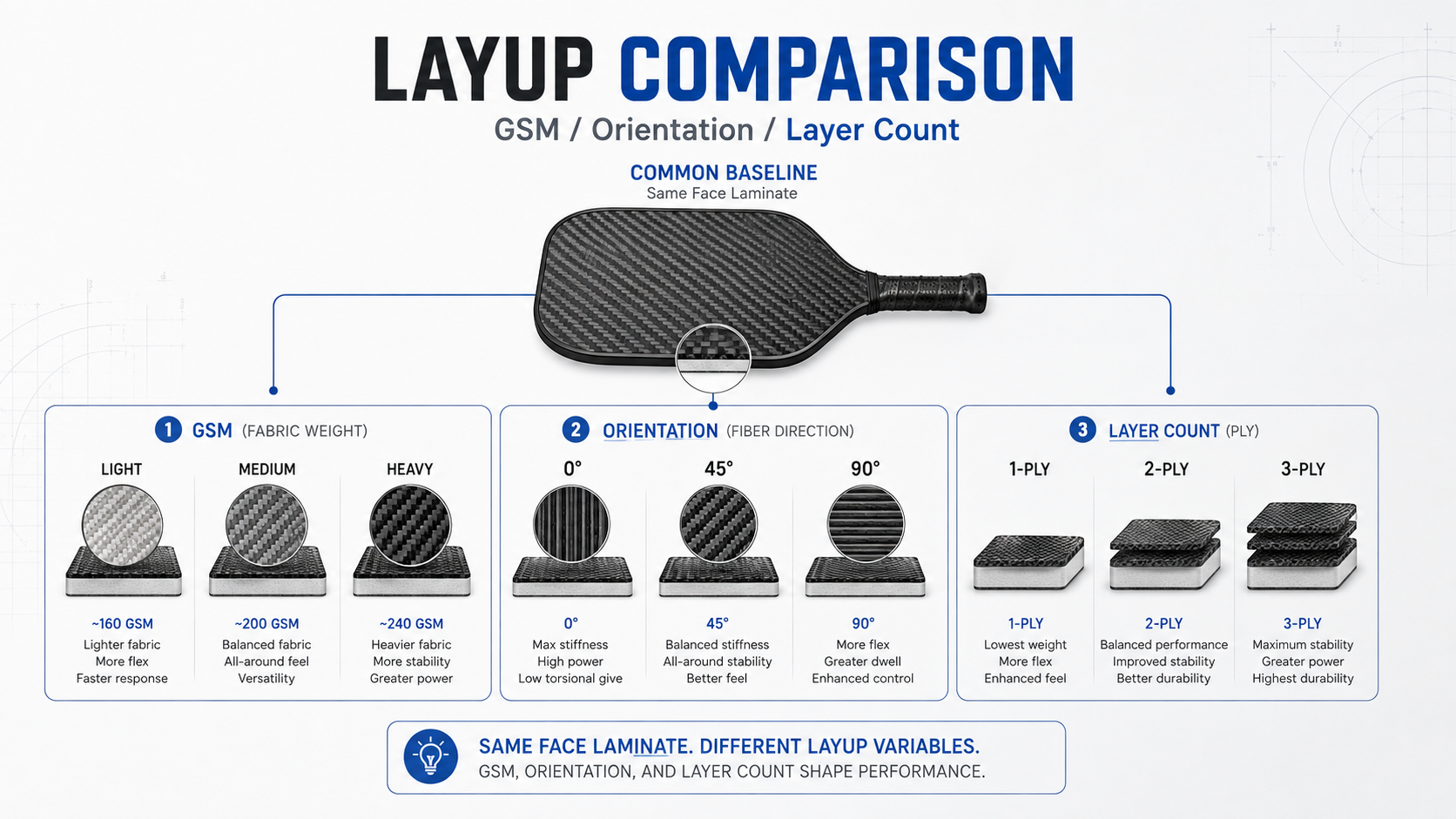
GSM, Orientation and Layer Count
These three variables often influence the finished face more directly than buyers realize.
GSM describes areal mass of the fabric. Orientation describes the direction of reinforcement. Layer count controls how many plies contribute to the laminate. Changing any of them changes weight, stiffness distribution, thickness and processing behavior.
The right comparison therefore freezes as many of these variables as practical when testing different reinforcement families.
Surface Finish Is Separate
A carbon face may use peel-ply texture, a coated grit system, printed texture or another surface process. A fiberglass face may use a different system.
If surface condition is different, comparing spin between the paddles does not isolate the reinforcement. Brands should specify surface manufacturing as its own line item in the BOM and quality plan.
Cost and Yield
Raw-material price is visible; yield cost is less visible.
A laminate that requires more difficult cutting, creates cosmetic rejects, has narrow processing windows or produces greater variation may increase finished cost. A higher-cost fiber that allows a thinner or simpler stack can sometimes offset part of its material premium, but that must be proven in production.
Compare acceptable finished yield and repeatability, not only purchase price.
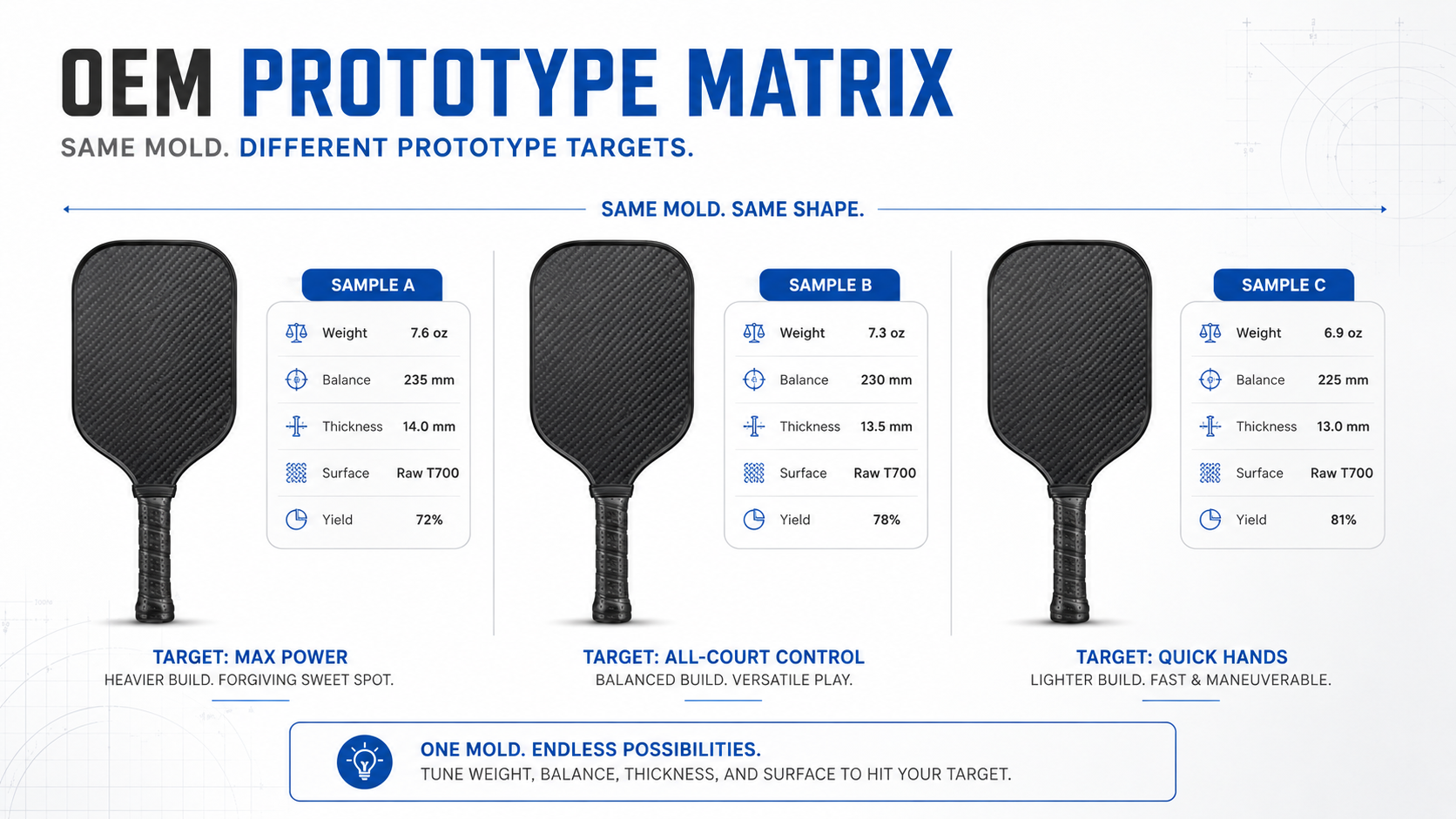
OEM Use-Case Matrix
For an entry or recreational product, prioritize cost, repeatability and the player job rather than material prestige. For a mid-tier control or all-court model, compare complete laminate options at a fixed geometry. For a premium model, advanced material can support the story only when the measured and perceived difference is clear enough to justify the additional cost.
In every tier, the correct question remains the same: can the factory make the target construction repeatedly?
Frequently Asked Questions
Is T700 stiffer than T300?
Not as a universal statement. Toray lists T300 and T700S with the same published tensile modulus while T700S has higher published tensile strength.
Is fiberglass only for beginner paddles?
No. It is a reinforcement family that can be used in different laminate designs and price positions.
Does T700 guarantee more spin?
No. Spin is strongly affected by the finished surface and test condition, not the fiber grade alone.
What should be frozen in a comparison?
Shape, core, thickness, surface process, target weight and as much of the laminate architecture as practical.
What should an OEM RFQ ask for?
Material supplier/grade, fabric code, GSM, weave or orientation, layer count, resin system and surface process.
The End about Mayvoci
1)Design:Over 100 paddle designs and photography service to assist start-up.
2)Professional:Focus on various of paddles manufacturing for 6 years
3)Quality:Strict quality management system to provide safety and satisfaction for customers
4)Amazon:Flexible comprehensive solution to make sure each Amazon seller is well cared.
5)Excellent Team:Experienced paddle experts & dynamic sales team give you 5-star service

If you work on this topic from the brand, sourcing, engineering or manufacturing side, I’d be interested in your experience: Do your suppliers normally provide the full face specification, or mostly the headline fiber grade?