
Carbon-fiber marketing often compresses several unrelated specification systems into one sentence: T700, 18K, UD, twill, 200 GSM and “raw carbon.” The uploaded Mayvoci article correctly separates these terms; V2 turns that taxonomy into a practical supplier-decoding tool. fileciteturn16file0
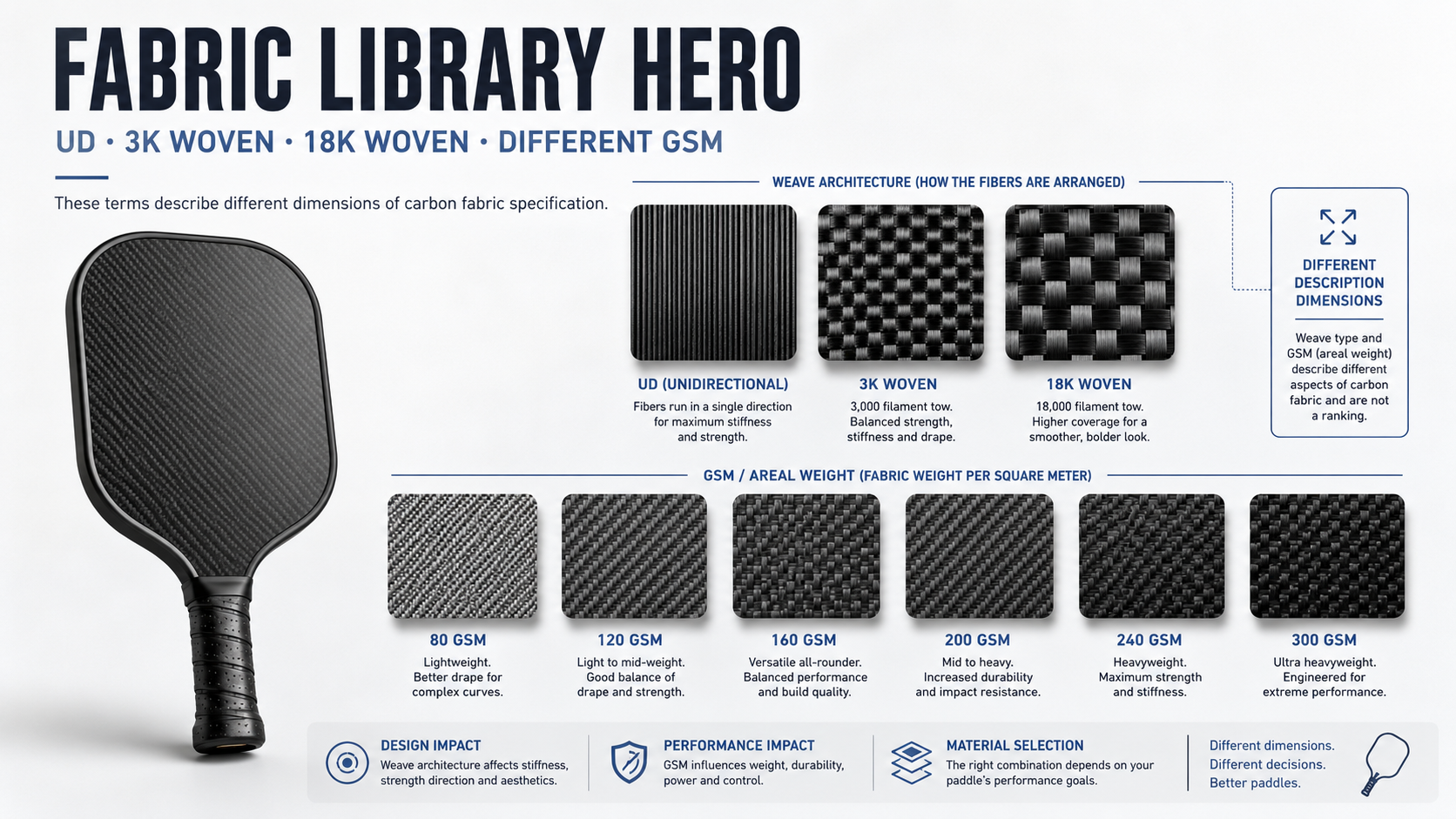
Read Carbon Specifications in Layers
Fiber grade, tow count, fabric architecture, areal weight, orientation and layer count describe different things. A buyer who treats them as one performance ladder can approve a substitute that looks similar but changes the laminate.
Example: “T700 18K 200 GSM twill” contains useful information, but it is still not a complete paddle-face specification.
| Supplier Phrase | What It Describes | Still Missing |
|---|---|---|
| T700 | Fiber product family / grade | Fabric form, tow arrangement, GSM, resin, layup, surface |
| 18K | Approximate filament count in a tow | Fiber grade, weave, GSM, resin, layer count |
| 200 GSM | Dry-fabric areal mass | Fiber grade, weave / UD, resin, stack |
| Twill | Weave architecture | Fiber grade, tow size, GSM, resin, orientation |
| UD | Primarily unidirectional architecture | Fiber grade, GSM, orientation sequence, layer count |
| “Raw carbon” | Commercial surface/material language | Actual laminate and final surface process |
Toray’s current carbon-fiber resources reinforce this separation. T300 and T700S are fiber grades, and Toray lists them with specific tow-size availability; its data also warns that published values are typical material-selection data rather than guaranteed application specifications. That is a useful model for paddle sourcing: use upstream data to define the input, then create an application-specific specification for the paddle.
Fiber Grade Is Not Fabric Architecture
T300, T700S and related names refer to carbon-fiber product families. The same fiber can be converted into different textile or prepreg formats. A paddle face described only as “T700” therefore remains incomplete.
Toray currently lists T300 and T700S in its standard-modulus family, with T700S positioned as a high-tensile-strength standard-modulus fiber. That is material information—not a finished-paddle ranking.
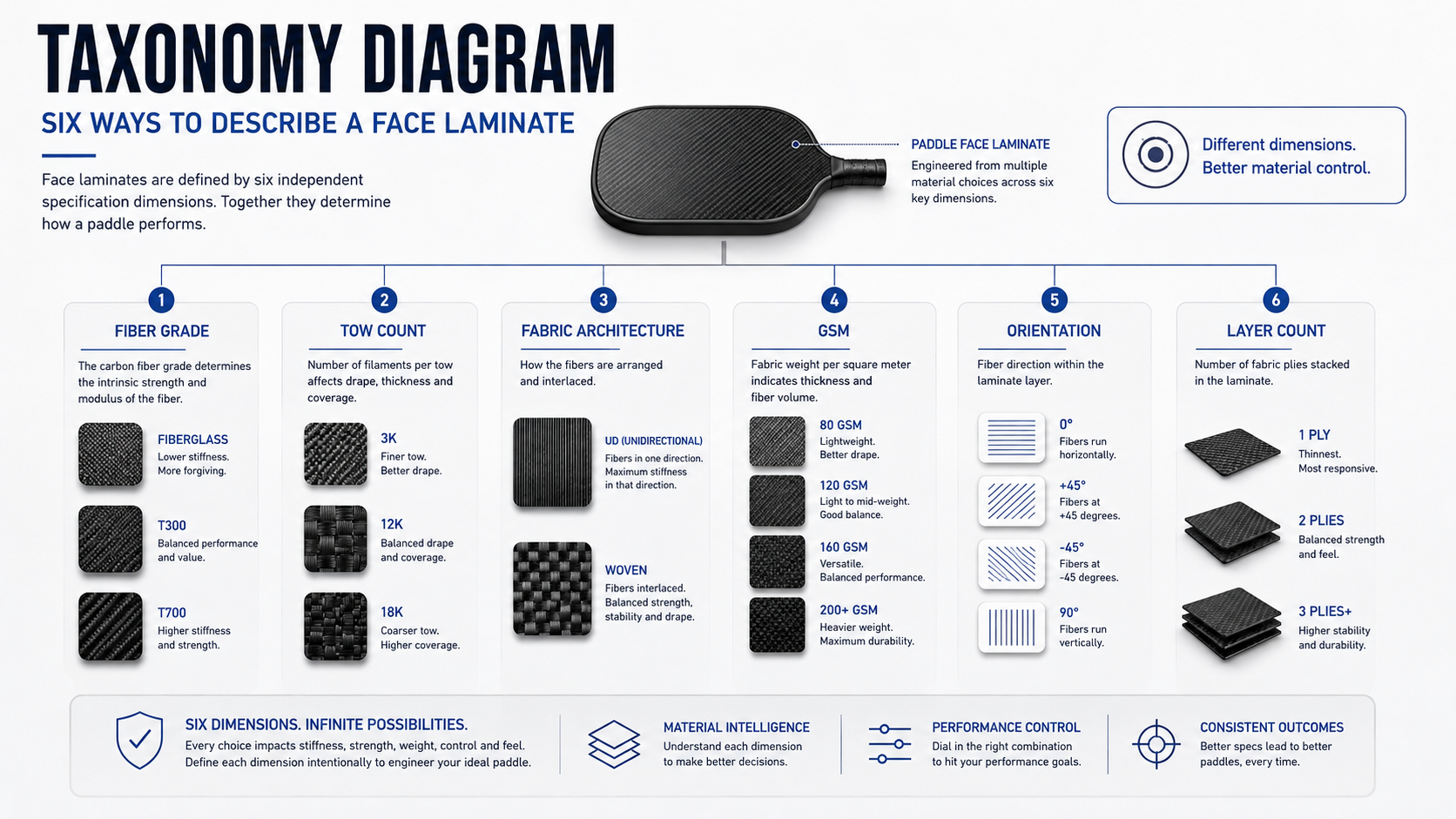
Tow Count, GSM and Weave Answer Different Questions
3K or 18K describes the approximate filament count in a tow. GSM describes dry-fabric mass per unit area. Twill or another weave describes how tows are interlaced. None of these alone proves “higher performance.”
The practical OEM benefit of these terms is traceability. If an approved face uses a defined fabric code, GSM and architecture, a proposed substitute can be compared against the same fields instead of being accepted because the visual pattern looks similar.
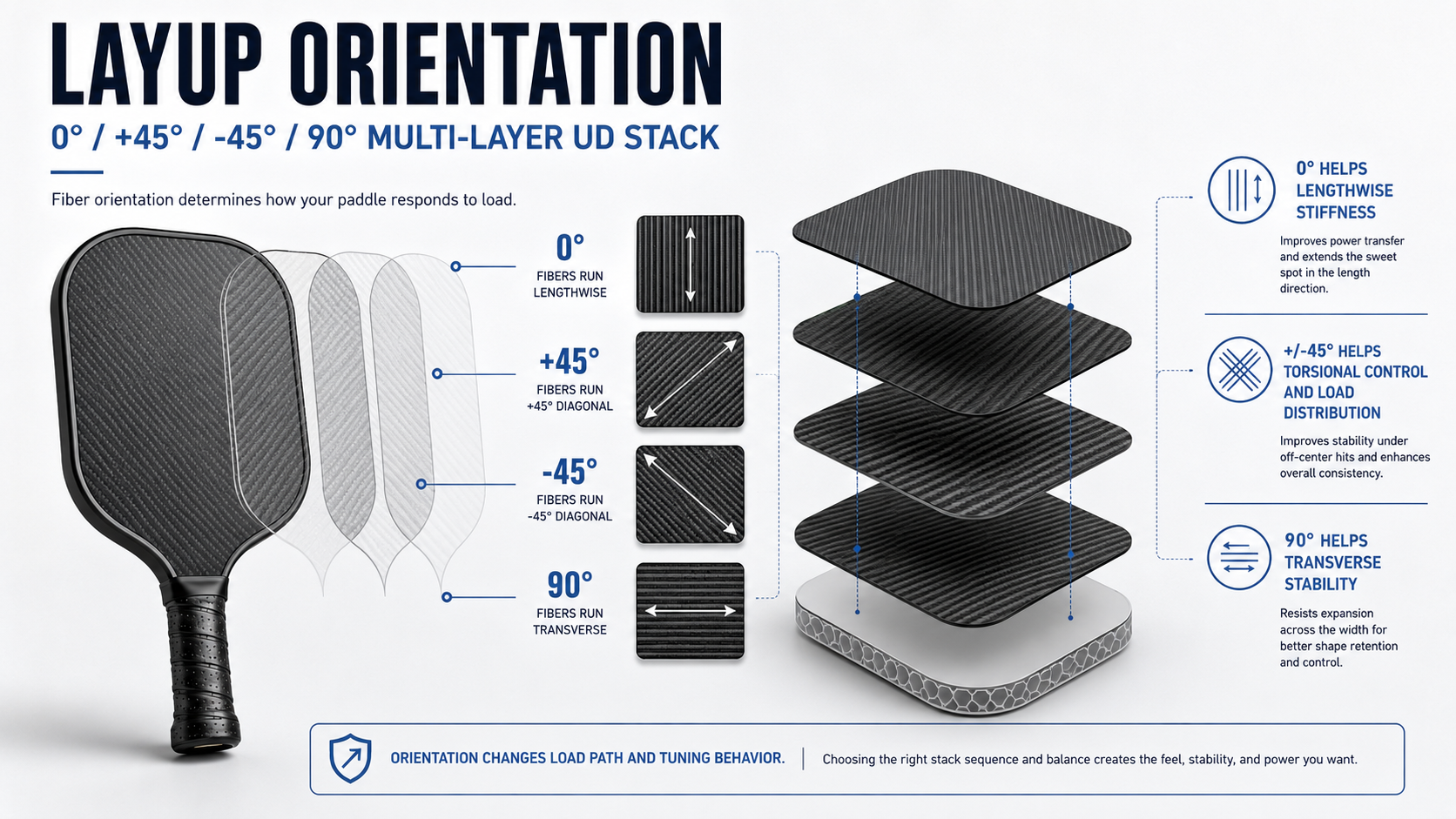
Orientation and Layer Count Create the Laminate
UD reinforcement is strongly directional, so a stack can use multiple orientations to distribute reinforcement. Woven fabrics already contain multiple directions, but orientation relative to the paddle and the order of the plies still matter.
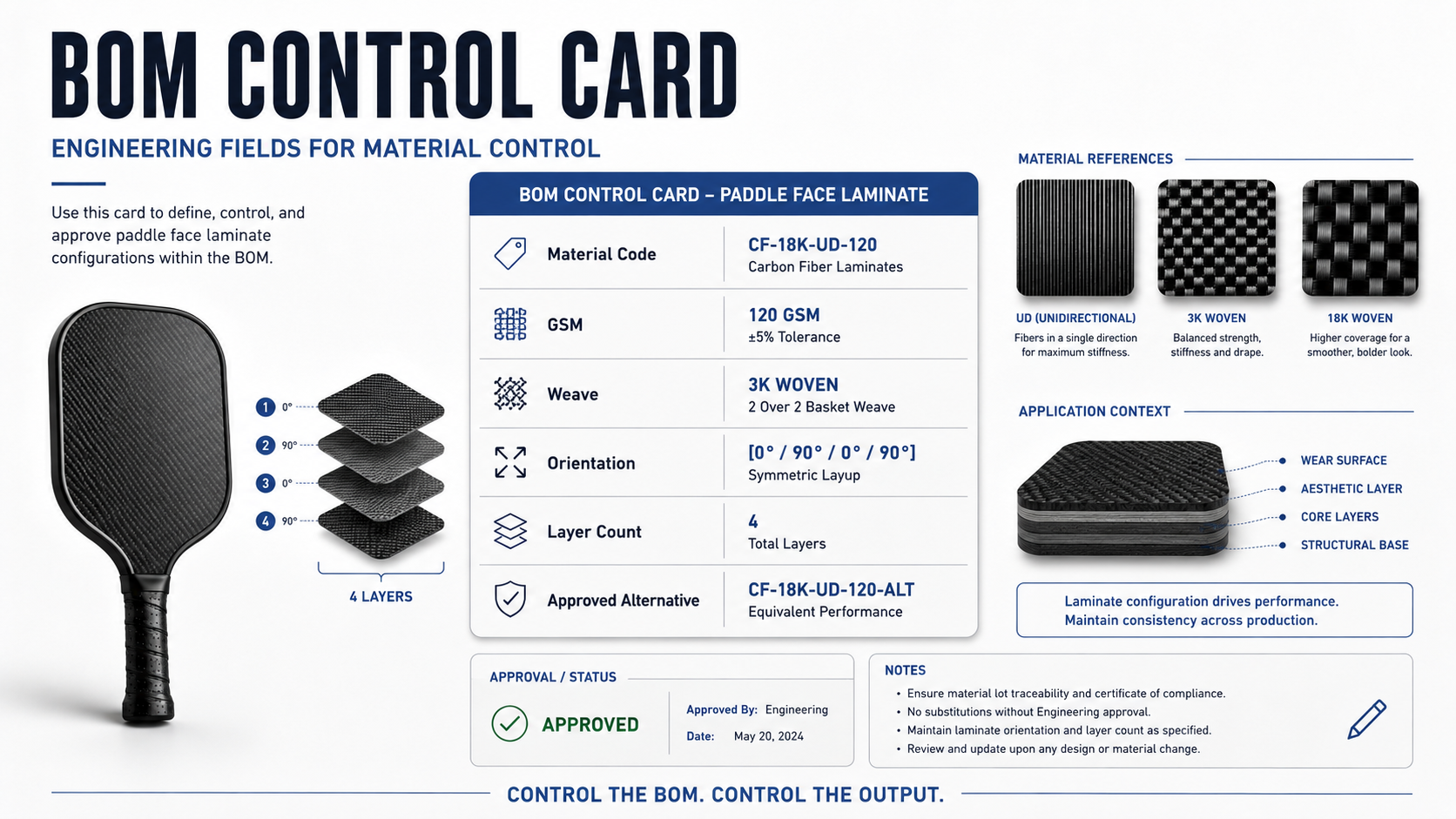
A controlled layup sheet should therefore record material code, ply order, orientation and layer count. Visual inspection of the outer face cannot confirm hidden plies.
Resin and Consolidation Complete the System
Dry fabric becomes a structural laminate only after resin, pressure and cure/forming. Resin content, wet-out, voids and consolidation can change quality even when the fabric is correct.
This is why a complete paddle-face specification has two layers: the incoming reinforcement specification and the manufacturing/layup specification.
Use a Supplier Specification Decoder
| Field | Example Entry | Why It Belongs in the OEM File |
|---|---|---|
| Supplier / fabric code | Supplier ABC / Fabric 123 | Traceability and substitution control |
| Fiber grade | T700S, if verified | Defines upstream fiber family |
| Tow / textile | 18K twill, if applicable | Defines textile architecture |
| GSM | Approved nominal value | Controls reinforcement mass per area |
| Resin / prepreg status | Dry fabric + resin system / prepreg code | Defines matrix route |
| Orientation / layer count | Approved layup sheet | Defines finished architecture |
| Surface process | Peel-ply / coating / other | Separates structure from playing surface |
Sources & References
- Toray Composite Materials America — Carbon Fiber — Current fiber-family, property and tow-size information for T300/T700 and other grades. Primary source
- Toray Composite Materials America — Data Sheets — Primary data-sheet library; Toray notes that typical values are for material-selection purposes and application specifications should be established where guaranteed values are needed. Primary source
Mayvoci First-Party Evidence to Add Before “Authority” Positioning
These are evidence tasks, not claims. Do not publish them as “our process” until the real photo, record or test exists.
Fabric library
Capture: Real approved T300/T700/3K/18K/UD material samples used in projects
Record: supplier code, GSM, architecture and approval status
After evidence exists: Show the difference between fiber grade, textile architecture and appearance using actual materials.
Layup sheet
Capture: One sanitized production layup sheet
Record: ply order, orientation, material code and version
After evidence exists: “The outer weave is only one layer of the controlled face construction.”
Substitution case
Capture: Approved fabric vs proposed alternative
Record: what matched, what differed, decision
After evidence exists: Turn substitution control into a real sourcing example.
Cross-section
Capture: Golden Sample face stack
Record: visible layers, version and sample ID
After evidence exists: Use as first-party evidence of architecture, without exposing confidential values.
Frequently Asked Questions
Is 18K better than 3K?
No. K-count describes tow size, not a universal performance grade.
Does T700 describe a weave?
No. It describes a carbon-fiber product family; the fiber can be converted into different architectures.
Why does GSM matter?
It helps identify reinforcement mass per unit area and makes fabric substitutions more transparent.
Is UD always stronger than woven carbon?
There is no universal paddle-level answer. Load direction, fiber, GSM, resin and the total layup matter.
What is the minimum useful RFQ description?
Supplier/fabric code, fiber family, architecture, GSM, resin route, orientation/layer count and surface process.
The End about Mayvoci
1)Design:Over 100 paddle designs and photography service to assist start-up.
2)Professional:Focus on various of paddles manufacturing for 6 years
3)Quality:Strict quality management system to provide safety and satisfaction for customers
4)Amazon:Flexible comprehensive solution to make sure each Amazon seller is well cared.
5)Excellent Team:Experienced paddle experts & dynamic sales team give you 5-star service

If you work on this topic from the brand, sourcing, engineering or manufacturing side, I’d be interested in your experience: Which carbon-fabric term causes the most confusion in your market: 3K/18K, GSM, UD, weave or fiber grade?