
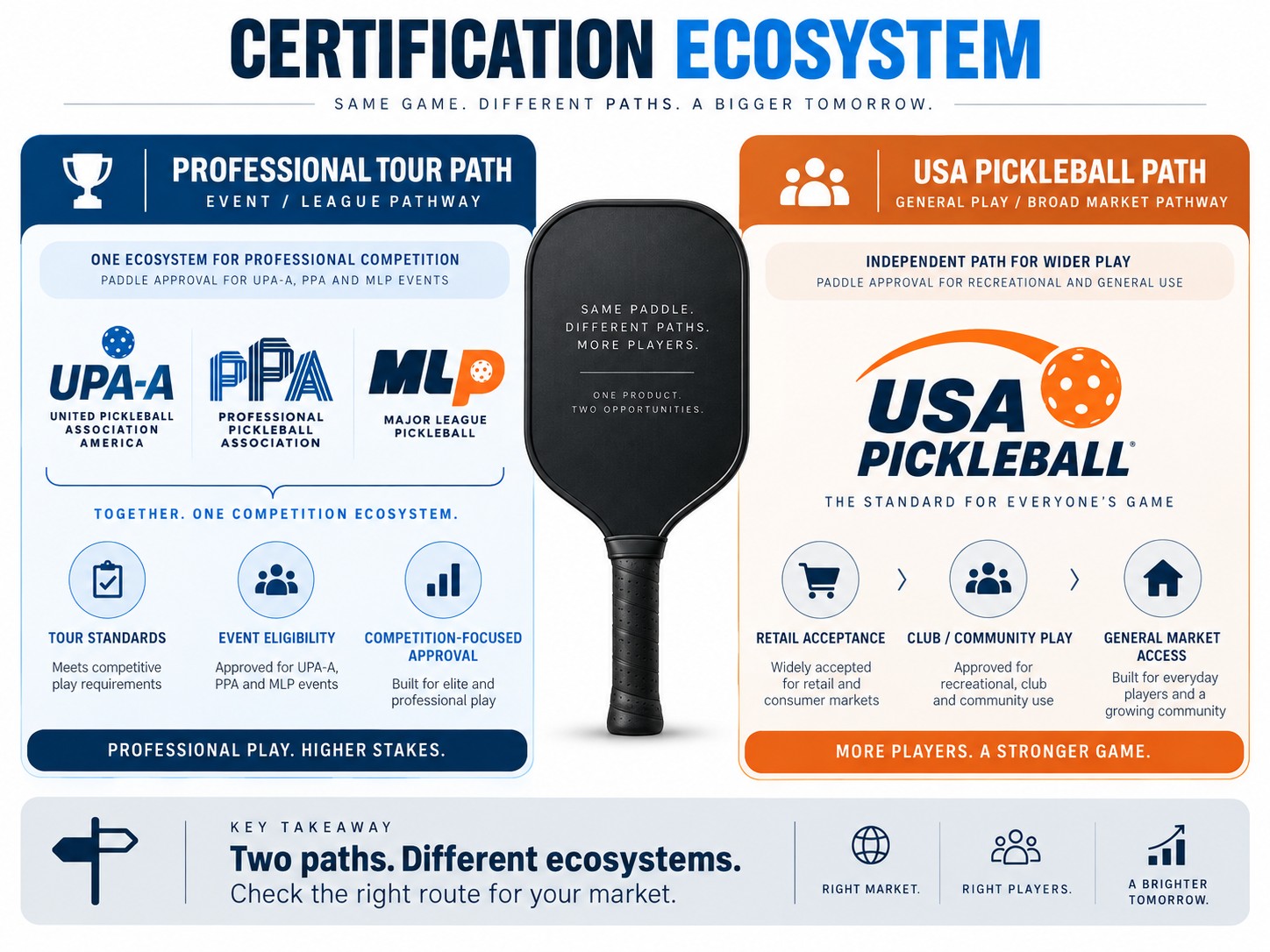
UPA-A certification and USA Pickleball approval are not the same program.
2026-08-21 update: UPA-A announced on Aug. 7, 2026 that first-time applicants now pay a prorated inaugural annual fee by quarter: Jan–Mar $10,000; Apr–Jun $8,500; Jul–Sep $6,000; Oct–Dec $3,500. The separate per-paddle and service fees should still be rechecked on the live certification page.
For a brand planning professional PPA/MLP exposure, that distinction affects budget, product architecture, testing and launch timing. UPA-A says its certification has been enforced for the professional ranks of UPA events since September 1, 2025, while USA Pickleball approval remains the equipment pathway for USA Pickleball-sanctioned play.
This page is the broad UPA-A certification hub. The separate Mayvoci cost-and-timeline page should remain the budgeting subpage rather than duplicate this full overview.
What UPA-A Certification Covers in 2026
Where UPA-A Certification Applies
UPA-A states that its paddle rules apply to paddles used in professional UPA events, including PPA and MLP-related professional competition. Its current FAQ also says USAP-approved paddles without UPA-A certification remain permitted in UPA amateur events, while UPA-A-certified paddles are eligible at UPA events.
Brands should confirm the exact division and event requirements before a launch because competition scope can evolve.
2026 Fee Structure
UPA-A currently lists a $10,000 annual brand fee and $3,000 per paddle certification, with the paddle certification valid for 24 months.
The program lists expedited and super-expedited options and a separate re-submission fee for failed paddles.
For a detailed budgeting worksheet, link to the dedicated UPA-A Cost & Timeline page rather than repeat a second full cost article here.
Submission Quantity and Readiness
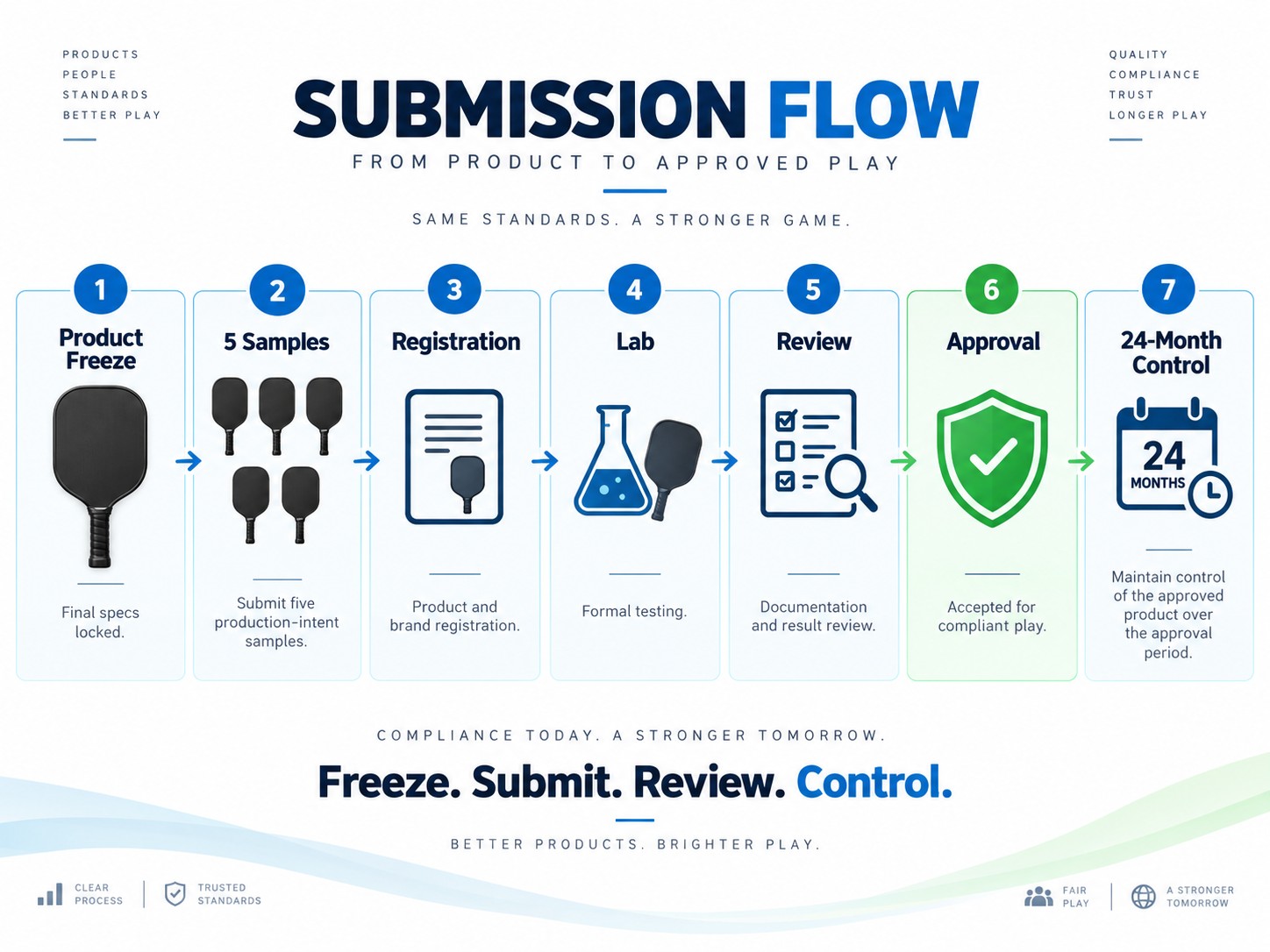
The 2026 checklist requires five paddles per submission.
UPA-A also specifies model identification and grip installation requirements and provides instructions for the certification request, lab shipment and follow-up.
Treat the submitted paddles as production-intent samples. A design still changing in materials, thickness, surface or geometry is not ready for a predictable certification program.
PEF: Direct Power Output
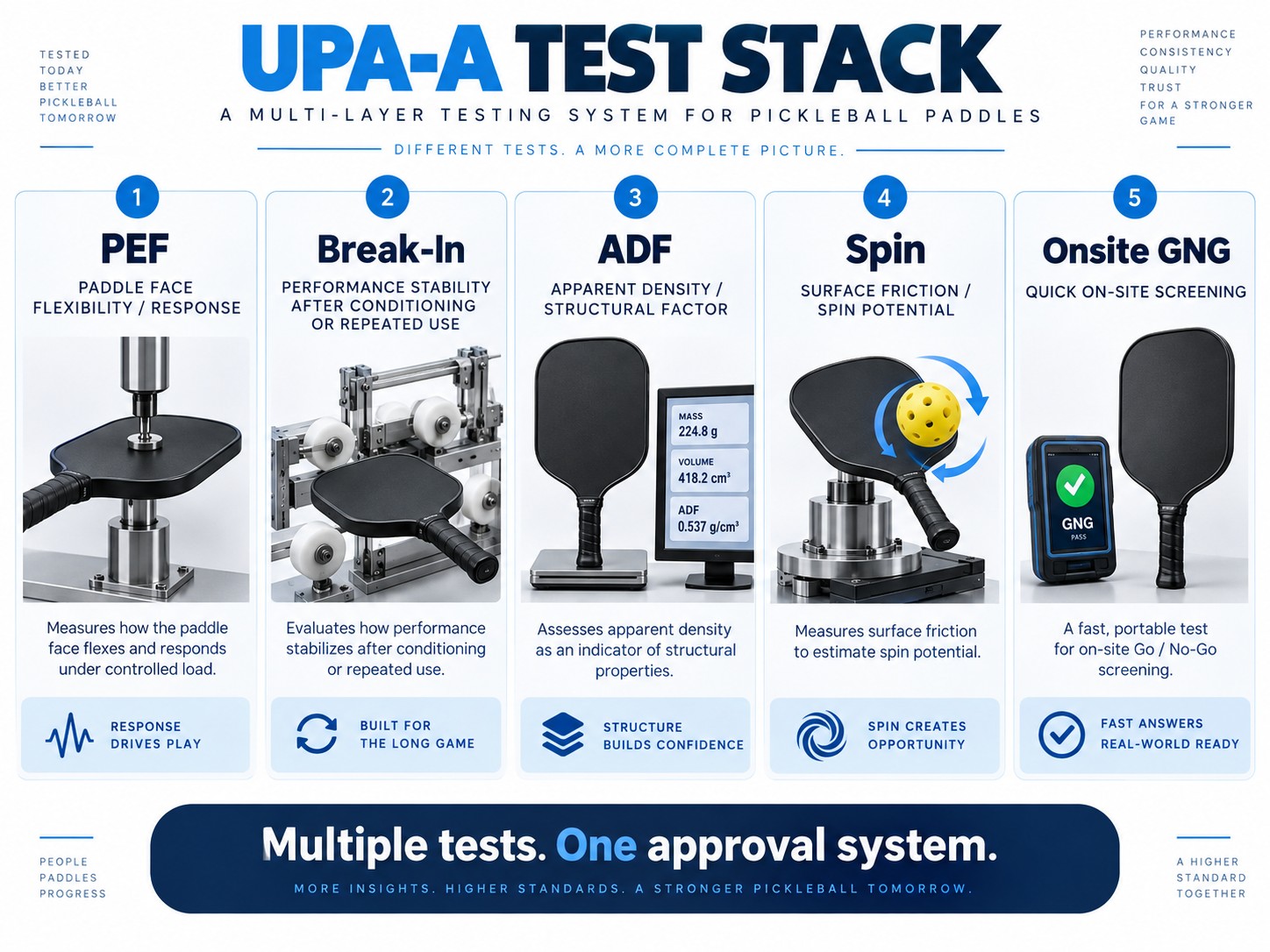
UPA-A describes PEF—Paddle Efficiency Factor—as its direct power metric based on ball-in / ball-out velocity behavior.
Its current About Us page states a new-paddle PEF limit of .385 and a post-break-in maximum of .405.
Because UPA-A periodically updates rules, brands should verify these numbers against the current Paddle Rules before every new submission.
Testing, Break-In and On-Site Enforcement
Accelerated Break-In
A central feature of the UPA-A system is testing after accelerated break-in.
The purpose is to identify paddles whose performance changes materially after use.
For manufacturers, this means prototype testing should include conditioned samples before formal submission, especially for constructions expected to soften or increase rebound.
ADF and On-Site Deflection
UPA-A also uses Average Deflection Force testing and describes a Go/No-Go device for onsite event screening.
The current Paddle Testing page provides an ADF laboratory procedure and criteria. The GNG field device is a screening and enforcement tool, not a replacement for the full certification system.
Keep these concepts separate in engineering records.
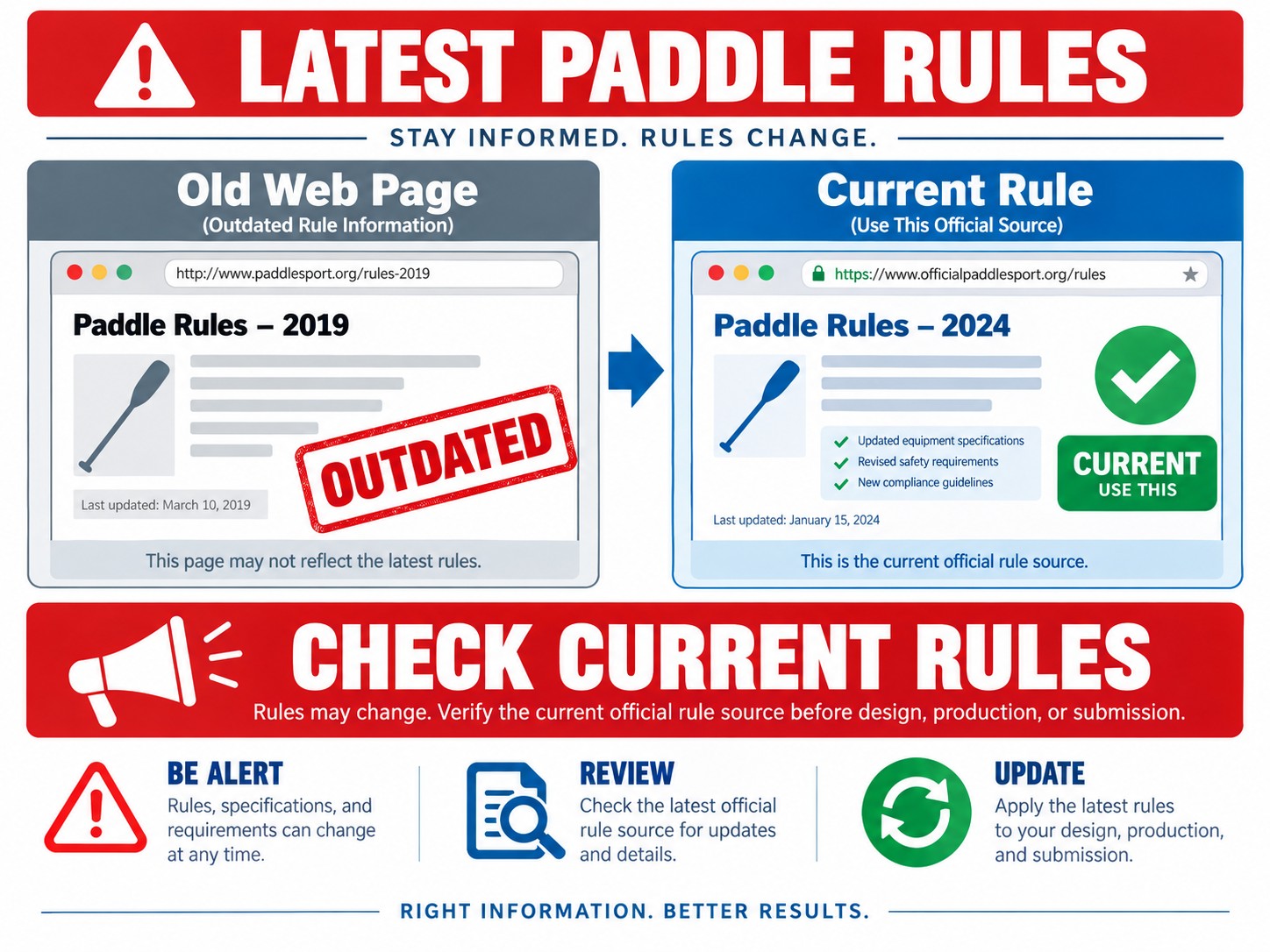
Spin: Check the Current Rule, Not an Old Web Page
UPA-A’s current About Us page states that certification uses direct spin measurement with a maximum of 2,100 RPM.
However, a separate Paddle Testing webpage still displays a 2,200 RPM limit, indicating that some site content may lag the current rules.
For publication and product submission, treat the latest Paddle Rules / official certification guidance as authoritative and re-check before testing. This article should visibly show its Last Updated date.
UPA-A vs USA Pickleball
The two systems are separate.
UPA-A focuses on its competition ecosystem and uses its own performance framework. USA Pickleball maintains its own approved-equipment program, PBCoR system and, beginning October 1, 2026, direct 2,100 RPM spin requirement for new submissions.
A brand can need one or both pathways depending on the markets and competitions it targets.
Build Certification Into Product Development
Do not wait until packaging is printed and mass inventory is complete.
Freeze the production-intent construction, run internal new/conditioned testing, maintain a golden sample, verify artwork/marking requirements, reserve budget and allow schedule buffer.
Certification should be one gate inside the product-development process.
Fees, Samples and Launch Readiness
Maintain Compliance After Approval
A certificate does not replace manufacturing control.
Keep the approved BOM, materials, surface, core, dimensions and relevant process conditions under change control. Retain production samples.
If a performance-relevant change is proposed, review whether revalidation or additional certification action is required before release.
Resolve the UPA-A Webpage Discrepancy Before Submission
As of August 19, 2026, UPA-A’s About Us page states a 2,100 RPM spin limit, while the separate Paddle Testing page still displays 2,200 RPM. That is exactly why a compliance article needs source hierarchy.
Before submission, use the latest Paddle Rules and direct certification instructions, and confirm with UPA-A/PPL if any published pages conflict. Do not build product tolerances around a stale web snippet.
Certification Portfolio Planning
Map every SKU by physical construction rather than colorway. UPA-A says physical differences that can affect performance—such as thickness, size, weight, surface material or grittiness—can require separate certification, while purely aesthetic differences may not.
A clear SKU matrix prevents paying to certify redundant cosmetics and prevents accidentally treating a performance-changing variant as the same model.
Internal Pre-Certification Gate
Before the five official samples are sent, require an internal release meeting: BOM frozen, material lots identified, new and conditioned performance reviewed, artwork/marking plan confirmed, five submission units selected randomly from production-intent build, and retained comparison units stored.
That gate reduces the chance that certification becomes the first serious test of the design.
Manufacturing Controls After Approval
UPA-A Launch Readiness
| Item | Ready When | Risk If Open |
|---|---|---|
| Production-intent build | Materials/process are frozen | Certification sample not representative |
| Five submission paddles | Same controlled version | Mixed prototype states |
| Model identity / grip | Matches checklist | Administrative delay |
| Internal pre-check | Known risks reviewed | Certification becomes first real test |
| Launch calendar | Standard/expedited route selected | Inventory exposure |
Sources / Current-Update Notes
- UPA-A 2026 Certification — Current certification program and submission fields. Primary source
- UPA-A Aug. 7, 2026 Fee Update — First-time applicant annual fee is prorated by quarter: Q1 $10,000, Q2 $8,500, Q3 $6,000, Q4 $3,500. Primary source
- UPA-A Paddle Rules — Use current rules for enforcement details. Primary source
Treat Certification as a Product-Release Gate
Certification works best when the submitted paddle already represents the intended production product. Submitting while the team is still changing core, surface, thickness or manufacturing route creates a mismatch between commercial urgency and technical control.
The release gate should include a production-intent BOM, identical submission samples, model identification, retained references and a clear owner for post-approval changes. Certification then becomes one stage in a controlled product launch rather than the first serious test of the design.
- Freeze the physical construction before submission.
- Keep an identical retained comparison set.
- Recheck the current UPA-A fee/rule pages before every active launch.
Frequently Asked Questions
How much is UPA-A certification in 2026?
UPA-A currently lists a $10,000 annual brand fee plus $3,000 per paddle certification.
How long is a paddle certification valid?
UPA-A currently states 24 months.
How many paddles must be submitted?
The 2026 checklist states five paddles per submission.
What is the current UPA-A spin limit?
The current About Us page and Paddle Rules indicate 2,100 RPM, while an older testing webpage still displays 2,200; verify the latest Paddle Rules before submission.
Is UPA-A the same as USA Pickleball approval?
No. They are separate certification/governance systems.
Planning UPA-A certification?
Mayvoci can help organize the production-intent sample, construction freeze, submission readiness and manufacturing change-control workflow.
The End about Mayvoci
1)Design:Over 100 paddle designs and photography service to assist start-up.
2)Professional:Focus on various of paddles manufacturing for 6 years
3)Quality:Strict quality management system to provide safety and satisfaction for customers
4)Amazon:Flexible comprehensive solution to make sure each Amazon seller is well cared.
5)Excellent Team:Experienced paddle experts & dynamic sales team give you 5-star service

If you work on this topic from the brand, sourcing, engineering or channel side, I’d be interested in your experience: Is certification currently an early product-development gate in your process, or something handled close to launch?