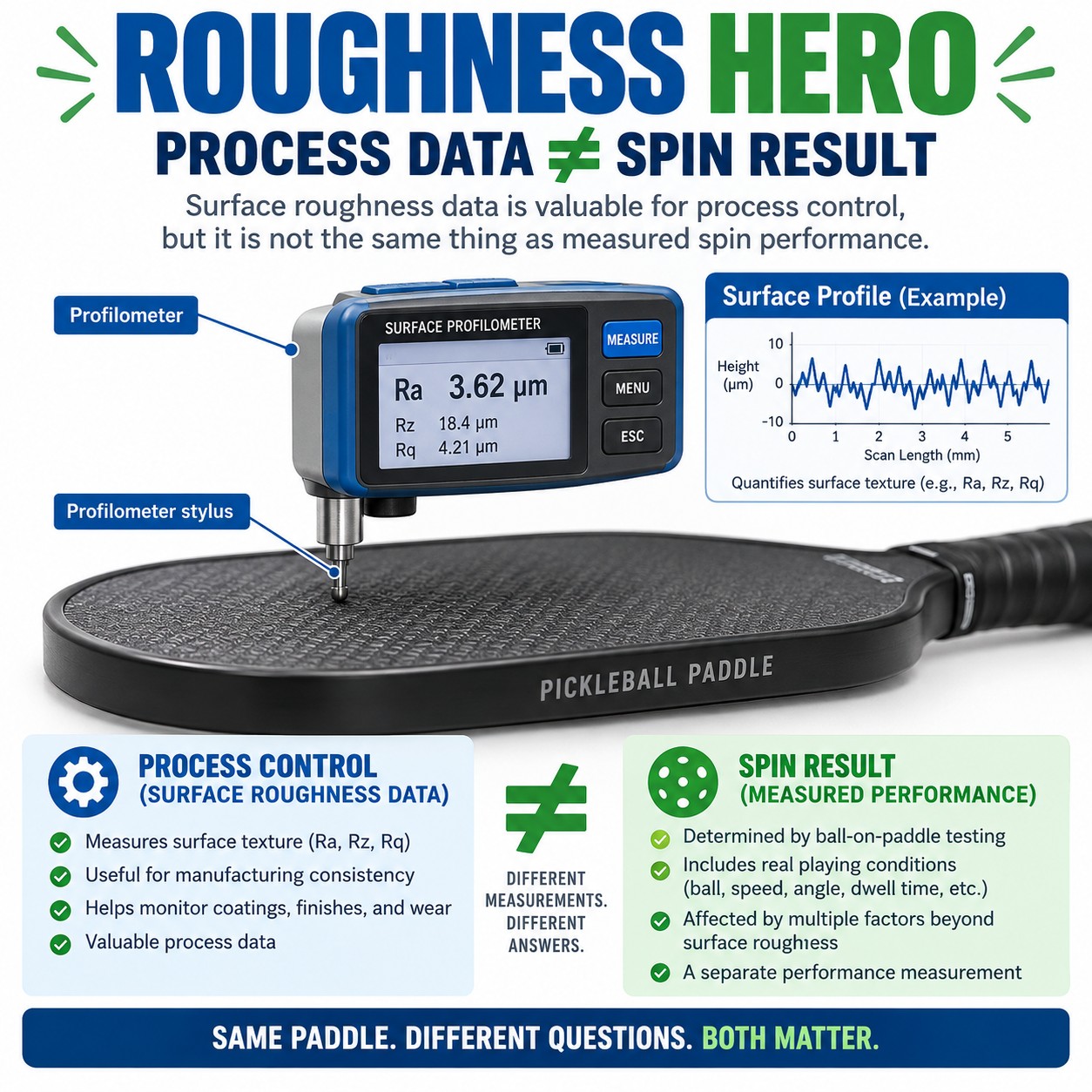
Surface roughness remains useful even as direct spin testing becomes more important. A profilometer or other controlled measurement can reveal texture variation, wear and manufacturing drift. It cannot by itself tell a player exactly how much spin a paddle will generate.
That distinction matters even more in 2026 as USA Pickleball moves new submissions toward a direct 2,100 RPM spin ceiling.
What Roughness Testing Measures
What Roughness Measures
Surface instruments quantify aspects of topography. Parameters, probe, direction and sampling location matter, so reports need the method as well as the number.
Why Independent Tests Are Useful
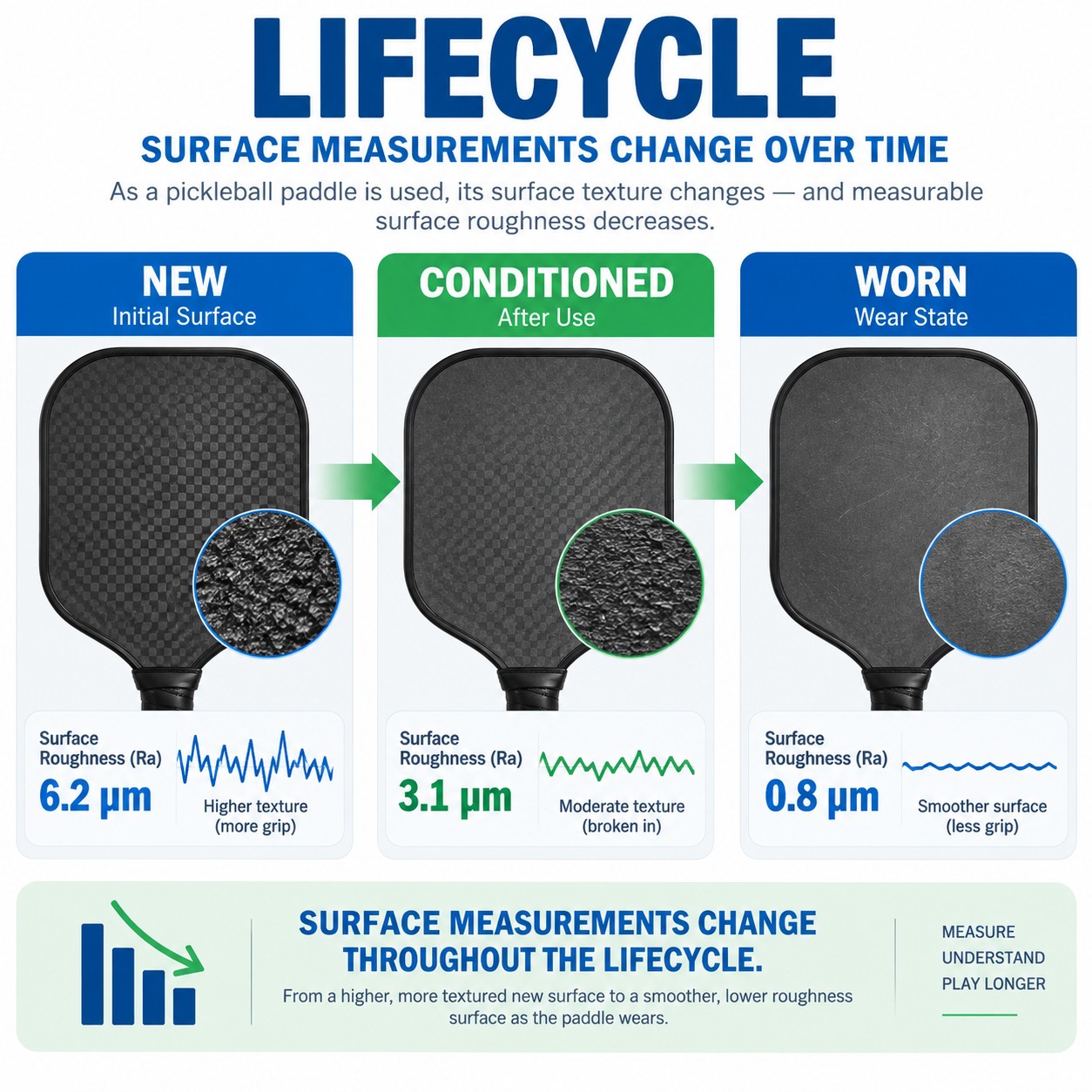
Measurements can compare new versus used paddles, multiple face zones and production samples. They are useful for QC and wear research.
Why Roughness Is Not Spin
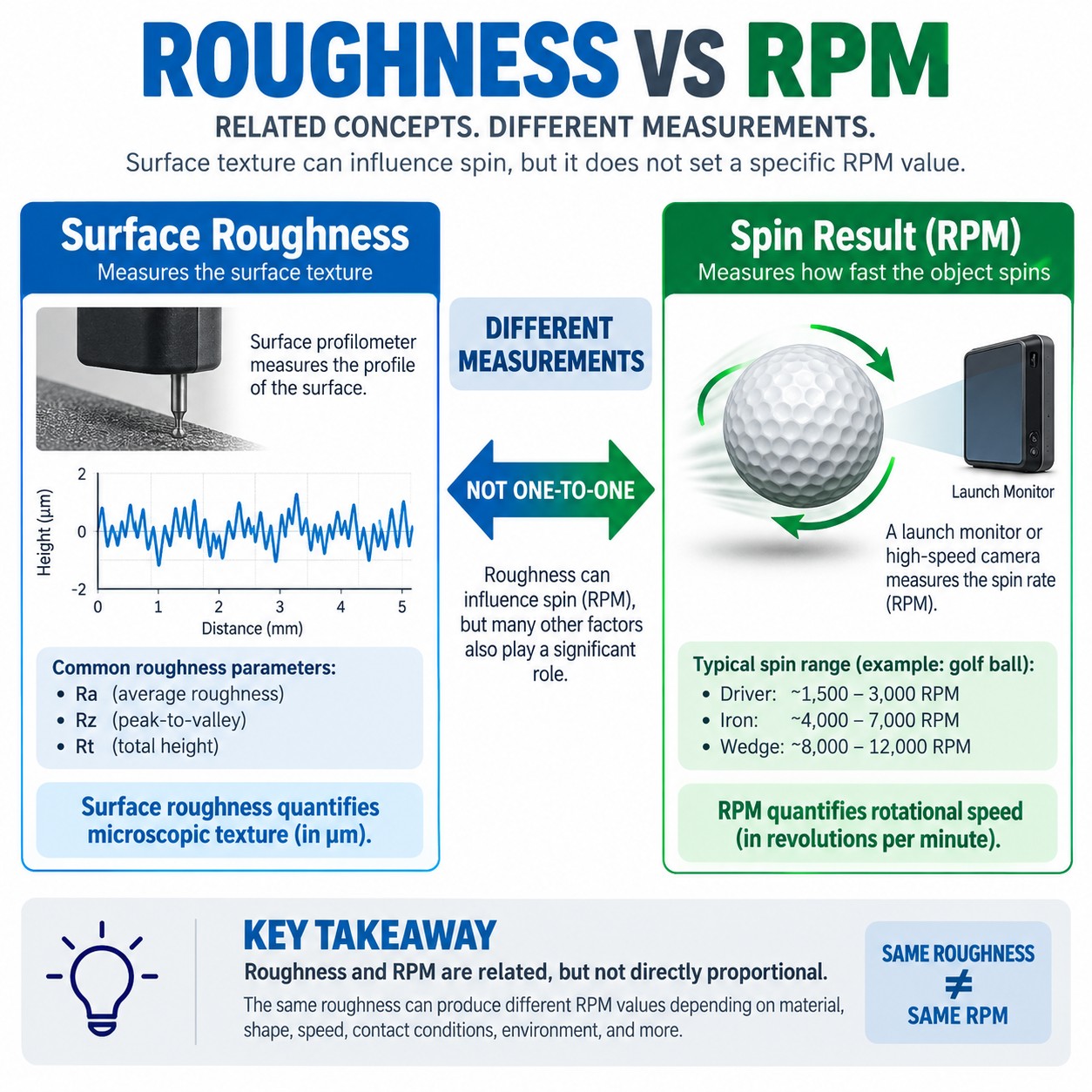
Spin depends on ball, speed, angle, contact, surface and test method. Two surfaces with similar roughness can behave differently.
Why Roughness Is Not Spin
Sampling and Wear
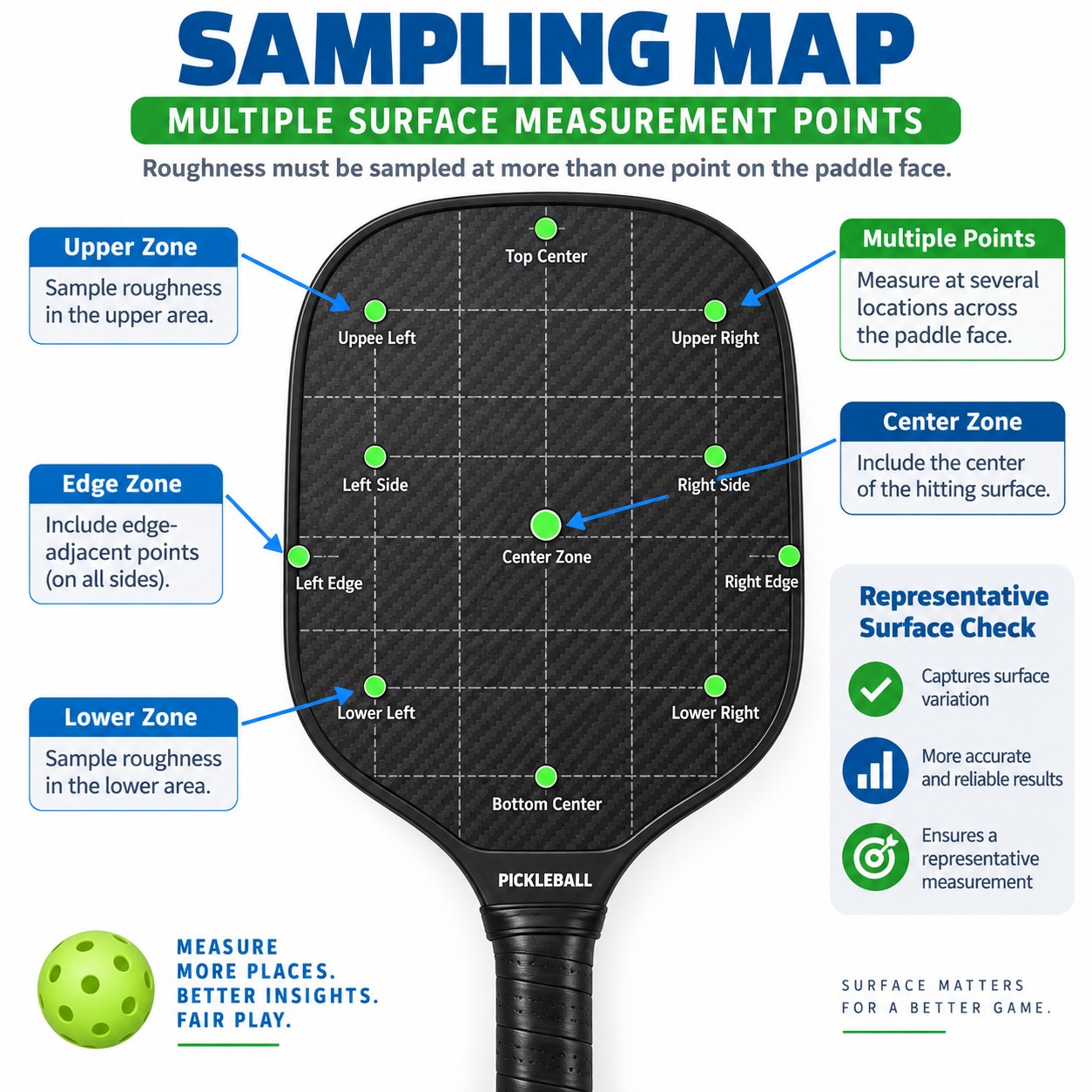
Measure several locations and several paddles. Repeat after defined conditioning and pair surface data with direct spin when possible.
2026 Rule Context
USA Pickleball announced direct spin testing for new submissions from October 1, 2026, with roughness and coefficient-of-friction upper thresholds becoming measurements of record.
How to Publish Results
Describe instrument, parameter, sample count, locations and condition. Do not declare one paddle “more spin” from roughness alone.
Measurement Uncertainty
Every instrument has repeatability and operator effects. A difference between two readings is meaningful only when it exceeds the normal variation of the method.
Independent testers should repeat measurements and, ideally, report variability instead of presenting one decimal value as absolute truth.
Sampling, Uncertainty and Lifecycle
Factory Control Limits
A factory can measure approved golden samples and pilot lots to establish an internal roughness range. The range should be based on a stable process and linked to direct spin data where available.
Control limits are production tools, not regulatory limits unless the governing body explicitly defines them.
Consumer Interpretation
Readers often assume rougher means better. The article should explain that an aggressive texture can wear quickly, create inconsistent zones or approach regulatory limits.
The useful target is repeatable legal spin over useful life, not maximum texture on day one.
Practical Editorial / Decision Notes
Instrument uncertainty matters. A small difference between two readings may be meaningless if it is within the repeatability range of the method.
Factories can use approved samples to establish internal process-control ranges, but those ranges are not official regulatory limits unless the governing body says so.
Use Surface Data for QC
Roughness Test Reporting Template
| Field | Report |
|---|---|
| Instrument / parameter | Name and settings |
| Sampling | Locations + number of paddles |
| Condition | New / conditioned / worn |
| Uncertainty | Repeatability / variation |
| Interpretation | Process QC, not direct RPM claim |
Sources / Current-Update Notes
- USA Pickleball Spin Rate Update — From Oct. 1, 2026 direct spin becomes the certification ceiling for new submissions while roughness/COF become measurements of record. Primary source
Report Measurement Quality Before Ranking Paddles
Independent surface data is only useful when readers understand the instrument, parameter, locations, number of paddles and repeatability. A decimal number without measurement context can look more precise than the method really is.
For factories, roughness is strongest as a process-control signal. It can identify drift across lots or wear states, but it should not be presented as a direct substitute for the current spin certification output.
- Publish method and sampling with every result.
- Report variation, not only one center reading.
- Keep internal process limits separate from regulatory limits.
Frequently Asked Questions
Does higher roughness always mean more spin?
No.
Is roughness still useful?
Yes, especially for process control and wear analysis.
How many points should be measured?
Use a defined multi-location sampling plan.
Can consumer tests certify a paddle?
No.
What should reports include?
Method, instrument, parameter, sample count, locations and condition.
Building a surface QC program?
Mayvoci can help define sampling zones, retained references and reporting that separates process measurements from certification output.
The End about Mayvoci
1)Design:Over 100 paddle designs and photography service to assist start-up.
2)Professional:Focus on various of paddles manufacturing for 6 years
3)Quality:Strict quality management system to provide safety and satisfaction for customers
4)Amazon:Flexible comprehensive solution to make sure each Amazon seller is well cared.
5)Excellent Team:Experienced paddle experts & dynamic sales team give you 5-star service