
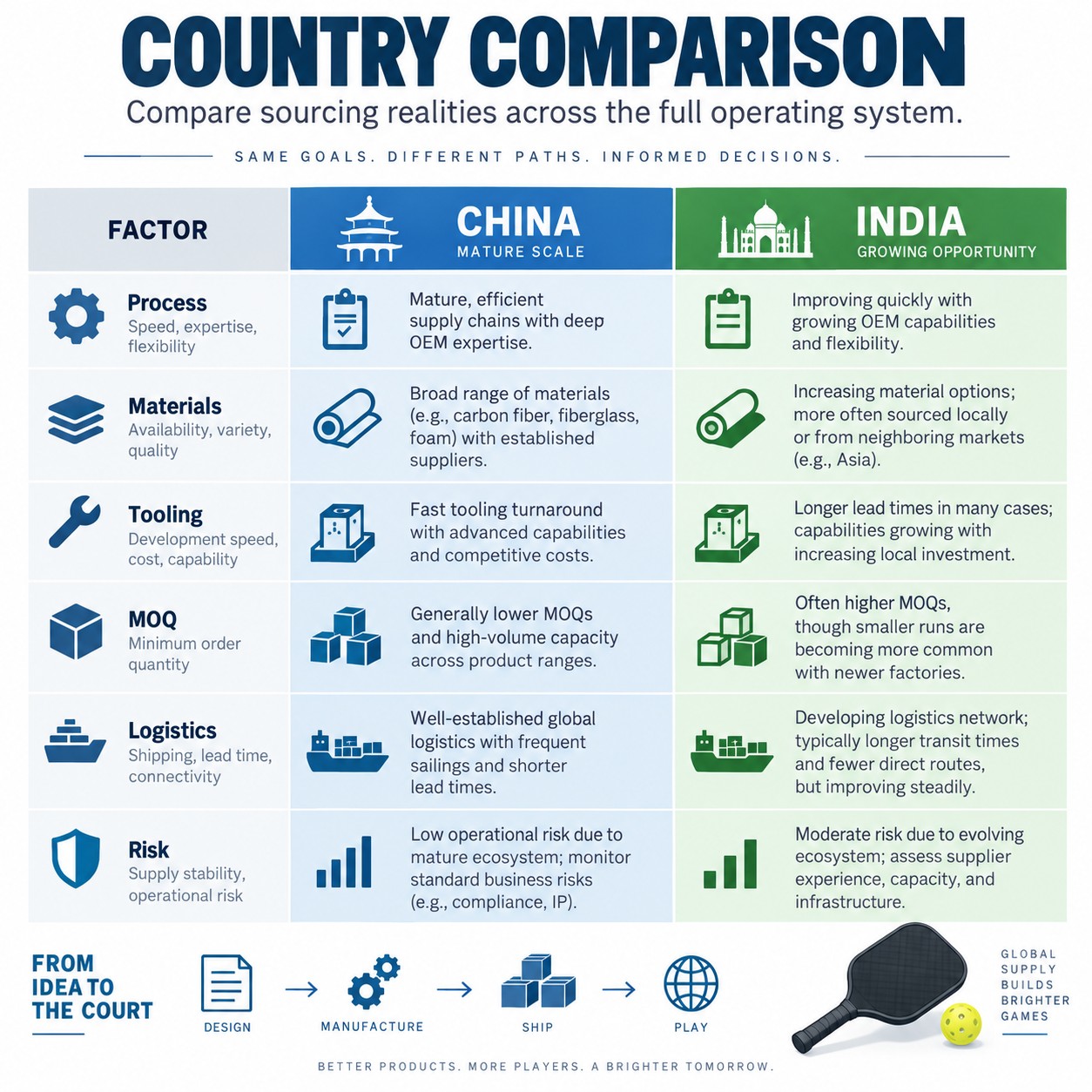
Supply-chain risk is often reduced to one sentence: “Should we move production out of China?”
That question is too narrow.
A pickleball brand can face tariff risk, origin risk, supplier risk, material risk, logistics risk, certification risk and inventory risk at the same time. Moving final assembly to another country may change some of those risks while increasing others. A second supplier may improve continuity but create new variation if the two factories use different materials or processes.
A resilient strategy separates the risks first, then chooses a response for each one.
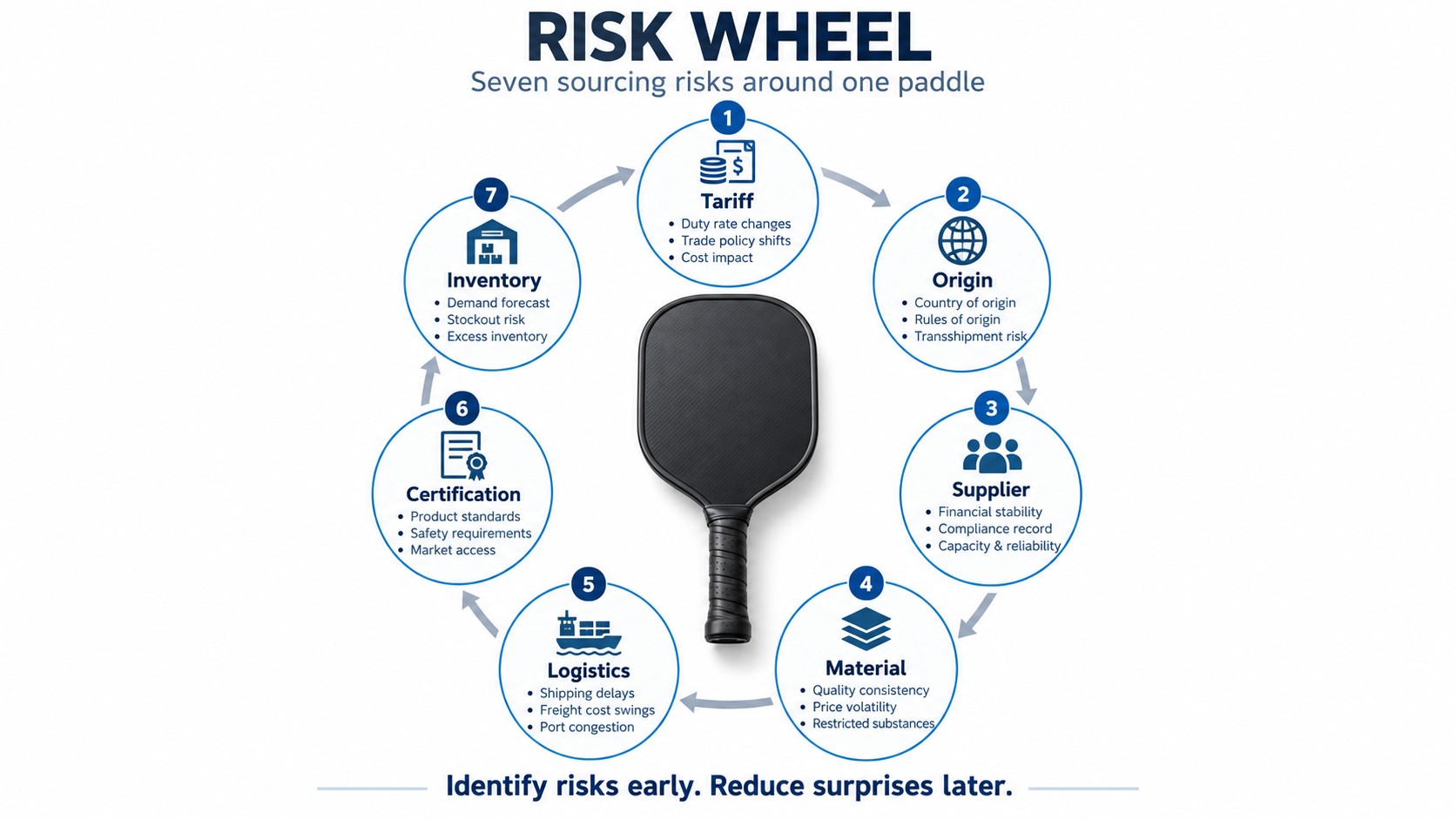
Map the Supply-Chain Risk Stack
Tariff Risk: Verify the Current Rules
U.S. import treatment depends on classification, country of origin and current trade actions. USTR continues to maintain China Section 301 tariff actions and, in May 2026, initiated a second four-year review process. Certain exclusions were previously extended through November 10, 2026.
That makes static “China tariff = X%” articles dangerous.
For every material sourcing decision, verify the likely HTS classification, current normal duty, applicable additional duties, exclusions and effective dates. Use the live USITC and USTR resources and confirm high-impact decisions with a customs professional.
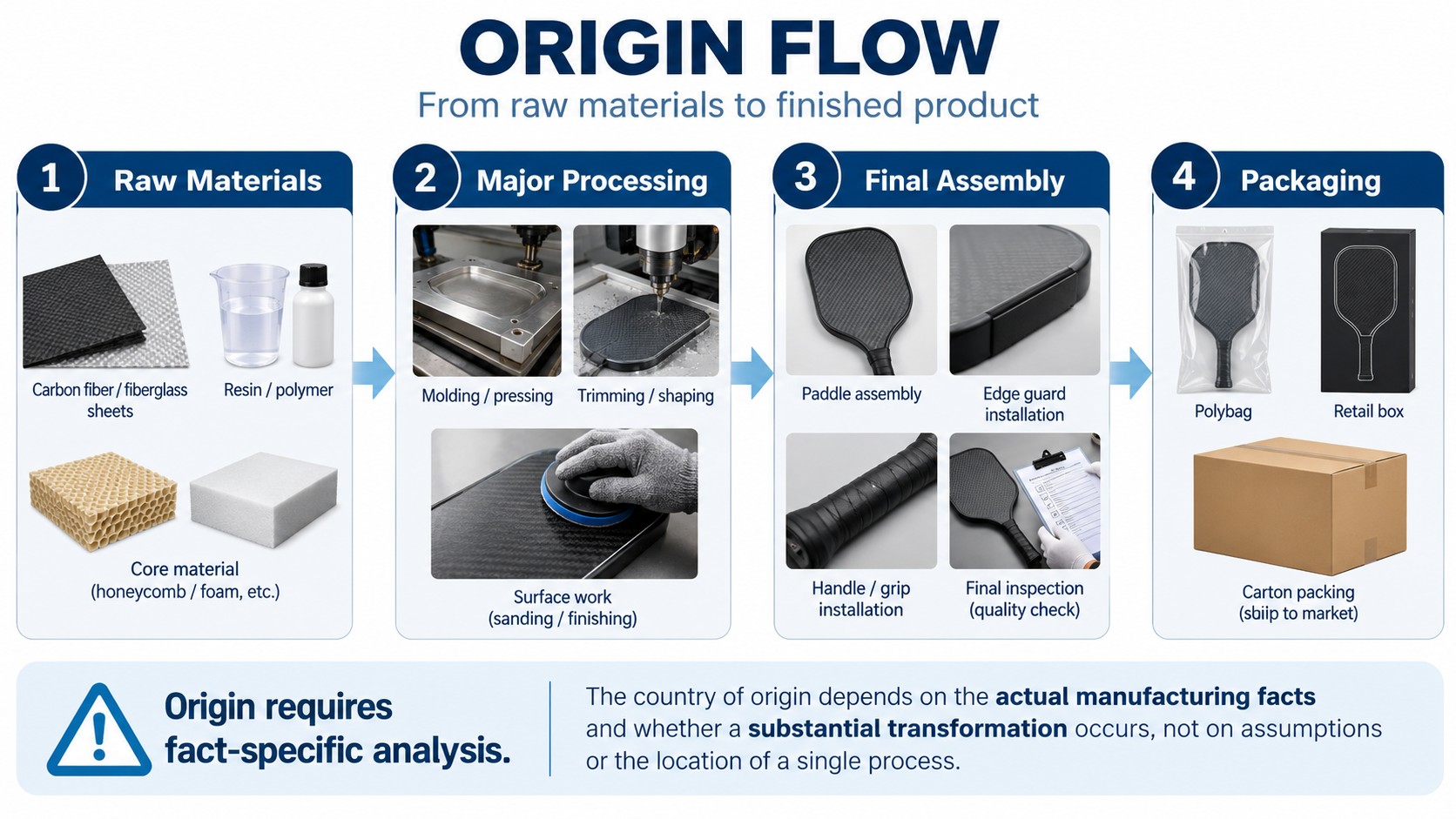
Origin Risk: Assembly Location Is Not Enough
CBP explains country of origin using the concept of substantial transformation for many non-preferential origin questions: whether processing creates a new article with a different name, character and use.
For a composite paddle, origin can be fact-specific.
Moving printing, grip installation, packaging or minor assembly to another country does not automatically create a new origin. If origin changes are part of a tariff strategy, obtain professional customs guidance before restructuring production.
Supplier Risk: Can the Factory Reproduce the Paddle?
Supplier risk is separate from tariff risk.
A factory may offer competitive duty exposure but weak control over face fabric, core density, thermoforming, surface wear or weight distribution. A technically strong factory may still create schedule risk if capacity is unstable.
Score process ownership, material control, change control, traceability, capacity, corrective action and communication independently from price.
Material Risk: Know the Single-Source Components
List the components that could stop production if one upstream supplier fails.
Examples can include a specific carbon fabric, aramid cloth, foam grade, honeycomb sheet, edge material, grip, coating system, adhesive or custom packaging component.
For each critical item, document lead time, MOQ, approved alternative, revalidation requirement and inventory coverage.
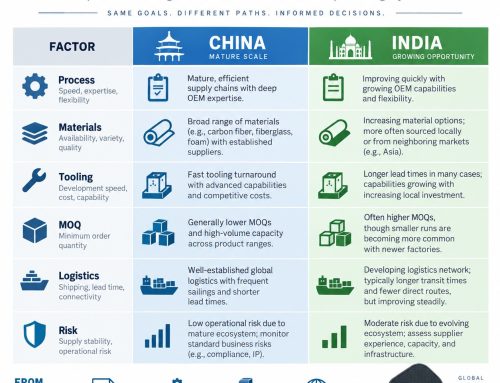
Separate Origin, Supplier and Material Risk
Logistics Risk: Protect the Launch Date
Do not plan only around average transit time.
Build buffers for factory schedule, inspection, export handling, vessel or flight capacity, customs clearance, domestic delivery and unexpected rework. If the product launch is tied to a tournament or retail reset, calculate the latest safe production-release date.
Emergency air freight should be treated as a contingency cost, not a normal planning method.
Certification Risk Belongs in Supply Chain Planning
A paddle that misses certification can create inventory risk even if manufacturing is perfect.
Freeze production-intent construction before certification, maintain internal compliance margin, and avoid mass-producing a large quantity before the design has passed the required approval path.
Compliance timing should be included in the same critical path as tooling, packaging and freight.
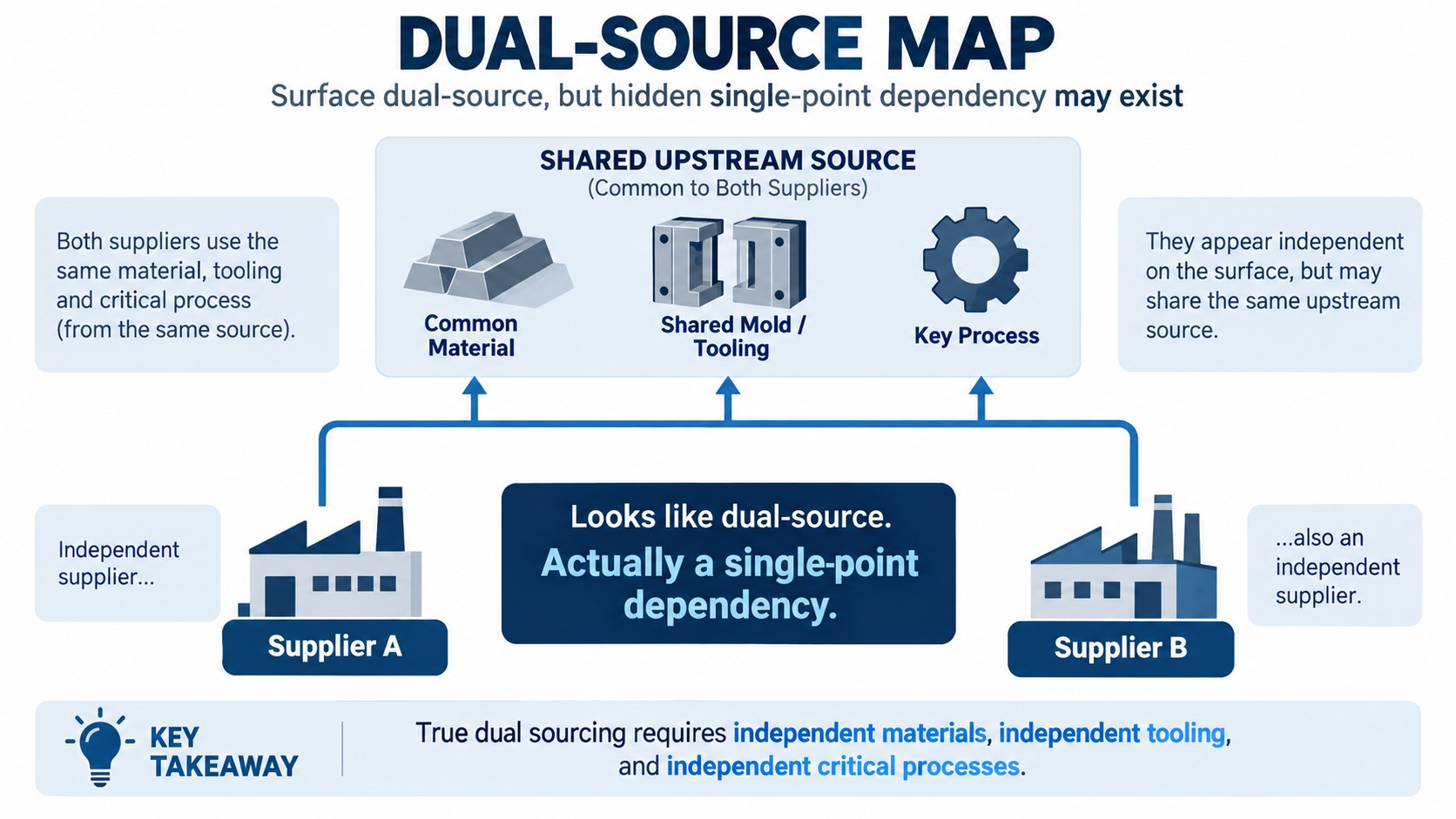
Diversification: Duplicate Capability, Not Just Geography
A second country is not automatically a second source.
If both factories depend on the same upstream face fabric, foam supplier, mold, artwork system or key process partner, the supply chain may still have a single point of failure.
Map process and material dependencies before calling a program “dual sourced.”
Inventory: Use Buffers Selectively
More inventory reduces some risks and increases others.
Use higher buffers for stable, high-volume components or SKUs with long replenishment time. Use smaller test quantities for new constructions, seasonal designs or products still moving through certification.
Separate raw-material buffer, work-in-process, finished-goods safety stock and launch inventory. They solve different problems.
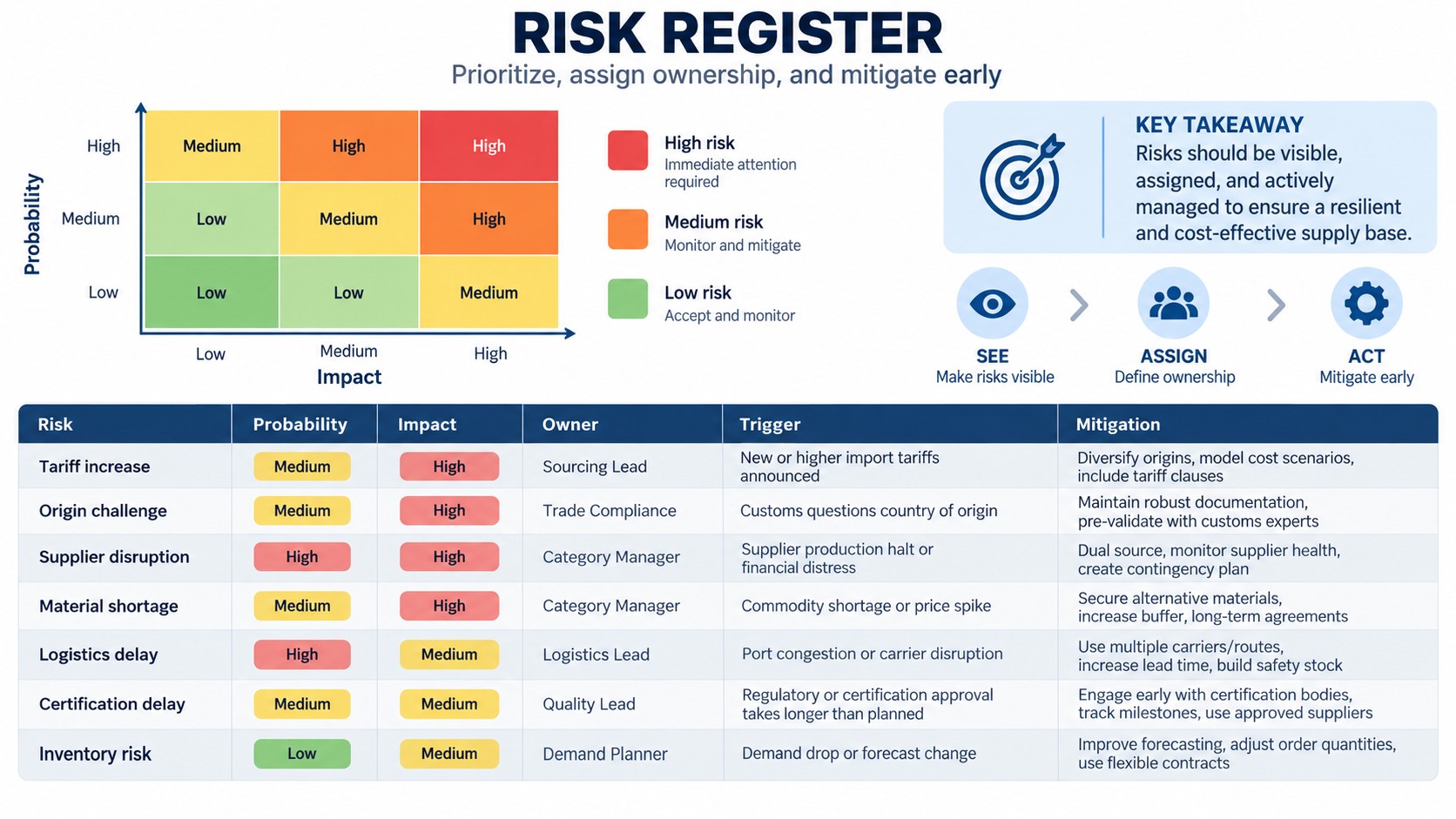
Build a Risk Register
For each risk, record probability, impact, warning indicator, owner and mitigation.
Examples: tariff change, supplier capacity squeeze, material substitution, certification delay, surface inconsistency, packaging delay, ocean congestion or demand spike.
Review the register at product launch and at least quarterly for active programs.
Protect Launch, Certification and Inventory
Use Total Landed and Risk-Adjusted Cost
The lowest FOB price is not the same as the lowest business cost.
Add freight, duty, brokerage, inspection, rework, rejects, emergency logistics, financing, inventory and expected warranty exposure. Then consider schedule and compliance risk.
That is the cost base on which sourcing decisions should be made.
Build Three Supply-Chain Scenarios
Maintain at least three scenarios: Base Case, Disruption Case and Launch-Critical Case.
The Base Case uses normal supplier lead time and planned freight. The Disruption Case assumes a material delay, tariff change, inspection failure or missed sailing. The Launch-Critical Case asks what must be done if the commercial date cannot move—reduced SKU count, partial shipment, air freight, alternate packaging or another approved source.
Pre-planning these options is less expensive than making them under pressure.
Do Not Diversify Before the Product Is Controlled
A second supplier cannot reproduce a product that the brand itself has not fully specified.
Before dual sourcing, freeze the critical BOM, tolerances, surface process, test methods and golden-sample criteria. Then run equivalence work at the second supplier.
Otherwise diversification can create two visually similar paddles with different performance, warranty behavior and certification risk.
Quarterly Supply-Chain Review
For active SKUs, review supplier capacity, critical material stock, upcoming holidays, certification status, outstanding engineering changes, freight exposure, inventory cover and open quality issues once per quarter.
For launch-stage products, review more frequently. The purpose is not more meetings; it is to see risks while there is still time to change the plan.
Build a Resilience Plan
Supply-Chain Risk Register
| Risk | Leading Indicator | Primary Response | Fallback |
|---|---|---|---|
| Tariff / trade | Rule or exclusion change | Verify HTS/origin/current action | Scenario budget |
| Origin | Processing route changes | Customs review | Do not assume assembly = origin |
| Material | Single-source input | Approved alternatives / buffer | Revalidation plan |
| Supplier | Capacity / quality drift | Second source / pilot | Retained samples + CAPA |
| Certification | Approval delay | Freeze design early | Delay inventory commitment |
Sources / Current-Update Notes
- USITC HTS — Use live classification/duty data; do not hard-code a permanent tariff. Primary source
- USTR Section 301 — Check current China trade actions/exclusions. Primary source
Turn Supply-Chain Risk Into Product Decisions
For a paddle brand, supply-chain resilience is not simply “China plus one.” The real unit of risk is the approved product: its material sources, factory process, certification state, lead time and inventory exposure. A second country does not reduce risk if both factories depend on the same critical input or if the alternate source cannot reproduce the certified construction.
Brands should therefore maintain a risk register at model level. Every material or supplier dependency should have an owner, an early-warning signal and a response that has already been considered before the launch date is threatened.
- Map single-source inputs and certification dependencies by SKU.
- Run normal, delay and disruption landed-cost scenarios.
- Qualify alternative capability before inventory pressure forces the decision.
Frequently Asked Questions
Should a pickleball brand leave China because of tariffs?
Not as a blanket rule. Compare classification, origin, total landed cost, technical capability, risk and commercial requirements.
Does moving final assembly change country of origin?
Not automatically. Origin can depend on substantial transformation and is fact-specific.
Is dual sourcing always safer?
Only if the second source actually reduces common material, tooling and process dependencies.
How much safety stock should I hold?
There is no universal number. Base it on demand variability, replenishment time, margin, product maturity and risk.
How often should the article be updated?
At least when trade actions, exclusions, origin guidance, certification rules or major logistics conditions change.
Need a more resilient paddle supply plan?
Mayvoci can help brands map construction dependencies, alternative materials, pilot validation and sourcing scenarios around a frozen product specification.
The End about Mayvoci
1)Design:Over 100 paddle designs and photography service to assist start-up.
2)Professional:Focus on various of paddles manufacturing for 6 years
3)Quality:Strict quality management system to provide safety and satisfaction for customers
4)Amazon:Flexible comprehensive solution to make sure each Amazon seller is well cared.
5)Excellent Team:Experienced paddle experts & dynamic sales team give you 5-star service

If you work on this topic from the brand, sourcing, engineering or channel side, I’d be interested in your experience: Which risk is hardest for your team to plan around today: tariff/origin, materials, capacity, certification or inventory?