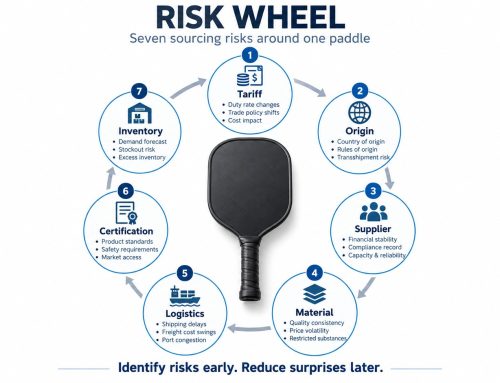
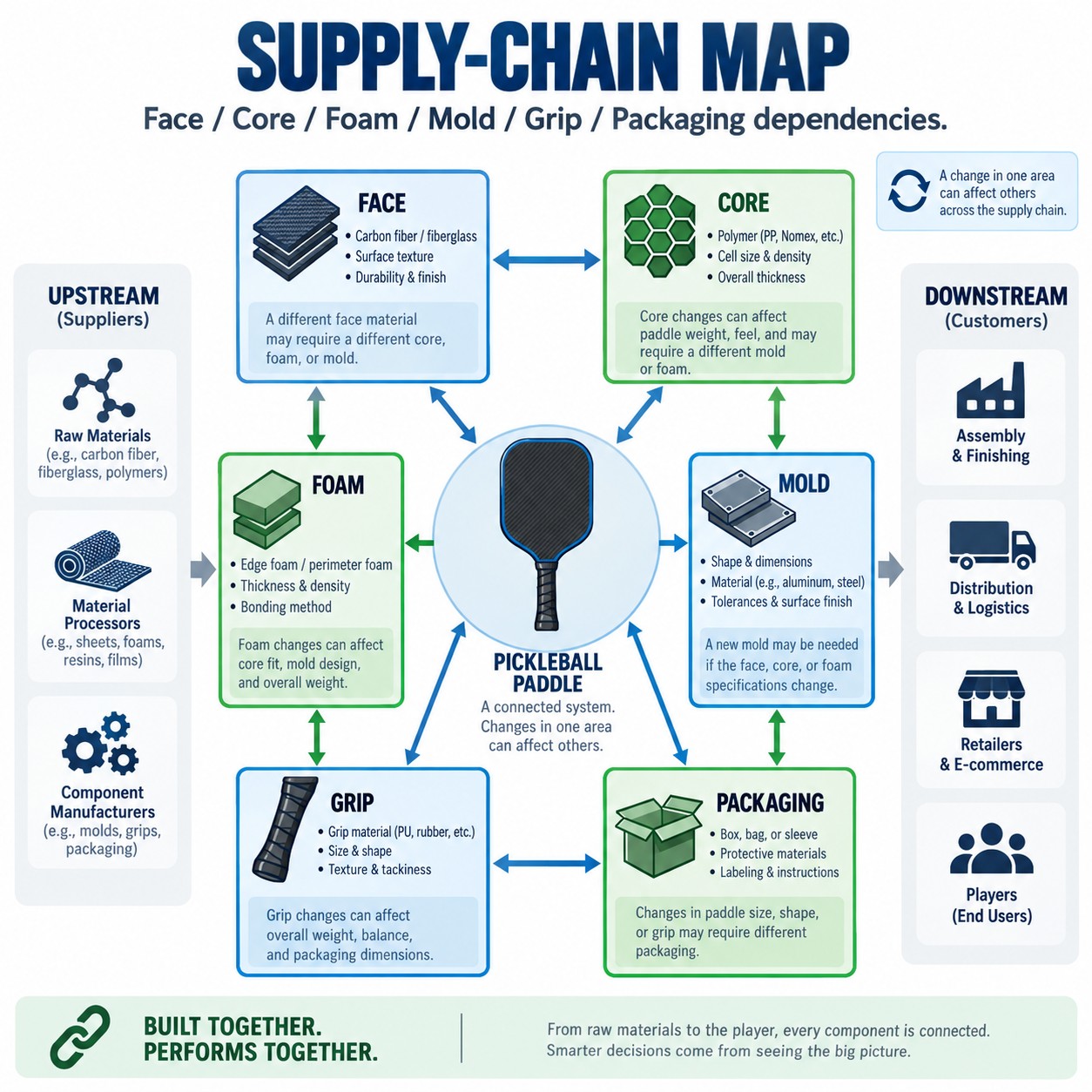
China versus India is often framed as a tariff or labor-cost decision. For pickleball paddles, the comparison is more complex because a finished product may depend on carbon or aramid fabrics, honeycomb or foam, molds, adhesives, coatings, printing, grips, packaging and export logistics.
A country comparison should ask which location can reproduce the required construction at the target landed cost and risk.
Compare Capability Before Country Stereotypes
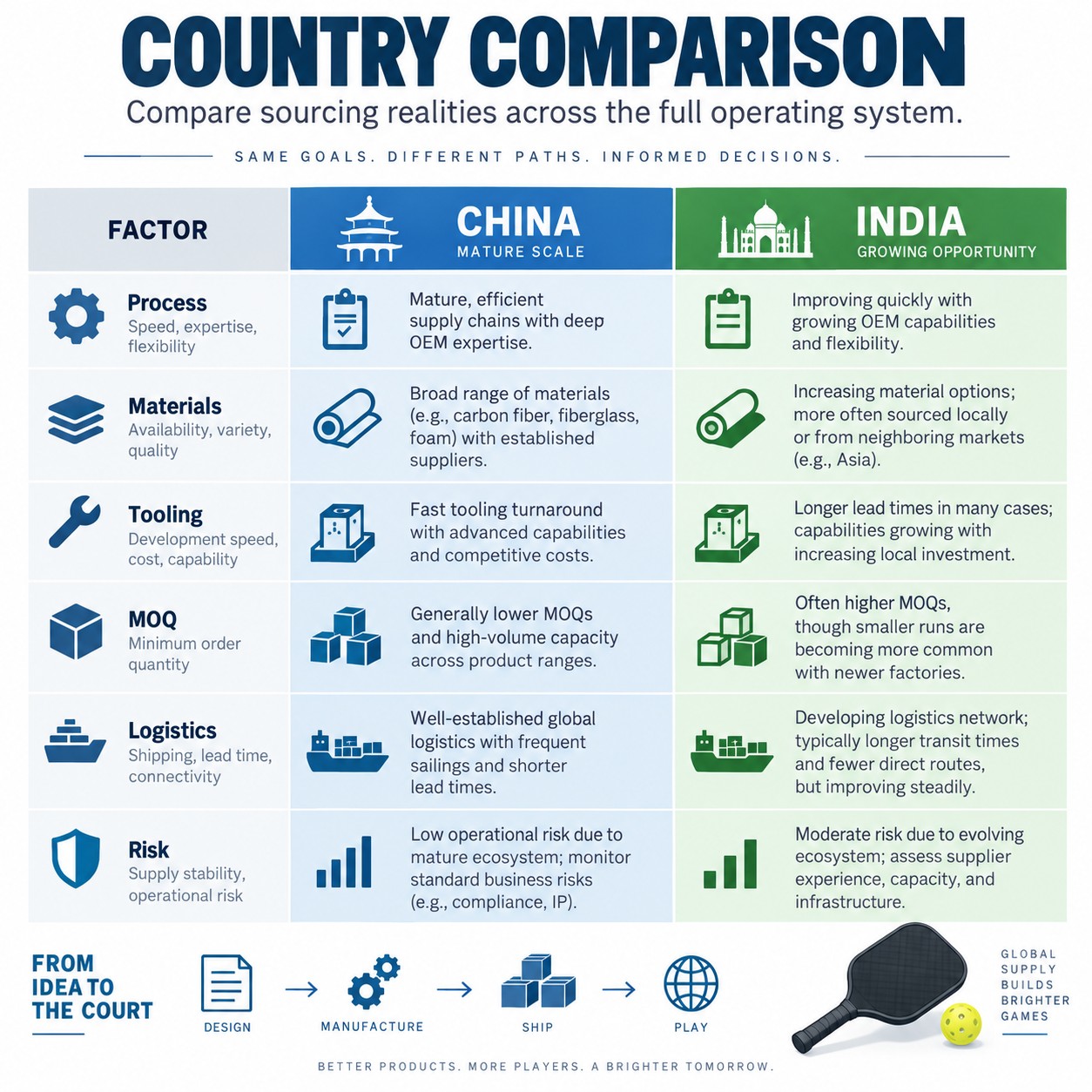
Compare Process Capability First
List the required processes: composite layup, thermoforming or cold press, foam, surface, printing, assembly and QC. Compare actual qualified factories rather than country averages.
Map the Upstream Ecosystem
A mature cluster can reduce lead time for fabrics, cores, molds, components and packaging. A newer cluster may rely more heavily on imported inputs.
Map dependencies before comparing final-assembly quotations.
Development and Tooling
New molds and rapid revisions depend on machining, engineering communication and sample speed. Time-to-approved-sample can be more commercially important than a small labor-cost difference.
Upstream Ecosystem, Tooling and MOQ
MOQ and Finished Cost
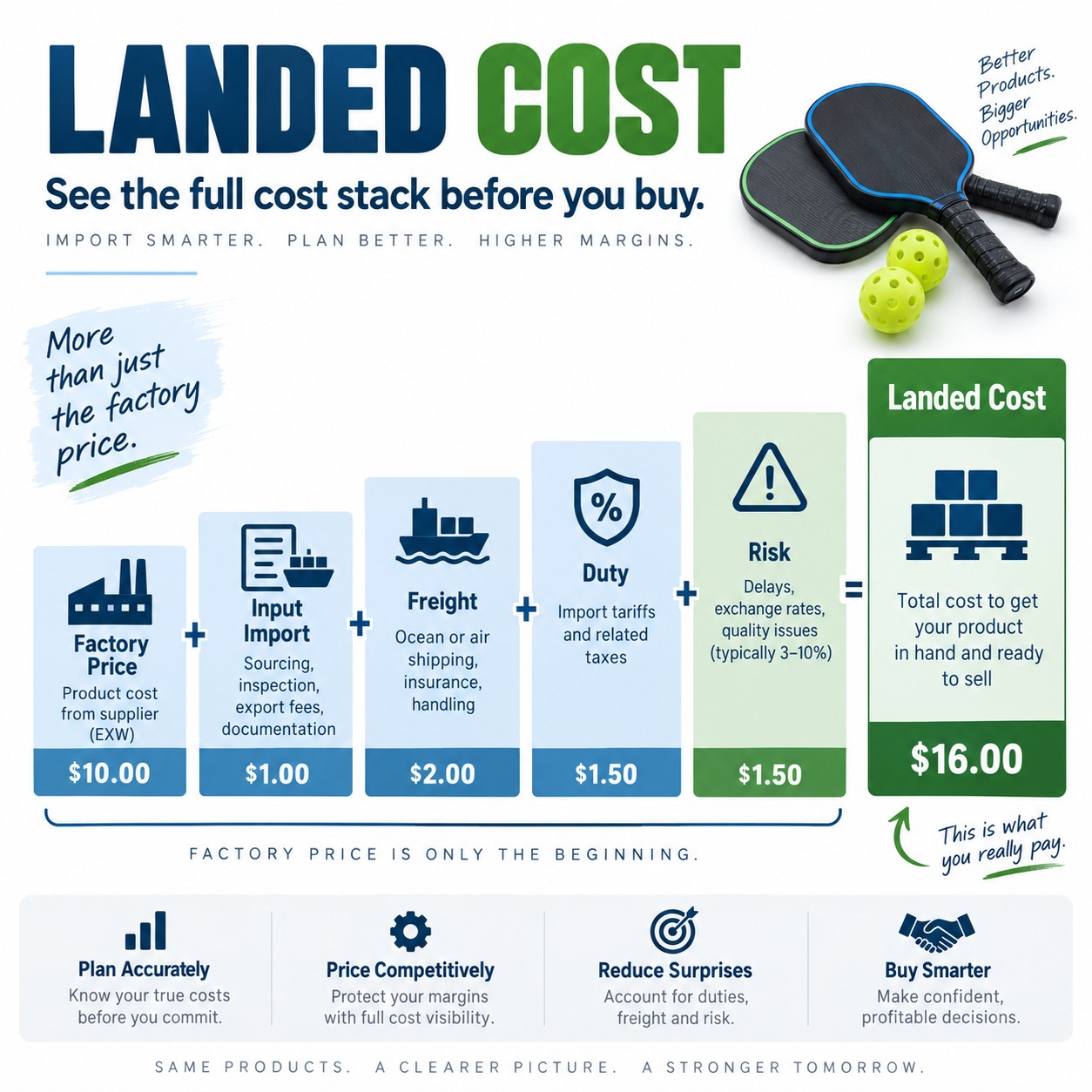
Labor is only one component. Yield, automation, scrap, imported materials, inspection and freight matter. Compare cost per acceptable finished paddle, not wage rates.
Origin and Tariff
Country of origin is determined under applicable customs rules. Moving minor assembly does not automatically change origin.
Verify classification and origin before building a tariff strategy.
Diversification
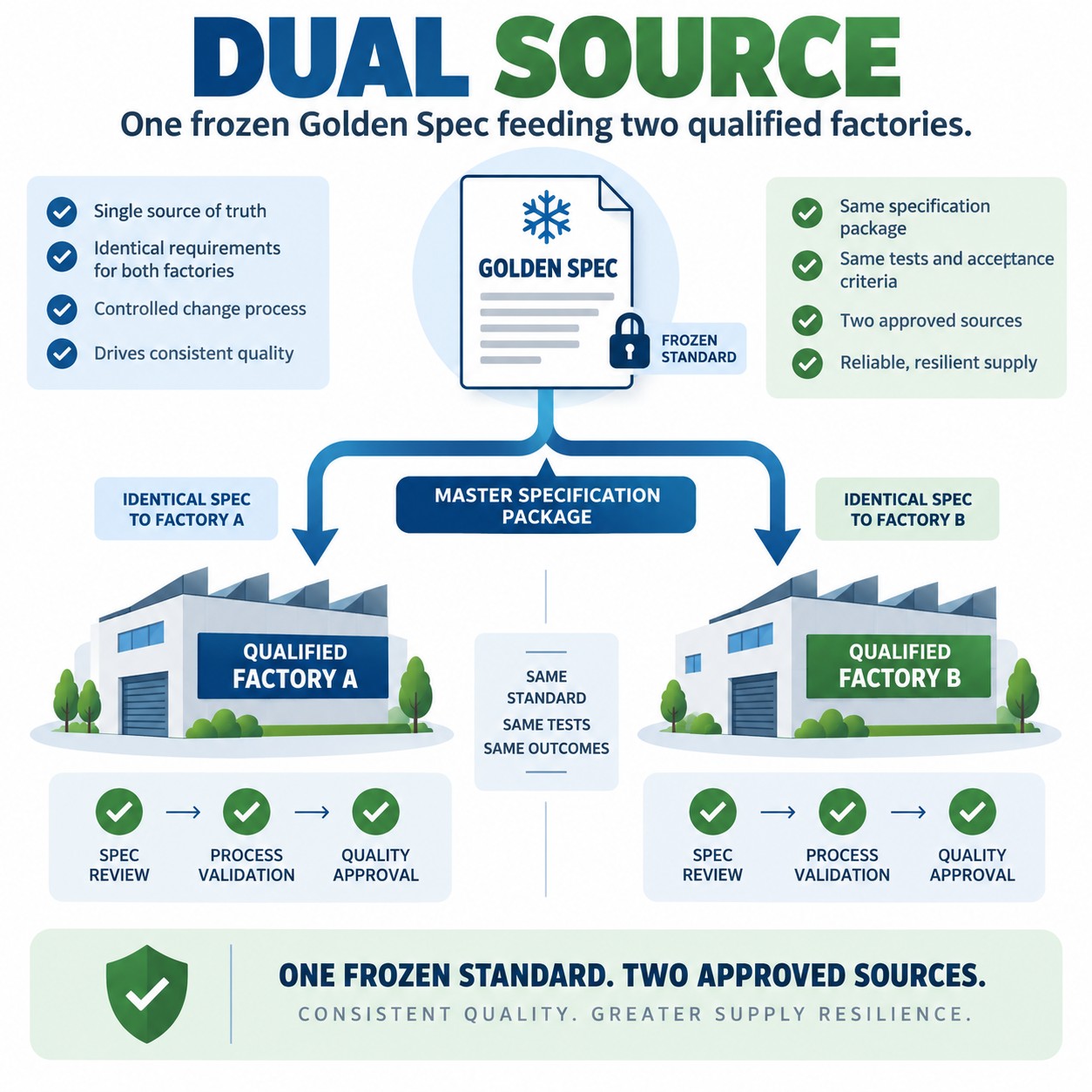
China and India can be complementary rather than mutually exclusive. Dual sourcing only reduces risk when both sources independently meet the same frozen specification and quality system.
Supplier Comparison Worksheet
Score candidate factories in both countries using the same fields: process ownership, material source, tooling, prototype lead time, MOQ, quoted cost, expected freight, quality system, certification experience and change control.
The worksheet prevents country-level assumptions from replacing supplier-level evidence.
Origin, Landed Cost and Logistics
Qualification Sequence
Use capability review, sample, factory verification, pilot and then scaled production. Do not move high-volume orders only because one location produces a favorable preliminary quotation.
A second country should pass the same product-development gates as the first.
Scenario Planning
Build at least three landed-cost scenarios for each source: normal trade/logistics, higher freight, and disruption. Include imported upstream materials when they affect cost or lead time.
This reveals whether diversification is truly resilient or simply shifts the same dependency to another location.
Practical Editorial / Decision Notes
Run the same supplier qualification sequence in both countries: capability review, sample, factory verification, pilot, then scale. A favorable preliminary quote should not skip development gates.
Build normal, high-freight and disruption landed-cost scenarios. Diversification is only resilient if the second source does not depend on the same single upstream bottleneck.
Build a Dual-Source Qualification Plan
China vs India Sourcing Matrix
| Dimension | China | India | Decision Evidence |
|---|---|---|---|
| Process capability | Supplier-specific | Supplier-specific | Audit / samples |
| Upstream materials | Map local/imported inputs | Map local/imported inputs | BOM source map |
| Tooling / speed | Compare actual lead time | Compare actual lead time | Prototype plan |
| Origin / duty | Fact-specific | Fact-specific | Customs review |
| Risk | Concentration | Qualification maturity | Scenario plan |
Country Diversification Only Works After Product Control
Moving sourcing geography before the product is well defined can multiply variation. The first source and the second source need the same frozen construction, drawings, material definitions and acceptance criteria.
A supplier-level comparison is therefore more useful than a country stereotype. The brand should score capability, prototype speed, material ecosystem, tooling, quality evidence, origin, logistics and landed-cost risk using the same framework.
- Use identical qualification gates in both countries.
- Map imported upstream inputs before claiming diversification.
- Verify origin under applicable customs rules.
Frequently Asked Questions
Is India always cheaper?
No.
Does India automatically avoid China-related tariffs?
Only if the goods genuinely have Indian origin under applicable rules.
Which country has better paddle capability?
Evaluate actual suppliers and their upstream systems.
Should brands dual-source?
It can help if both sources are independently qualified.
What should be compared?
Capability, landed cost, development speed, MOQ, logistics, quality and risk.
Comparing China and India for a paddle program?
Mayvoci can help build a common technical brief and supplier-qualification framework so the comparison is based on capability, not country assumptions.
The End about Mayvoci
1)Design:Over 100 paddle designs and photography service to assist start-up.
2)Professional:Focus on various of paddles manufacturing for 6 years
3)Quality:Strict quality management system to provide safety and satisfaction for customers
4)Amazon:Flexible comprehensive solution to make sure each Amazon seller is well cared.
5)Excellent Team:Experienced paddle experts & dynamic sales team give you 5-star service