
“Thermoformed” has become one of the most common construction labels in the pickleball market, but the word is used inconsistently. Some paddles use integrated perimeter structures and consolidated face/edge systems; others receive heat and pressure in only part of the production sequence.
For buyers and engineers, the useful question is not whether a supplier uses the word thermoformed. It is what is formed together, which materials are in the stack, how the edge is built, where foam is placed, and how the process window is controlled.
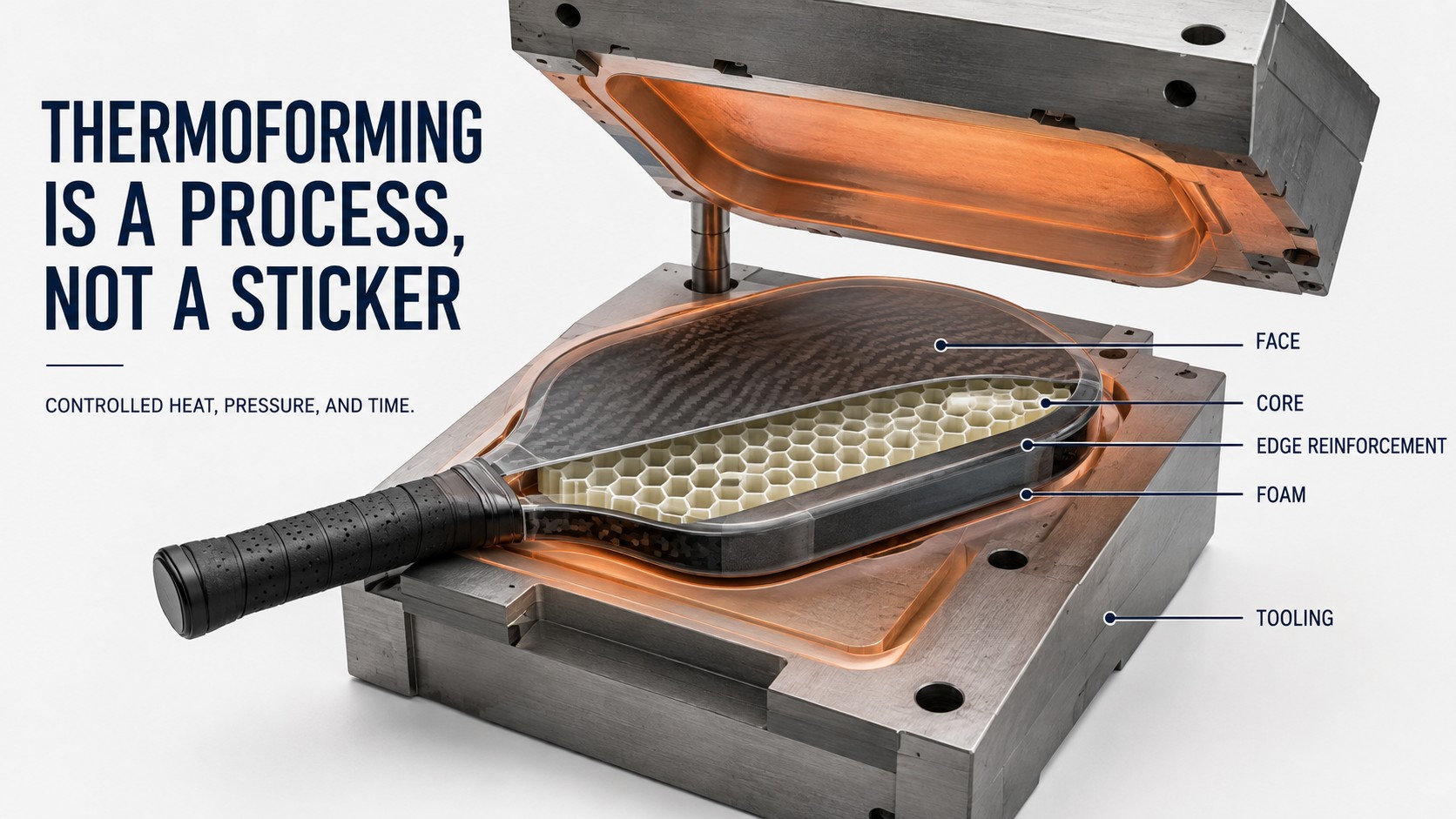
Define Thermoforming by the Actual Stack and Sequence
Heat and pressure can consolidate composite layers, cure adhesives or resins and shape components. But the final paddle depends on materials, geometry, tooling, pressure distribution, temperature, time and downstream operations.
Two paddles can both be marketed as thermoformed while using different face layups, edge architecture, foam, core preparation and cure sequence.
- Face laminate
- Core
- Perimeter reinforcement or wrap
- Foam location
- Adhesive layers
- Handle/throat structure
- Edge guard or edgeless finishing
Then ask at which stage each component enters the assembly and which stages see the main heat-and-pressure cycle.
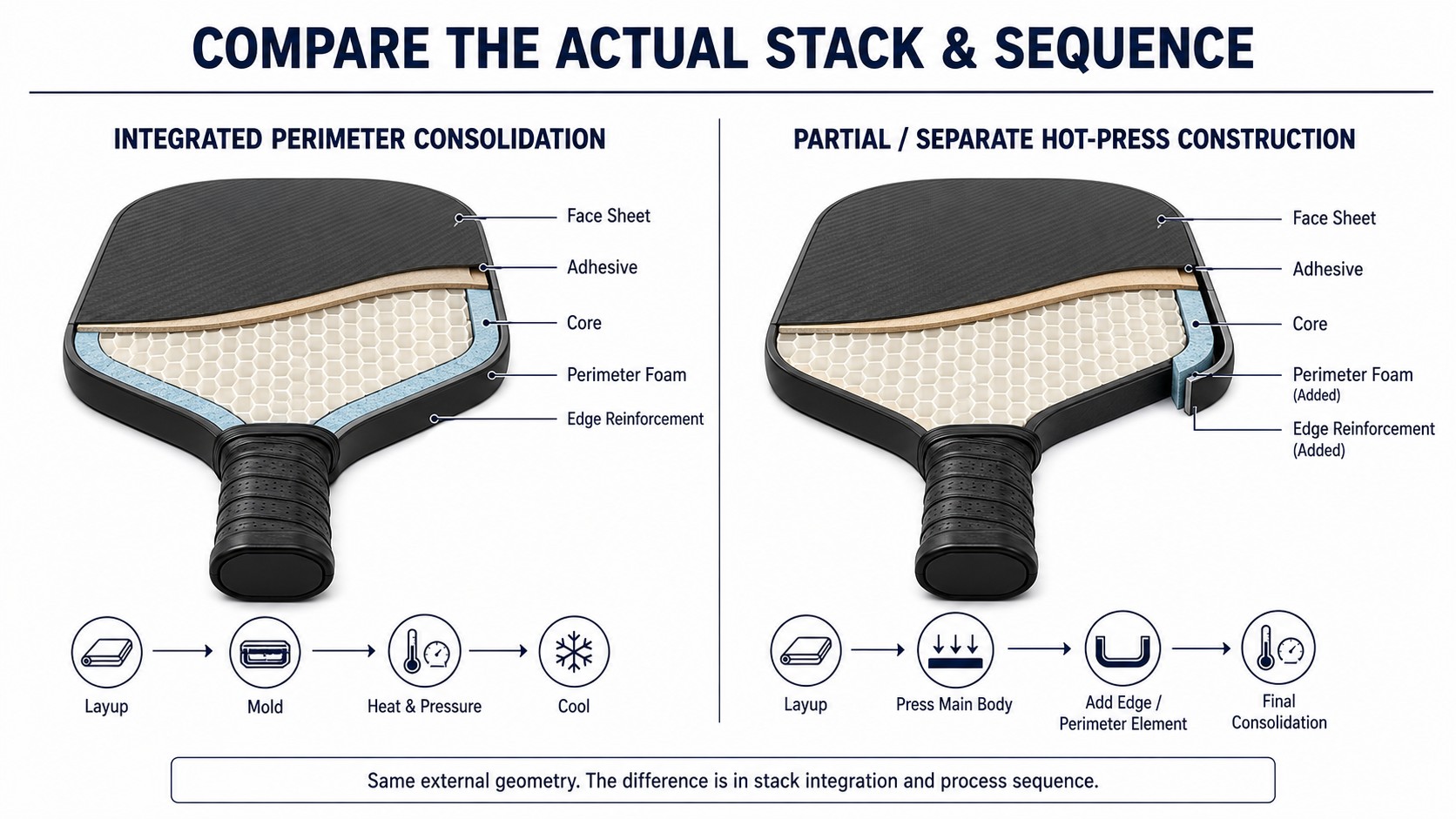
Industry terms such as “true thermoforming,” “pseudo hot press” and “partial hot press” are not universal standards. A better comparison uses the actual stack and sequence.
One construction may consolidate a face and reinforced perimeter around the core in an integrated process. Another may hot-press flat face panels and later assemble the edge or other structure separately. Both use heat and pressure, but interfaces and process risks differ.
If a structural wrap, foam or reinforced wall is used, its position and continuity matter. A visually clean outside edge does not prove a consistent internal structure.
Cross-sections from retained samples can reveal gaps, uneven foam, resin accumulation or misalignment.
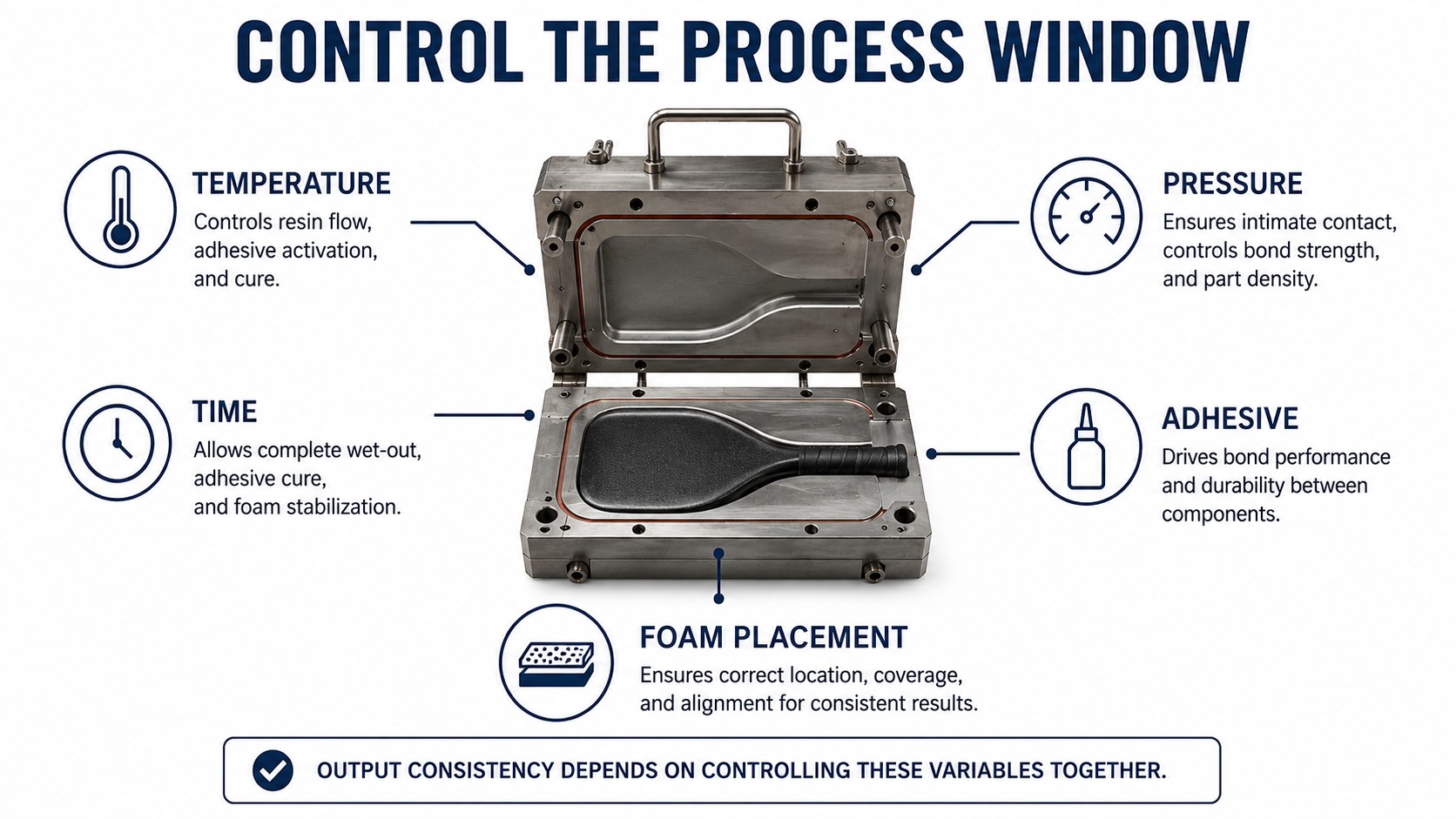
Control Heat, Pressure, Time, Adhesive and Foam as One Process Window
Heating too little may leave incomplete cure or poor flow; too much can affect materials, core geometry or resin behavior. Pressure must be sufficient and distributed correctly without crushing the core. Time must be compatible with the resin or adhesive system and the thermal mass of the assembly.
The factory does not need to publish proprietary settings, but it should have controlled parameters and a method for identifying out-of-window production.
A paddle may look perfect while containing local voids or weak interfaces. During development, inspect destructive samples for consistent contact between face and core and for meaningful failure modes.
Perimeter or local foam can influence mass distribution, edge support and damping, but only if placement is consistent. Too little, too much or uneven filling can shift weight and create local structural differences.
Thermoforming Process Audit Table
| Control Area | Buyer Question | Evidence to Request |
|---|---|---|
| Stack-up | What is consolidated together? | Process flow / cross-section / controlled BOM |
| Process window | How are temperature, pressure and time controlled? | Parameter records / equipment controls |
| Bonding | How is adhesive coverage/cure verified? | Cut samples / process standard / failure analysis |
| Foam | Where and how is foam placed? | Placement method / retained sections / weight control |
| Tooling | How is mold/fixture condition maintained? | Maintenance / first-piece checks |
| Pilot repeatability | Can normal production reproduce the prototype? | Multi-unit pilot data + retained samples |
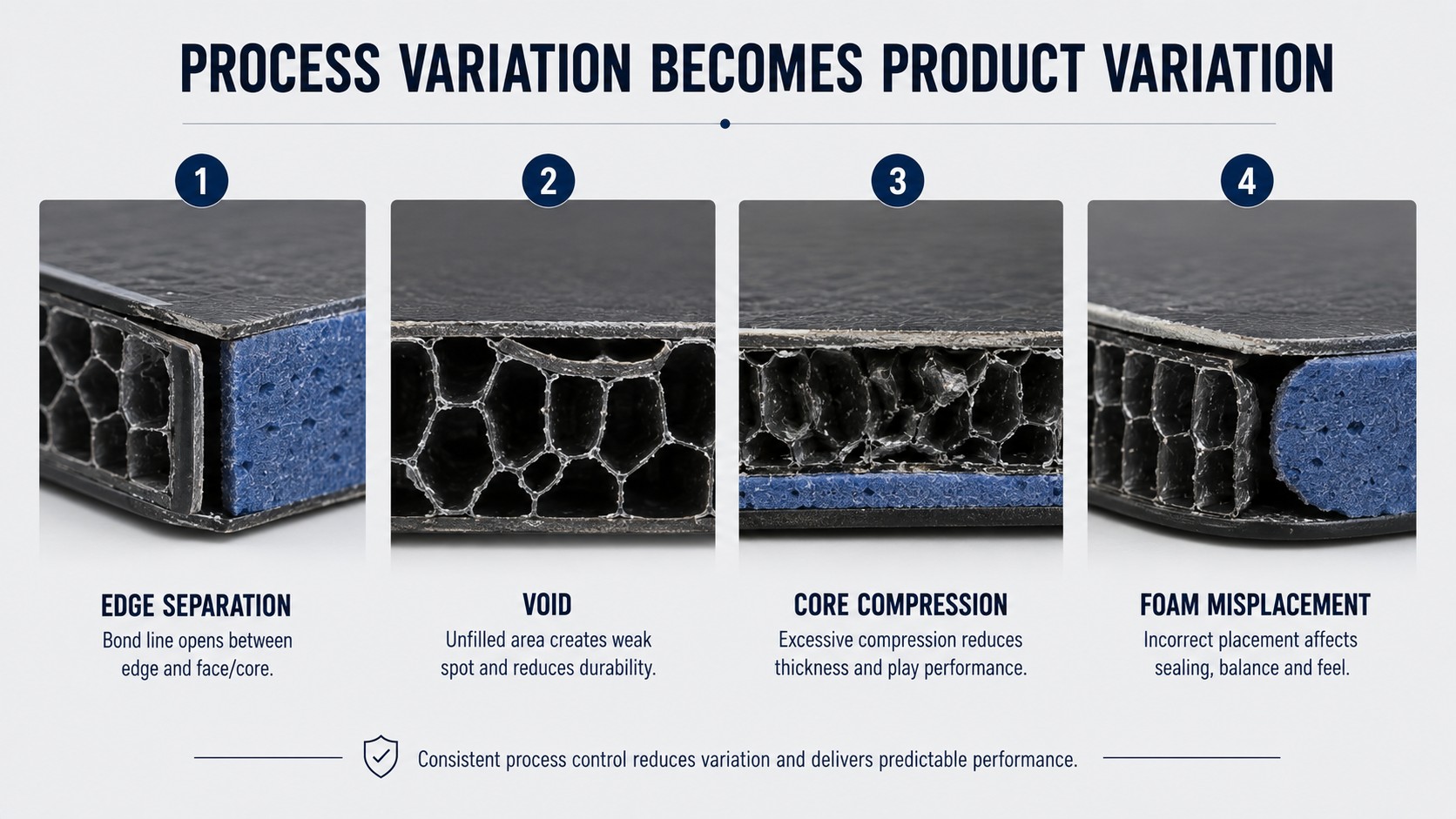
Diagnose Process Failure by the Internal Mechanism
- Face-to-core voids or incomplete bond
- Local core compression
- Edge separation
- Uneven structural wrap
- Foam misplacement or density variation
- Weight drift caused by uncontrolled resin or foam
- Surface distortion after cure
Treat Tooling Condition as Part of the Process
Even when the recipe is unchanged, mold wear, release condition, pressure distribution and fixture alignment can change the result. Maintenance records and first-piece checks are therefore part of a stable thermoforming system.
When a product suddenly drifts in thickness, edge definition or weight, inspect tooling and fixtures before assuming the material is the only cause.
Prove Repeatability Through Pilot Production, Records and Change Control
A prototype can be hand-selected and carefully managed. A pilot run tests whether normal operators, tooling and materials can reproduce the construction repeatedly.
Measure multiple units for dimensions, static weight, balance, thickness and relevant functional tests. Section retained units if the internal structure is a critical risk.
Keep the approved golden sample and pilot samples. When a material, adhesive, foam, tooling condition or process changes, compare against the retained reference and revalidate affected properties.
A useful pilot record can include material lots, mold/fixture identification, operator or line, major process parameters, finished weight, thickness, balance and nonconformities. For critical structures, add cross-section photos from retained units.
This record becomes the baseline for later production orders and gives the team something objective to compare when a complaint appears months later.
Build a Process Evidence Chain From Prototype to Production
A thermoforming article becomes more defensible when every important statement points to a physical or documentary checkpoint. The evidence chain should begin with the approved stack and end with production samples traceable to the same version.
USA Pickleball’s current equipment guidance says manufacturers are responsible for keeping production units consistent with certified samples, that market samples may be inspected and that lifecycle compliance matters. That makes silent changes to materials, surface or construction a real product-control risk.
The exact certification consequence of a change depends on the governing program and the change itself. The manufacturing system should nevertheless be able to show what changed, when it changed and how the revised product was reviewed.
| Stage | Evidence to Keep | What It Proves |
|---|---|---|
| Approved stack | BOM / layup / cross-section / version | What construction was approved |
| Process window | Controlled work instruction; sensitive values may stay internal | That forming is a defined process, not operator memory |
| First-off | Dimensions / weight / visual section / surface | That tooling and setup produced the intended build |
| Pilot lot | Multi-unit inspection + retained units | Repeatability under normal production |
| Change event | Change request + revalidation record | Which variable changed and whether it was reviewed |
Connect OEM Due Diligence With Certification Planning
- Which parts are thermoformed together?
- Which steps are separate hot-press or secondary assembly operations?
- What is the perimeter architecture?
- Where is foam placed, and how is it controlled?
- How are temperature, pressure and time monitored?
- What requires customer approval before change?
- Can the supplier show pilot-run inspection data?
If a certified or approved paddle is modified after testing, the brand should understand whether the change affects the submitted construction. This is especially important for face layup, core, surface, perimeter structure or any variable that can influence regulated performance.
Freeze the production-intent construction before spending heavily on packaging and launch inventory.
Do not buy the word “thermoformed.” Buy a defined construction with a controlled process, evidence from multiple samples and clear change control.
FAQ
Does thermoformed automatically mean more power?
No. Construction, geometry, mass distribution, core, face and surface all contribute to paddle behavior.
What is pseudo hot press?
It is an informal industry term, not a universal technical standard. Ask for the actual process sequence.
Why cut open prototype paddles?
Cross-sections reveal internal bond coverage, core condition, foam placement and edge architecture.
Can foam injection be part of a thermoformed paddle?
Yes, but the material, location, amount and timing depend on the construction.
What should be frozen before mass production?
BOM, stack-up, critical materials, foam/edge architecture, process controls, dimensions, tolerances, golden sample and change-control requirements.
The End about Mayvoci
1)Design:Over 100 paddle designs and photography service to assist start-up.
2)Professional:Focus on various of paddles manufacturing for 6 years
3)Quality:Strict quality management system to provide safety and satisfaction for customers
4)Amazon:Flexible comprehensive solution to make sure each Amazon seller is well cared.
5)Excellent Team:Experienced paddle experts & dynamic sales team give you 5-star service



We wrote this because we kept seeing the same gap: suppliers say “thermoformed,” but buyers have no shared language to verify what that actually means.
So instead of just listing best practices, we want to hear from people who’ve lived this:
💬 If you could ask your paddle supplier ONE question about their thermoforming process — and get an honest answer — what would it be?
(No wrong answers. Whether it’s about foam placement, edge wrap continuity, pilot repeatability, or something we didn’t even cover — we want to know what keeps you up at night.)
We’ll compile the top questions + our team’s take in a follow-up post. 👇