
Experience in tennis, footwear or other sporting goods can be valuable when a company enters pickleball. Materials knowledge, ergonomics, athlete insight, sourcing and brand development can all transfer.
What does not transfer automatically is the assumption that a company that makes an excellent product in one sports category already understands the failure modes, process variables and compliance requirements of a pickleball paddle.
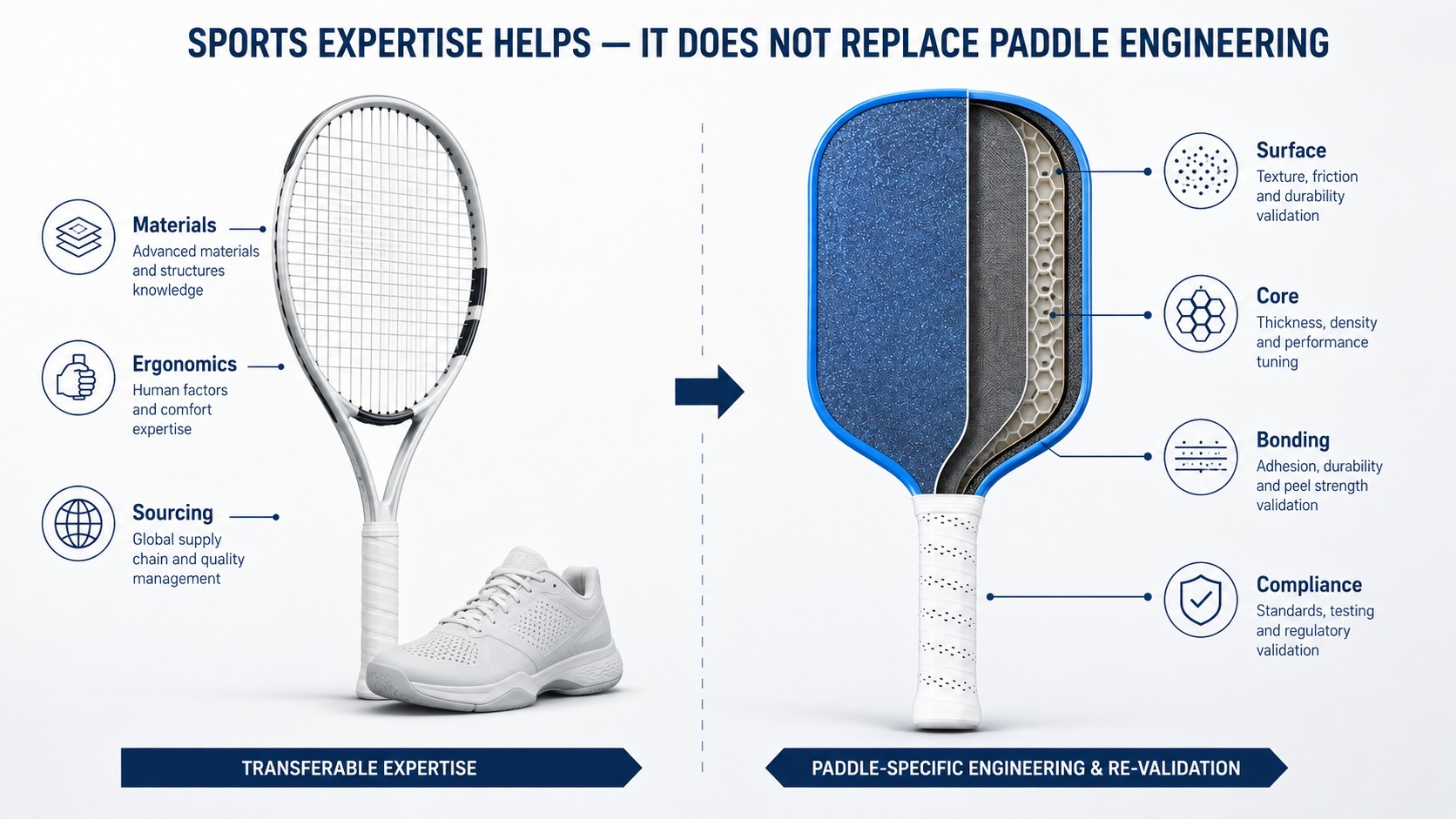
Cross-Sport Expertise Helps—but It Is Only a Starting Advantage
A tennis-racket team may understand composite materials, grip ergonomics, mold development and athlete testing. A footwear team may understand foams, polymers, product segmentation and high-volume sporting-goods supply chains.
These capabilities shorten the learning curve. They are inputs—not proof that the final paddle engineering system is mature.
Tennis and Pickleball Use Different Structures, Contact Interfaces and Failure Modes
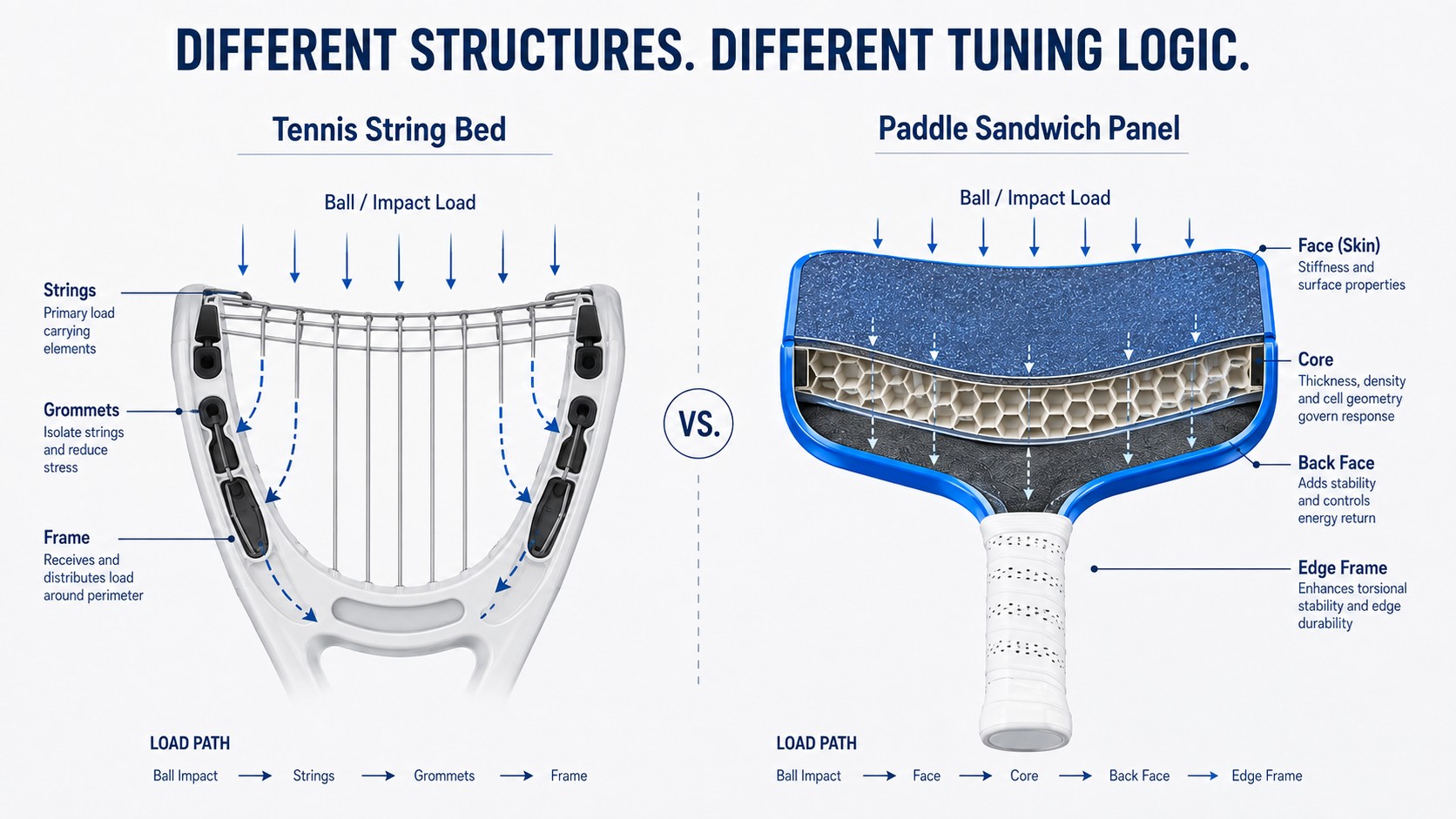
A tennis racket uses a string bed held by a frame. Ball response is strongly influenced by strings, tension, pattern, frame stiffness and their dynamic interaction.
A pickleball paddle usually uses a solid face bonded to a lightweight core. Load moves through a face-core-face sandwich structure and perimeter. Face stiffness, core support, bonding and mass distribution therefore create a different tuning problem.
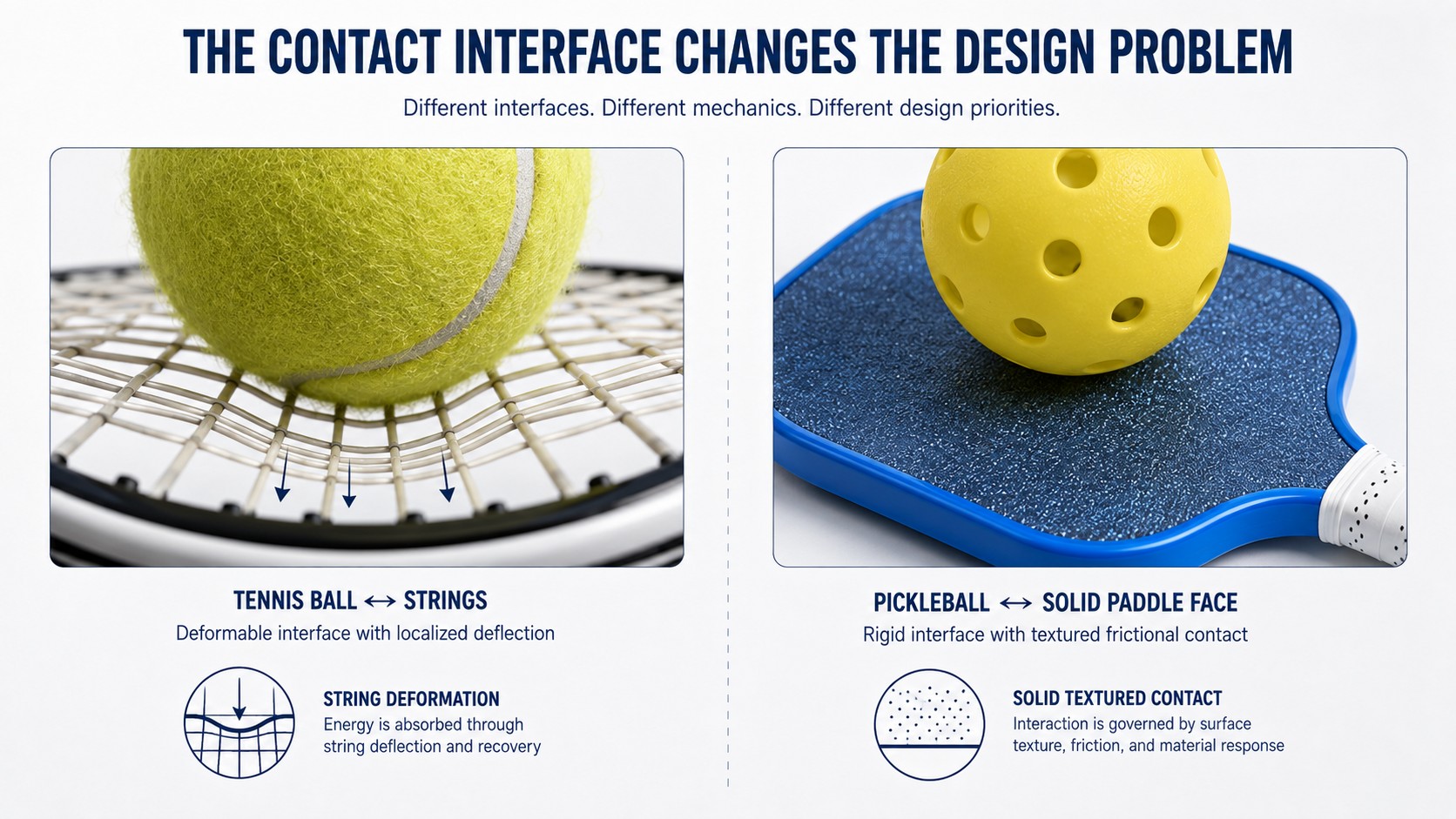
In tennis, the ball contacts strings. In pickleball, the ball contacts a solid surface whose texture, coating, resin condition and wear can influence friction.
That means surface manufacturing becomes a direct product-development and compliance issue.
PP honeycomb, foam and hybrid core systems create internal interfaces that are not equivalent to a strung racket. The paddle face must remain supported and bonded through repeated impact.
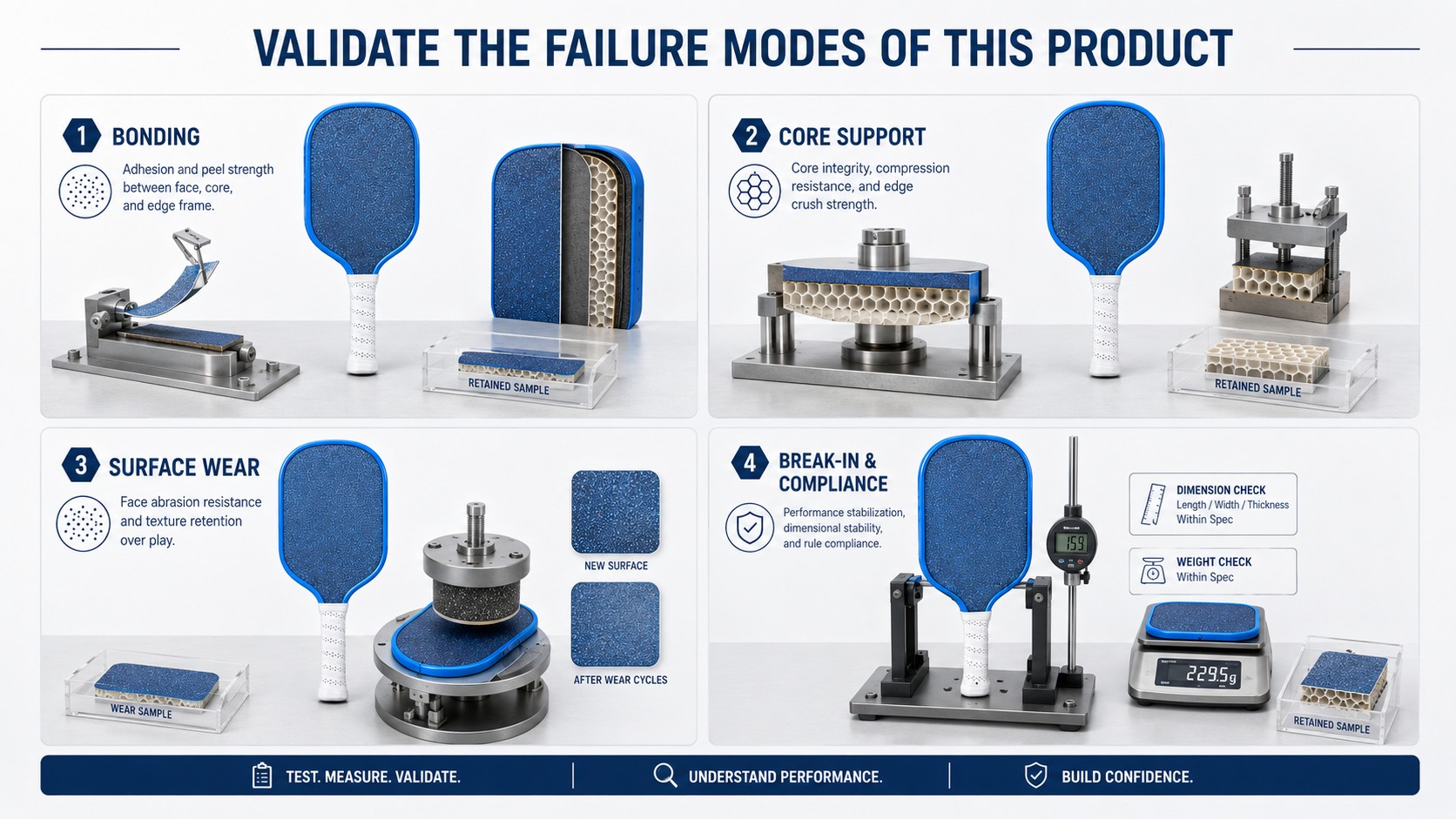
Core crush, delamination, voids, foam misplacement and edge separation require paddle-specific controls.
Some paddle constructions can change through repeated use as materials settle, bonds experience cycling or internal structures compress. A product that meets the target when new may behave differently after conditioning.
That creates a lifecycle testing problem.
Rule and certification systems define limits and test methods relevant to paddles. A product-development team must plan around the applicable governing body and market rather than adding an approval mark at the end.
Footwear, Famous Brands and General Sports Experience Still Need Paddle-Specific Proof
Shoes involve fit, outsole traction, cushioning, upper construction, flex and human movement. Foam expertise from footwear can inspire paddle materials, but a foam that works in a midsole is not automatically appropriate as a structural paddle core.
A famous sports brand can recruit strong engineers and learn quickly. But buyers should still evaluate the paddle itself: construction, test method, production consistency and warranty performance.
The same applies to OEM suppliers. A factory that produces carbon parts, tennis rackets or shoes has useful capabilities, but must still demonstrate paddle-specific control.
Transferable Expertise vs Paddle-Specific Revalidation
| Capability From Another Sport | What Transfers | What Must Be Revalidated for Pickleball |
|---|---|---|
| Composite engineering | Fiber/resin/tooling discipline | Solid face-core sandwich behavior and bond failure |
| Footwear foam knowledge | Polymer/foam literacy | Structural core role, bonding, fatigue and mass distribution |
| Athlete testing | Test-panel discipline | Pickleball-specific strokes and player jobs |
| Sports sourcing | Supplier/quality systems | Paddle process controls and hidden-component traceability |
| Brand strength | Launch resources and consumer trust | Actual paddle performance, durability and compliance |
What a Cross-Over Brand or Supplier Must Build
- A paddle-specific product brief and specification system
- Core and face material controls
- Surface process and wear validation
- Bonding and destructive inspection methods
- Mass-distribution targets
- Lifecycle/break-in testing
- Applicable compliance and version control
- Pilot production and retained-sample comparison
- Can you define the paddle’s full stack-up?
- Which variables are measured on every production lot?
- How do you inspect bond and core integrity?
- How does the surface change after wear?
- What changes after break-in?
- Which parts of the process are outsourced?
- What requires customer approval before change?
Transfer Methods, Not Assumptions
Strong cross-sport teams do not force old answers onto the new product. They bring their best methods—design of experiments, materials discipline, athlete testing and quality systems—and use them to learn the new failure modes faster.
A supplier can be highly capable at carbon bicycle parts, automotive panels or industrial laminates and still need to learn paddle-specific requirements. Existing composite expertise is valuable because the team understands fibers, resin, tooling and cure. But the relevant tolerances, impact pattern, surface contact and compliance path are different.
The buyer should reward transferable process discipline while still requiring paddle-specific evidence.
Cross-over teams learn fastest when they keep geometry constant and compare one variable at a time. For example, use the same paddle mold and core while comparing face layups, then keep the winning face while comparing surface processes. This prevents category knowledge from turning into uncontrolled experimentation.
The objective is not to prove that the new category behaves like the old one. It is to identify where the old methods remain useful and where new methods are required.
Translate the Language and Validate the New Product System
Marketing terms often migrate faster than engineering definitions. “Sweet spot,” “dwell,” “stiffness,” “energy return” and “control” may be used differently across tennis, footwear and pickleball. A cross-over team should define how each term will be measured or observed in the new product.
This prevents a familiar word from creating false confidence in a different physical system.
Do not reject cross-over brands or suppliers. Do not trust them automatically either. Evaluate whether the team can define, test and reproduce the variables that control a pickleball paddle.
FAQ
Can a tennis-racket manufacturer make good pickleball paddles?
Yes, but it must translate its composite and manufacturing expertise into paddle-specific core, surface, bonding, mass-distribution and compliance controls.
Does footwear foam expertise help with paddle cores?
It can help with material knowledge, but a footwear foam is not automatically suitable for a structural paddle application.
What is the main structural difference from tennis?
A pickleball paddle usually uses a solid face bonded to a lightweight core, while a tennis racket relies on a string bed and frame.
Why is surface engineering more direct in pickleball?
The ball contacts the solid paddle face itself, so surface texture, coating and wear are part of the contact interface.
What should buyers look for instead of brand reputation?
Product specification, process control, test evidence, lifecycle behavior, pilot consistency and change control.
The End about Mayvoci
1)Design:Over 100 paddle designs and photography service to assist start-up.
2)Professional:Focus on various of paddles manufacturing for 6 years
3)Quality:Strict quality management system to provide safety and satisfaction for customers
4)Amazon:Flexible comprehensive solution to make sure each Amazon seller is well cared.
5)Excellent Team:Experienced paddle experts & dynamic sales team give you 5-star service

Which skill transfers best from tennis to pickleball product development—and which one needs the most re-learning?