Pickleball “Gen 1,” “Gen 2,” “Gen 3,” “Gen 4” and “Gen 5” labels are widely used in product discussions, but they are not an official engineering standard.
That creates a problem: two brands can use the same generation label for different internal constructions.
The safest way to use generation terminology is as a rough historical shorthand—and then immediately describe the physical architecture.
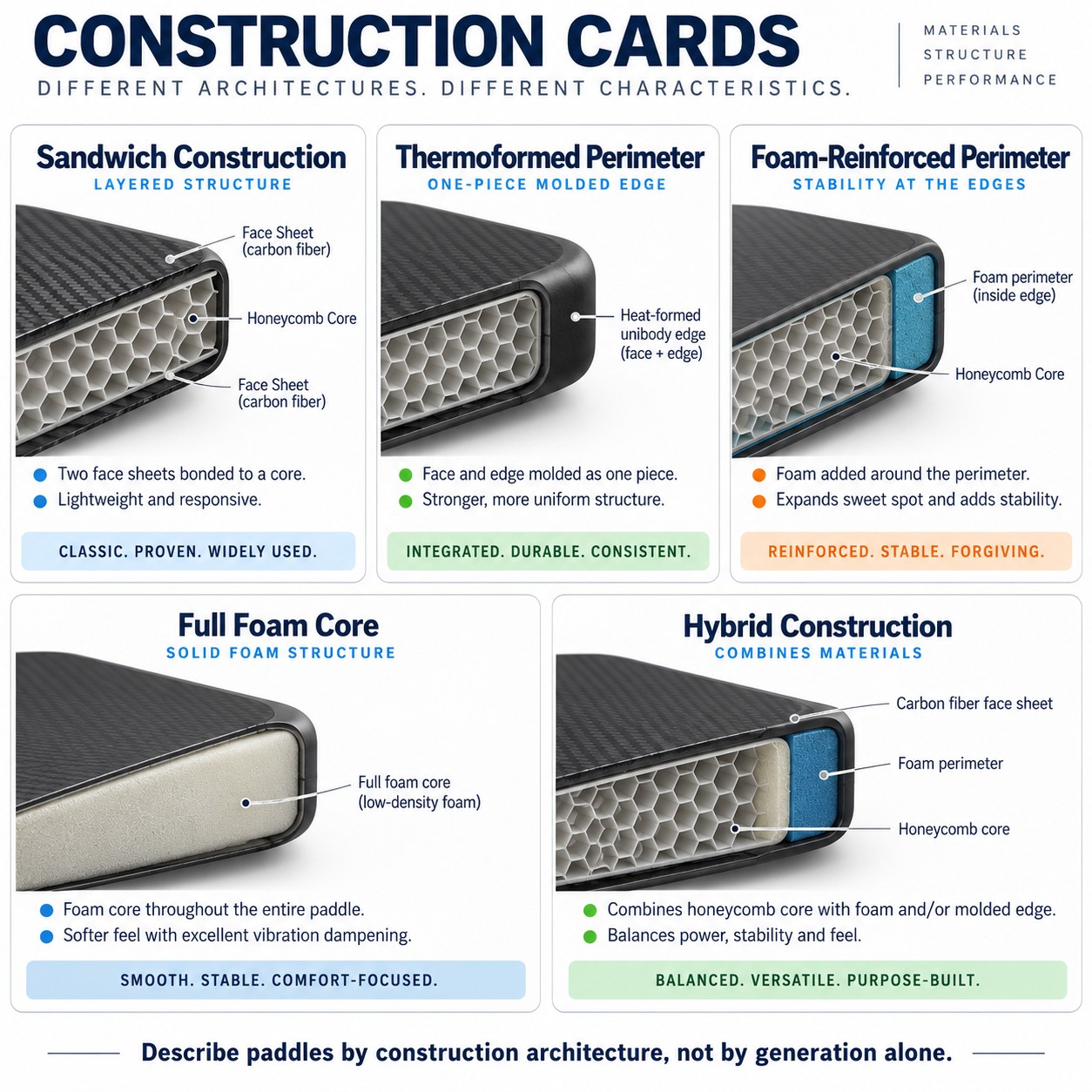
Treat ‘Generation’ Labels as Market Shorthand
Generation Labels Are Industry Shorthand
USA Pickleball equipment rules regulate dimensions, materials and performance; they do not define commercial Gen 1–5 categories.
Brands, reviewers and manufacturers created the generation language to describe broad shifts in construction.
Treat the label as navigation, not a specification.
Gen 1: Conventional Sandwich Construction
The typical Gen 1 description refers to face sheets bonded to a polymer honeycomb core with a conventional edge/handle structure.
There can still be major differences in face material, core thickness, cell size, adhesive, surface and mass distribution.
“Gen 1” does not mean low quality.
Gen 2: Thermoformed / Perimeter-Reinforced Direction
Gen 2 is commonly associated with thermoformed perimeter construction, carbon wrap or increased edge integration.
Exact definitions vary.
The engineering significance is the stronger connection between face, edge and perimeter support—not the number itself.
Gen 3: More Extensive Foam or Structural Tuning
Gen 3 is often used for honeycomb-based paddles with significant perimeter foam or additional structural tuning.
Again, the foam amount, location and process vary by brand.
Ask for a cross-section instead of assuming all Gen 3 paddles are equivalent.
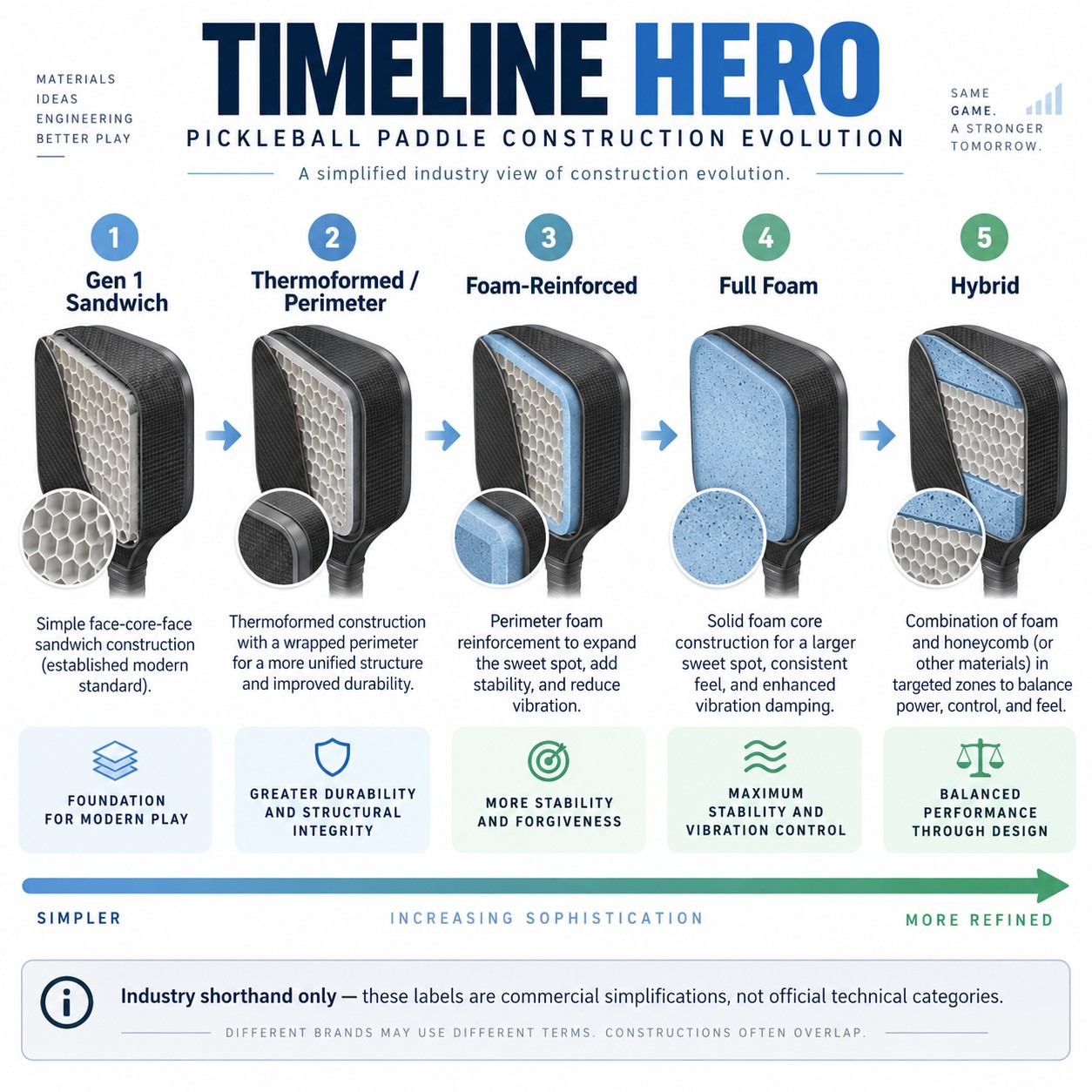
Map the Physical Construction Spectrum
Full Foam and ‘Gen 4’
Some brands use Gen 4 for full-foam or other post-honeycomb architectures. CRBN, for example, markets TruFoam around “4th Generation Technology.”
That is brand terminology, not an industry authority.
Describe the actual full-foam construction first.
Hybrid and ‘Gen 5’ Claims
Later generation labels increasingly become marketing territory.
Hybrid cores can combine honeycomb, foam, elastomers, inserts or multiple densities.
A “Gen 5” label is meaningless without a physical construction description.
Why the Labels Still Have Value
Generation language helps consumers discuss historical trends quickly.
It becomes useful when paired with concrete terms: thermoformed perimeter, full foam, hybrid core, carbon wrap, edge reinforcement and surface process.
Use both layers in article titles and product education.
OEM Classification Rule
For every paddle, create a construction card showing face stack, core, perimeter, handle, forming process and surface.
The generation label can be a secondary field.
This prevents marketing terminology from replacing the BOM.
Compare Trade-Offs Instead of Ranking Generations
A Better Way to Compare ‘Generations’
Instead of asking whether Gen 4 beats Gen 3, compare five physical fields: primary core, perimeter support, face-to-edge integration, forming process and handle structure. Add surface process as a sixth field because spin and wear can be independent of the core architecture.
This comparison works even when a brand uses completely different generation language.
Why Newer Is Not Automatically Better
A newer architecture can add cost, process sensitivity or weight. An older architecture can be highly refined, stable and appropriate for a volume product. Player preference also varies.
A technology timeline explains market evolution; it should not become a quality ladder. The engineering target is repeatable performance for a defined user.
How Brands Should Use the Terms in Marketing
If a product page uses “Gen 3” or “Gen 4,” follow it immediately with plain construction language. For example: honeycomb core with perimeter foam, or full-foam primary core.
That makes the claim understandable and reduces dependence on terminology that may change next season.
Practical Editorial / Decision Notes
Generation labels are useful navigation terms for consumers but weak engineering language. Two brands can both call a paddle “Gen 3” while using different foam, edge, face and forming architectures.
For manufacturing and certification, replace generation language with physical fields that can be frozen in the BOM and sample record.
Use Construction Language in Product Briefs
Paddle ‘Generation’ Decoder
| Market Term | Typical Description | What Must Still Be Defined |
|---|---|---|
| Gen 1 / conventional | Basic sandwich / cold-press shorthand | Actual face/core/edge/process |
| Gen 2 | Often perimeter / forming evolution | No universal industry definition |
| Gen 3 | Often thermoformed + perimeter foam shorthand | Exact construction varies |
| Full foam / hybrid | Architecture description | Foam type / location / face / process |
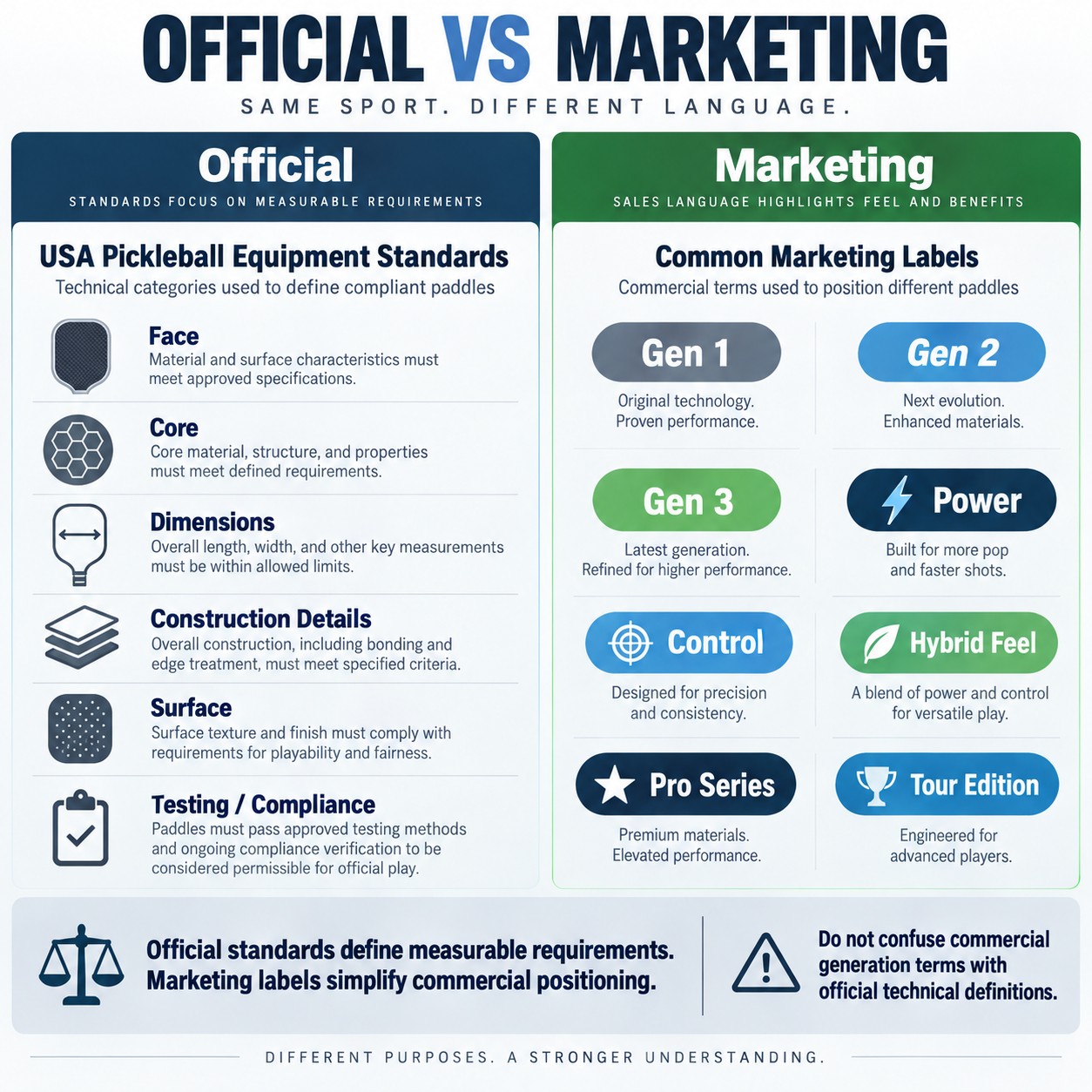
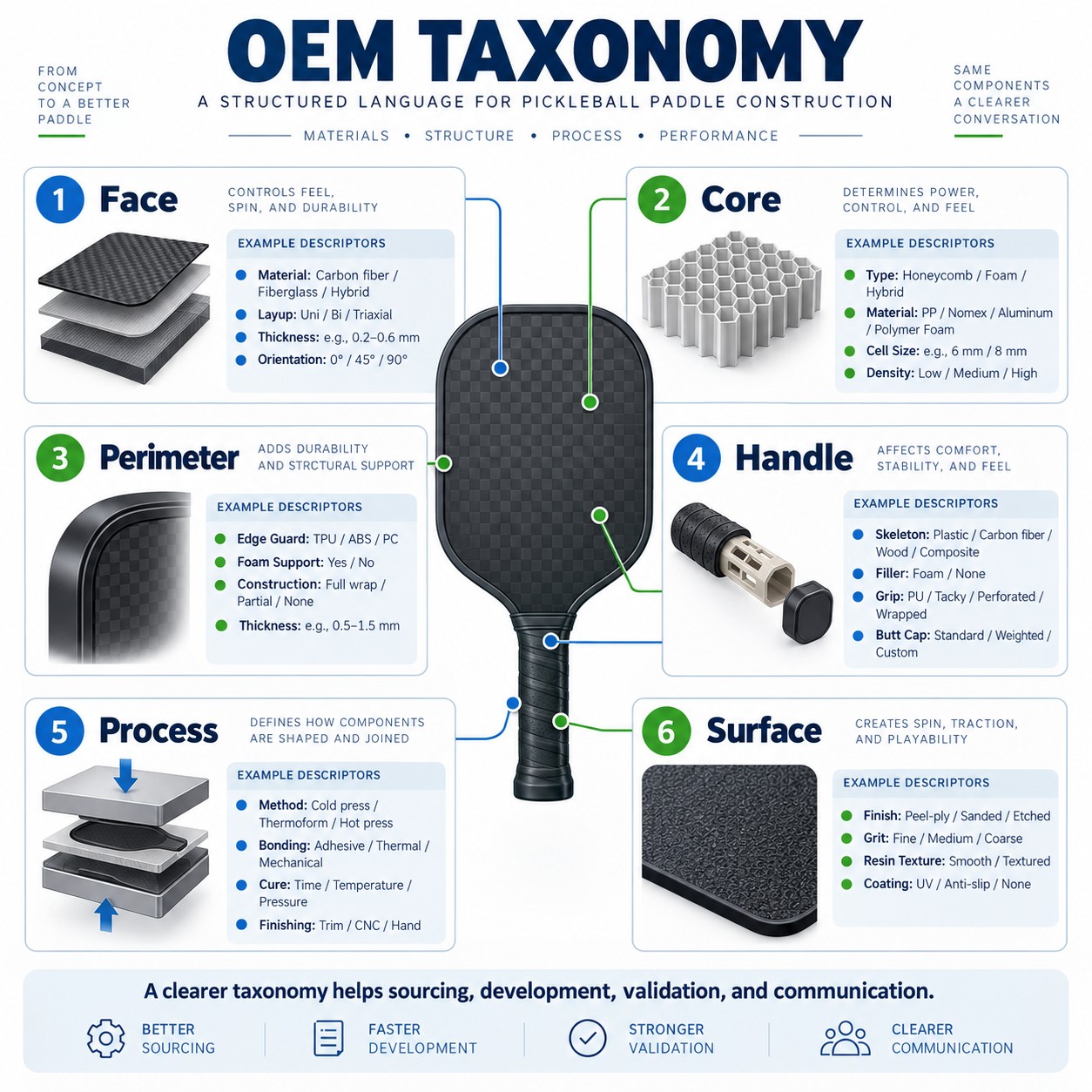
Use Physical Construction Language in the BOM
Generation labels can help consumers navigate the market, but they should never replace engineering fields. “Gen 3” is not a material, process window or test method.
For product development, record the primary core, perimeter support, face-to-edge integration, forming route, handle construction and surface process. Marketing can still use a generation label as shorthand, but the factory and certification file should use physical language.
- Treat Gen labels as secondary metadata.
- Freeze actual construction fields in the product file.
- Do not rank newer generations as automatically better.
Frequently Asked Questions
Are Gen 1–5 official USA Pickleball categories?
No.
Is Gen 3 always better than Gen 2?
No. The labels describe broad construction trends, not quality rankings.
Is full foam always Gen 4?
Some brands use that language, but it is not standardized.
What should buyers compare instead?
Internal architecture, materials, process, mass distribution, validation and lifecycle behavior.
Can brands still use generation labels?
Yes, if they also explain the physical construction clearly.
Need to define a next-generation paddle clearly?
Mayvoci can help convert market terminology into a physical construction brief that a factory can actually control.
The End about Mayvoci
1)Design:Over 100 paddle designs and photography service to assist start-up.
2)Professional:Focus on various of paddles manufacturing for 6 years
3)Quality:Strict quality management system to provide safety and satisfaction for customers
4)Amazon:Flexible comprehensive solution to make sure each Amazon seller is well cared.
5)Excellent Team:Experienced paddle experts & dynamic sales team give you 5-star service