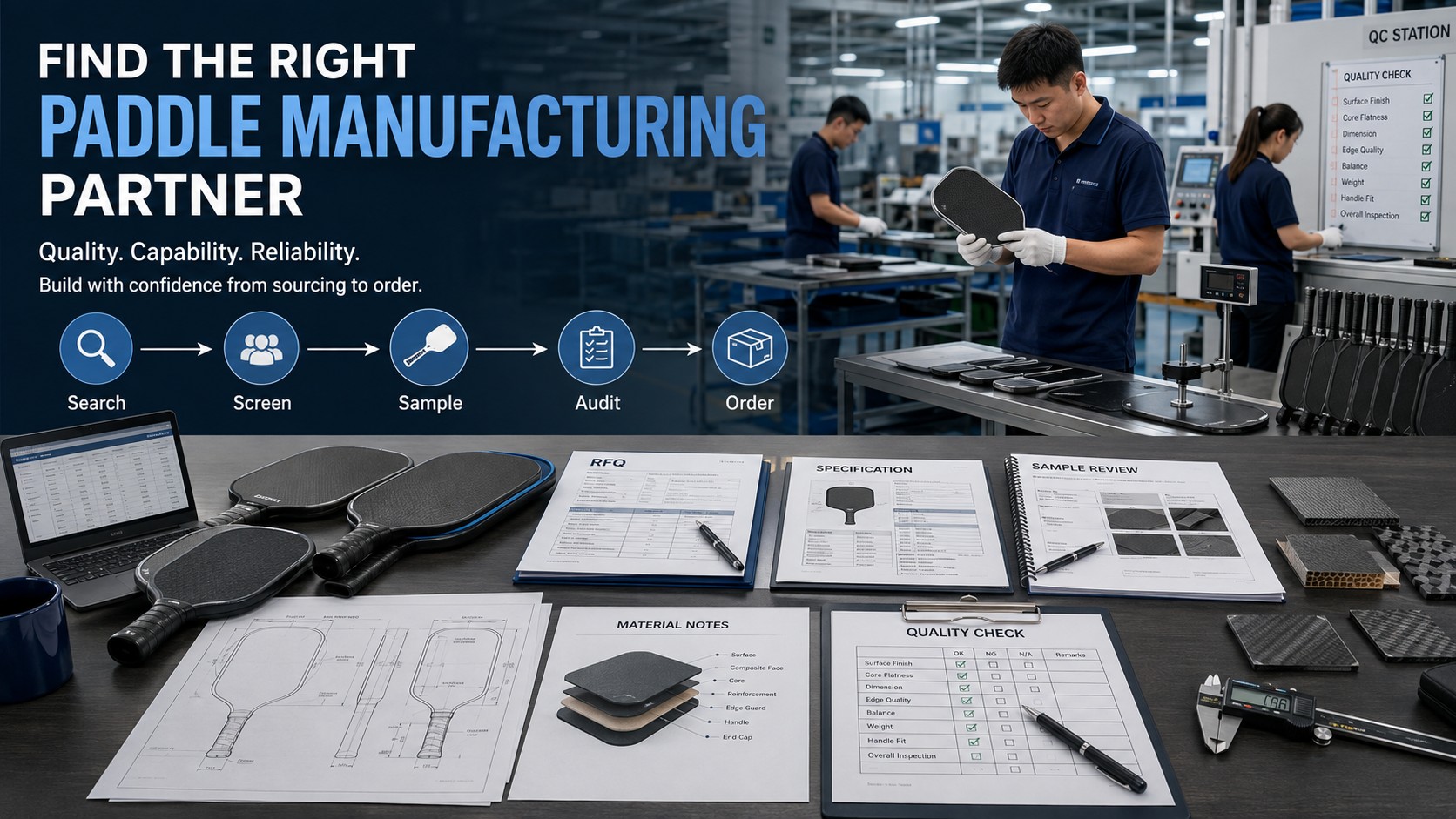
Finding a pickleball paddle supplier in China is easy. Finding a supplier that can turn a product brief into a repeatable, documented production system is much harder.
For a brand owner, distributor, Amazon seller or sporting-goods buyer, the right question is not simply, “Which factory has the lowest price?” A more useful question is: Which supplier can control the parts of the project that matter to my product, prove that control with evidence, and respond correctly when a specification changes?
That distinction matters because a paddle is a composite product. Face material, core, adhesive, perimeter construction, surface process, handle assembly, artwork, packaging and final tolerances all interact. A supplier can produce an attractive first sample and still struggle with lot-to-lot consistency.
Start With a Product Brief That Makes Quotes Comparable
Before searching for a manufacturer, define what the supplier will actually be responsible for. A basic private-label project using an existing mold, stock core and standard grip is very different from a new thermoformed platform with custom geometry, foam placement, a controlled surface process and certification targets.
A useful RFQ should identify the target player, paddle shape, thickness, approximate weight range, face construction, core concept, surface requirement, grip and handle needs, artwork, packaging, expected order volume, target market and required testing. If some variables are still open, say so explicitly and ask the supplier to propose options rather than allowing silent substitutions later.
This prevents a common sourcing mistake: comparing quotes for products that only look similar on the outside.
Find Suppliers and Choose the Right Responsibility Model
Brands normally build an initial supplier list through several channels rather than relying on one platform. B2B marketplaces can be useful for discovery, Google can surface independent manufacturers and specialist suppliers, trade shows can accelerate face-to-face qualification, and referrals can help identify experienced teams.
The discovery channel is not proof of capability. A verified profile, attractive website or large product catalog is only a lead. Qualification starts after the first contact.
Instead of sending “Please quote your best price,” send a structured brief and compare how suppliers respond. A capable supplier should ask questions about construction, target use, artwork, testing, volume and timeline.
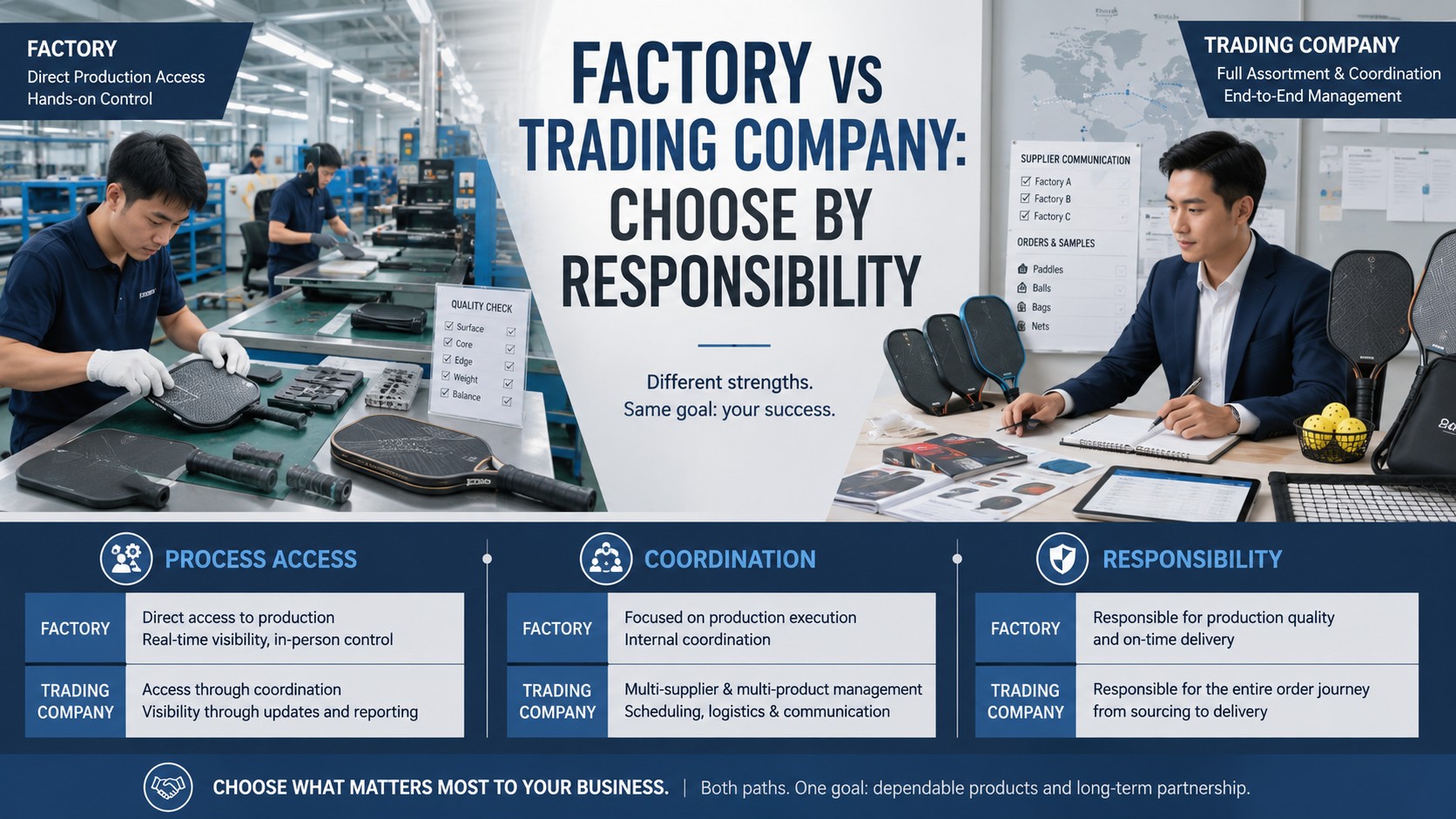
“Direct factory” is not automatically better, and “trading company” is not automatically worse. The right structure depends on what needs to be controlled.
A direct paddle factory can be valuable when the project requires close access to lamination, forming, surface treatment, assembly, tooling, process trials and root-cause analysis. A trading company or integrated sourcing partner can be useful when one program combines paddles, balls, bags, nets, packaging and other items produced by different specialist factories.
The practical test is responsibility. Ask: Who owns the BOM? Who approves material substitutions? Who keeps the golden sample? Who controls artwork versions? Who signs off on corrective actions? Who is responsible when the product shipped is different from the approved sample?
Screen Capability With Evidence Before Sampling
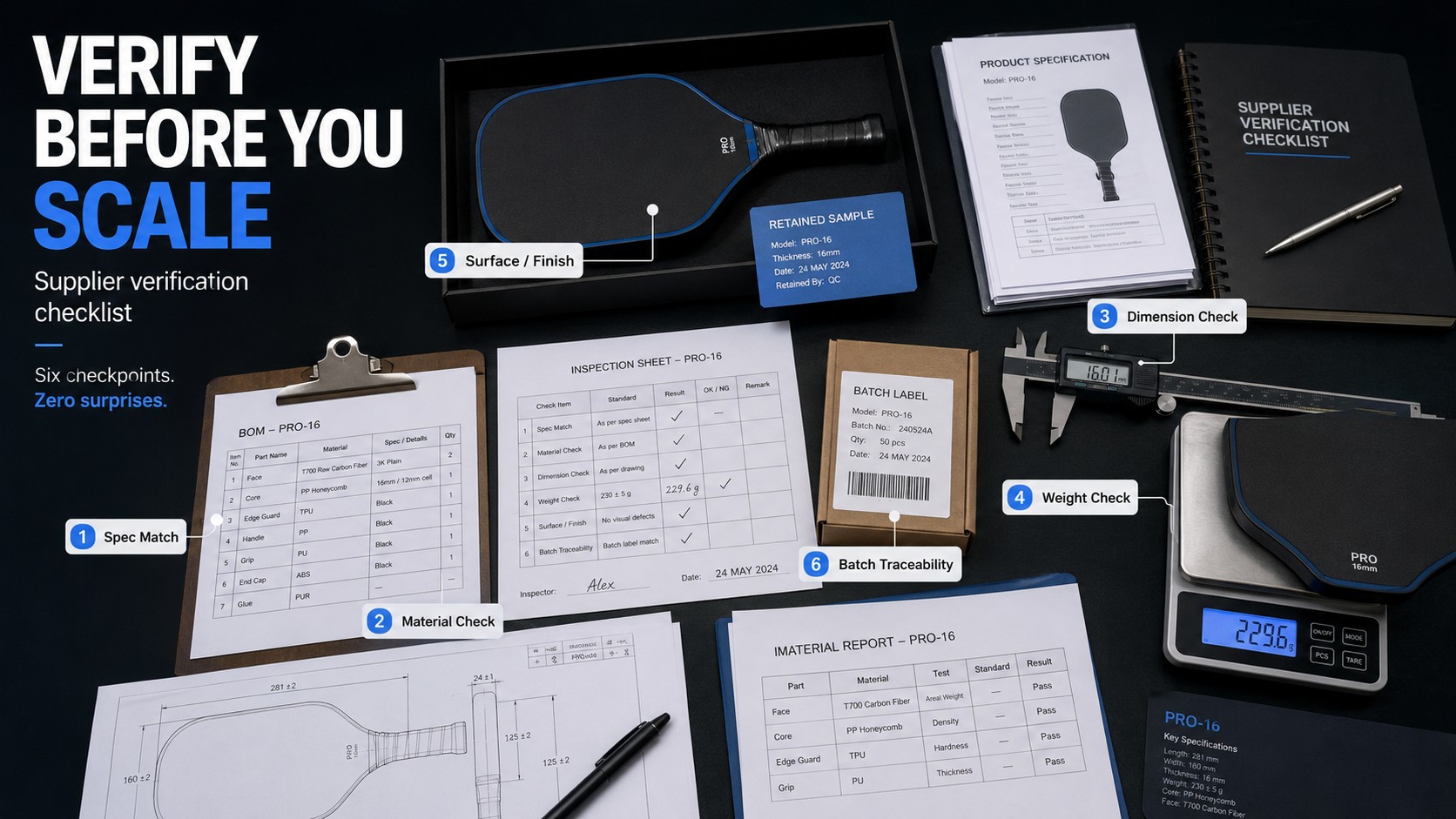
- Product fit: Does the supplier already work with comparable paddle constructions?
- Process access: Which operations are performed in-house and which are subcontracted?
- Material control: Can the supplier identify face, core, foam, adhesive and grip materials by controlled specification?
- Tooling: Who owns and maintains molds, trimming fixtures and process tooling?
- Quality system: Are incoming, in-process and final inspection records actually used?
- Traceability: Can finished samples be linked to a material lot or production batch?
- Change control: What happens if a material supplier, adhesive, surface system or process setting changes?
A sourcing team should collect enough information to understand whether the supplier can support a controlled development project. Depending on the product and market, this can include company information, process flow, sample inspection records, material specifications, test reports, quality procedures, capacity information and examples of version-controlled artwork or BOM documents.
Do not treat certificates as a substitute for product evidence. A management-system certificate can be useful context, but it does not prove that one specific paddle construction is stable.
Supplier Evaluation Scorecard
| Criterion | What Good Evidence Looks Like | Why It Matters |
|---|---|---|
| Product/process fit | Comparable constructions, process flow, sample records | Reduces the risk of learning your architecture during mass production |
| Material control | Named/controlled face, core, foam, adhesive and grip specifications | Prevents silent substitutions |
| Sample discipline | Version records, production-intent sample, retained golden sample | Separates prototype success from repeatability |
| Factory system | Incoming/in-process/final records, traceability, CAPA | Shows the supplier can control normal production |
| Commercial fit | MOQ, lead time, payment, capacity and communication aligned to the project | A technically strong factory can still be a poor business fit |
Use Samples and Factory Audits as Two Different Proofs
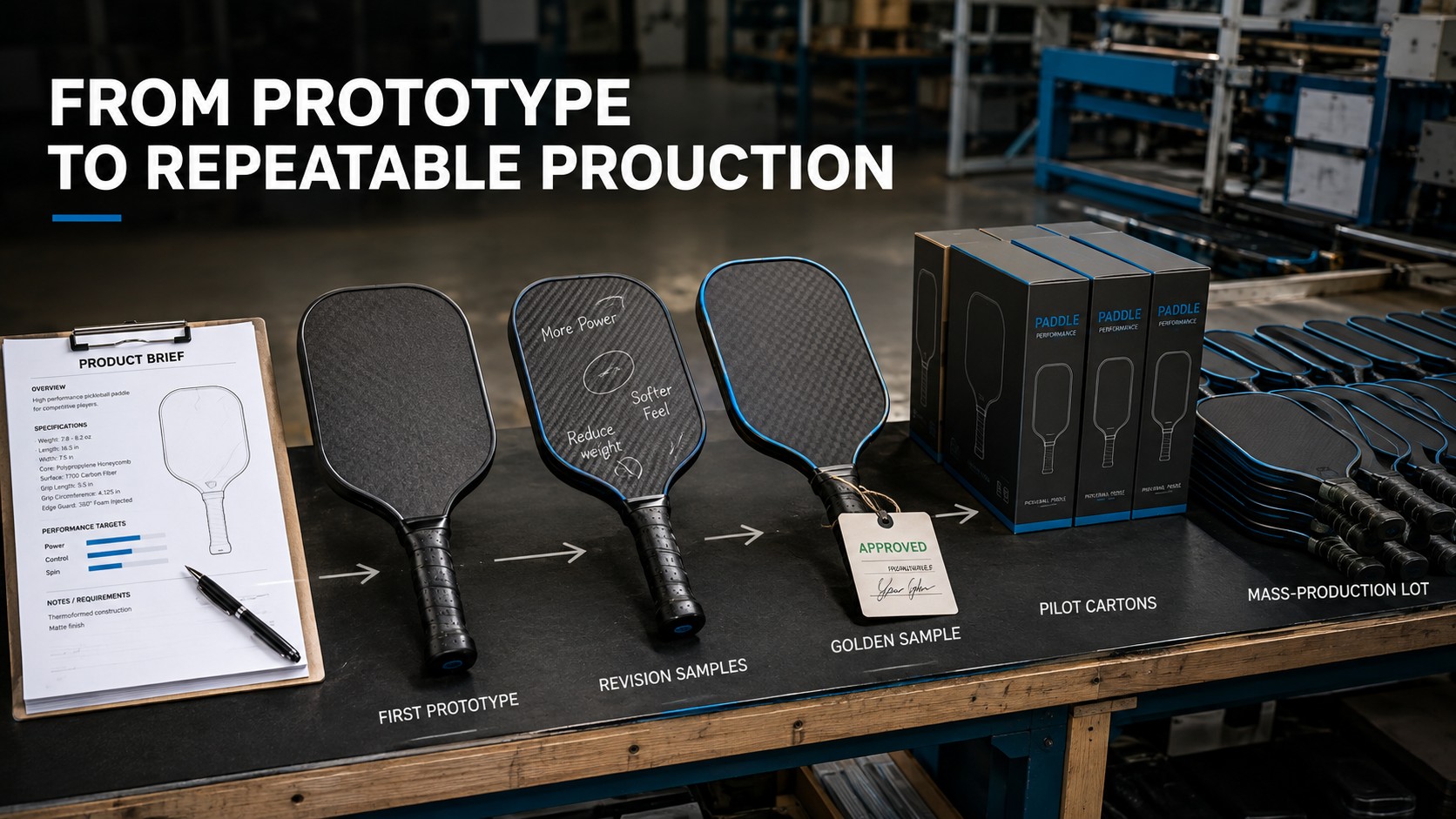
A first sample is not a golden sample. Treat sampling as a sequence. Prototype: proves that the concept can be built. Revision samples: isolate changes. Production-intent sample: uses the intended materials, tooling and process. Golden sample: becomes the approved physical reference. Pilot run: checks whether the supplier can reproduce the result across multiple units.
Record each sample version. If several variables change at once, the team may like the new sample without knowing why it improved—or why the next batch changes again.
For a larger or higher-risk program, an audit should verify material receiving, storage, tooling, forming or lamination, surface process, assembly, inspection, traceability, retained samples, equipment maintenance and corrective action.
Ask for records, not only explanations. “We check every paddle” is different from showing what is checked, the tolerance, the sampling plan, how the result is recorded and what happens when it fails.
Build a Supplier Verification Evidence Pack
A sourcing article becomes much more credible when the buyer can see what “verification” means in practice. The evidence pack should connect the sales conversation to the physical factory and to the records behind the sample.
For a paddle supplier, a useful pack can include legal company identity, live production-area evidence, material-lot identification, sample revision history, a real inspection form, retained samples and a named engineering or quality owner. No single item proves perfect quality; the combined trail reduces ambiguity.
The editorial distinction is simple: “We control materials” is a claim. A dated incoming-material record tied to a lot is evidence. “We can customize thermoformed paddles” is a claim. A production-intent sample, cross-section and controlled process record are stronger evidence.
| Buyer Question | Weak Answer | Better Evidence | Useful On-Page Asset |
|---|---|---|---|
| Do you make this construction in-house? | “Yes, we are a factory.” | Live process view + equipment + responsible team | Factory process photo/video |
| Can you control the specified core/face? | Material marketing name only | Supplier/material code + incoming lot record | Material label + incoming QC sheet |
| Will production match the sample? | “Same quality.” | Revision record + golden sample + pilot inspection | V1/V2/V3 + approved sample |
| Can you investigate a complaint? | Generic QC certificate | Lot traceability + retained sample + corrective action | Retained sample / CAPA example |
Score Suppliers, Identify Red Flags and Control the First Order
A practical scorecard can weight technical fit, quality control, communication, sample accuracy, change control, lead time, commercial terms, capacity and risk. Price should be one factor, not the scoring system.
For an early-stage brand, a slightly higher unit price from a supplier that can handle low-volume development and controlled changes may create lower total risk. For a mature volume program, capacity, yield, process stability and continuity can become more important.
- The supplier cannot explain the actual construction behind a marketing material name.
- The BOM changes between sample rounds without documented approval.
- Only one “perfect” sample is available for evaluation.
- Weight, thickness or balance varies significantly but no one investigates.
- The supplier will not show which steps are subcontracted.
- Artwork files and packaging versions are not controlled.
- Testing is discussed only as a certificate, not as a product-development process.
For a new supplier relationship, reduce the number of uncontrolled variables. Use a clear product brief, approve a golden sample, run a manageable pilot or first production lot, define inspection criteria and document what requires written approval before change.
The goal of sourcing is not to find the factory that can make one good paddle. It is to find the manufacturing partner that can reproduce the product you approved—and explain why it remains the same.
FAQ
Is a direct factory always cheaper than a trading company?
No. Total cost also depends on coordination, order complexity, quality, consolidation, rework and risk.
How many suppliers should I sample?
There is no universal number. Shortlist enough suppliers to compare capability and communication, then reduce the list quickly.
What should I freeze before mass production?
BOM, approved materials, geometry, artwork, colors, key dimensions and tolerances, surface requirement, grip, packaging, golden sample and change-control rules.
Can a factory audit replace sample testing?
No. An audit checks the manufacturing system; samples and pilot production check the product.
What is the biggest sourcing mistake?
Comparing unit prices before defining what each quote actually includes and which product specification each supplier is pricing.
The End about Mayvoci
1)Design:Over 100 paddle designs and photography service to assist start-up.
2)Professional:Focus on various of paddles manufacturing for 6 years
3)Quality:Strict quality management system to provide safety and satisfaction for customers
4)Amazon:Flexible comprehensive solution to make sure each Amazon seller is well cared.
5)Excellent Team:Experienced paddle experts & dynamic sales team give you 5-star service