
Alibaba can generate a long list of potential pickleball paddle suppliers in minutes. The difficult part is not finding names. It is turning those names into comparable evidence.
A low quotation may come from a stock construction that does not match your brief. A polished supplier profile may still hide outsourced critical processes. A fast sample may not represent the material, tooling or process that will be used for mass production. Even platform protection only works within the terms of the actual order and cannot replace product engineering or supplier due diligence.
The practical goal is therefore to create a screening system that makes suppliers answer the same questions in the same format.
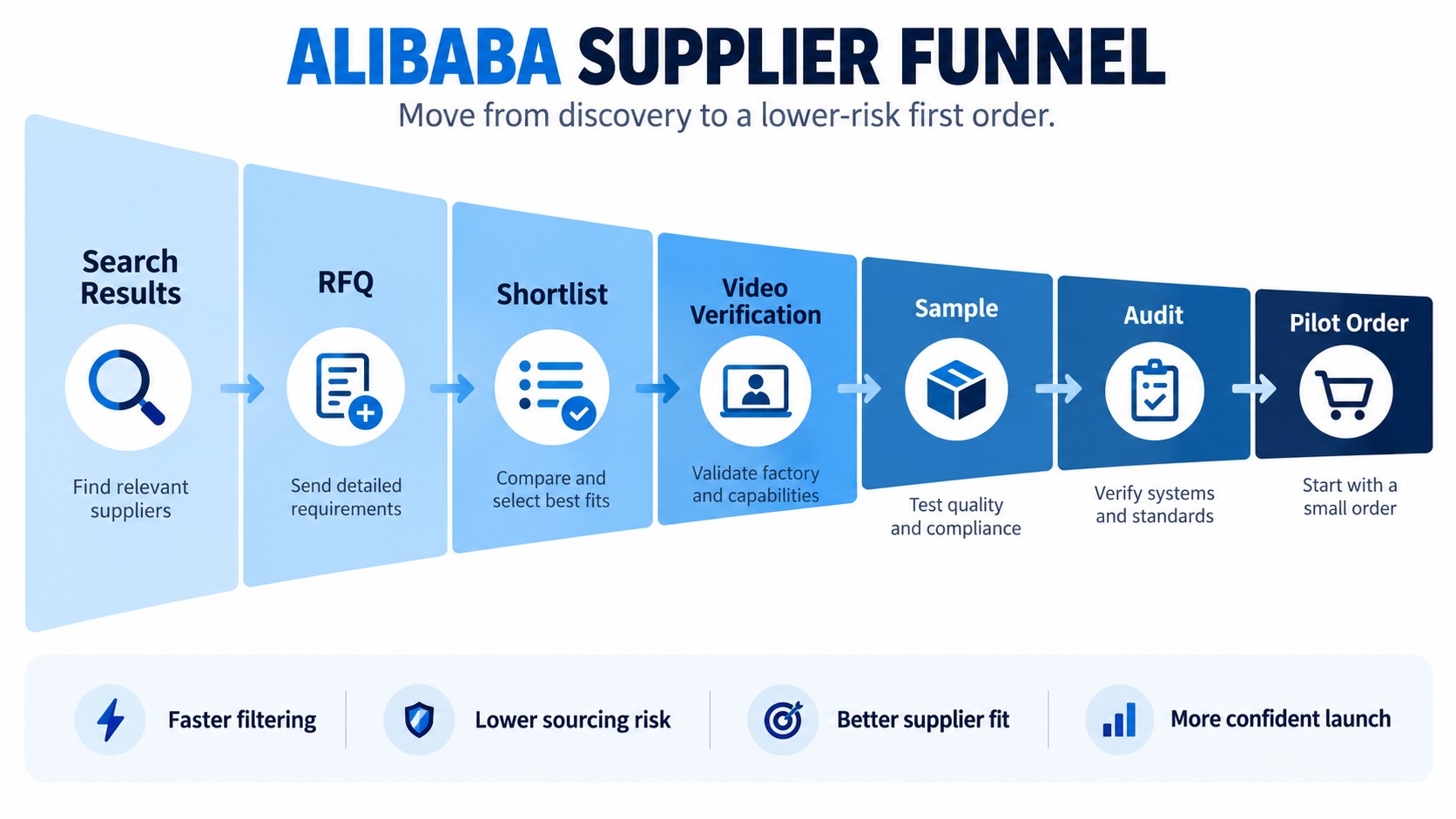
Build the RFQ Before Comparing Suppliers
Start With a Comparable RFQ
Do not send “Please quote your best price for a carbon pickleball paddle.”
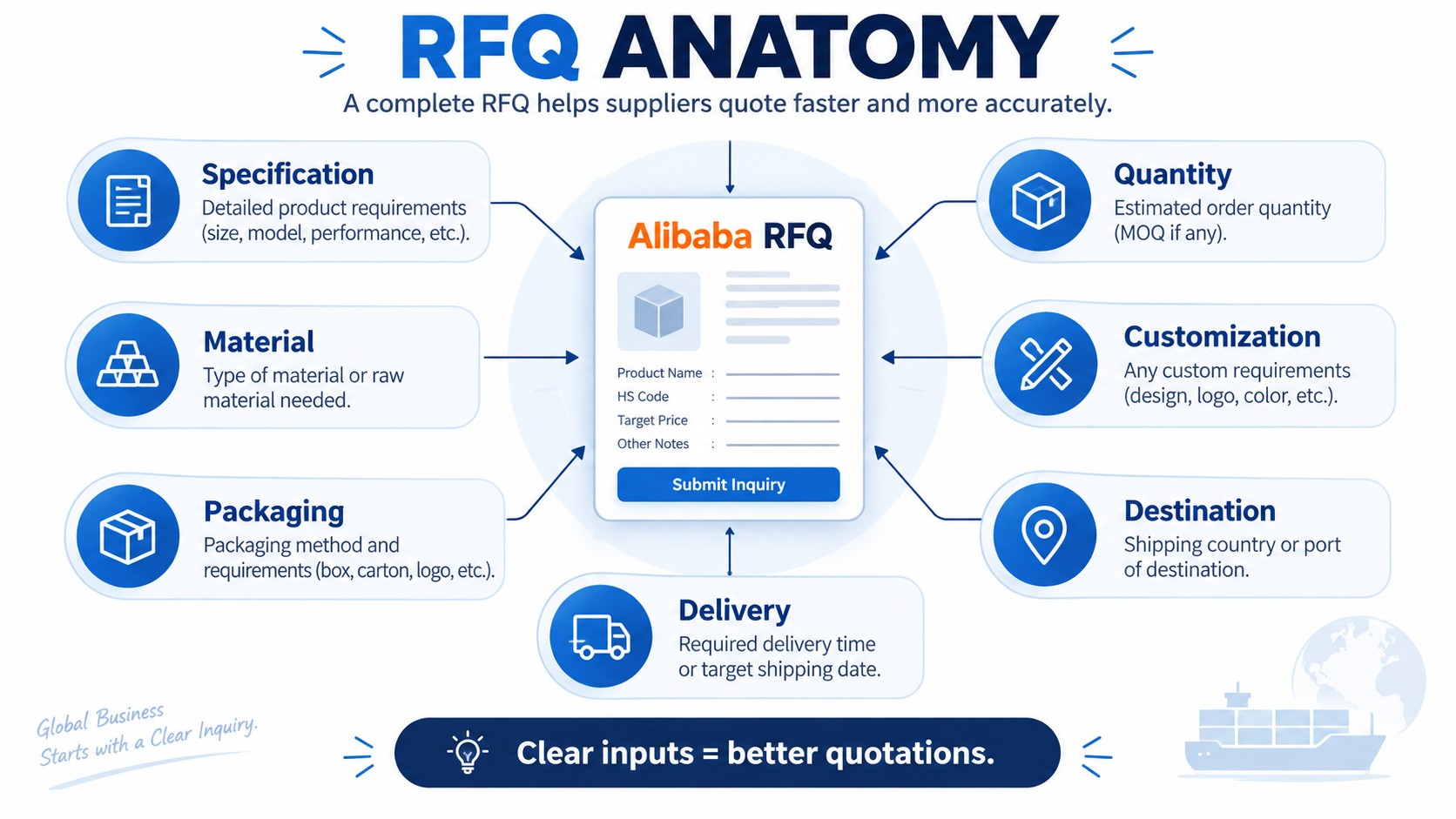
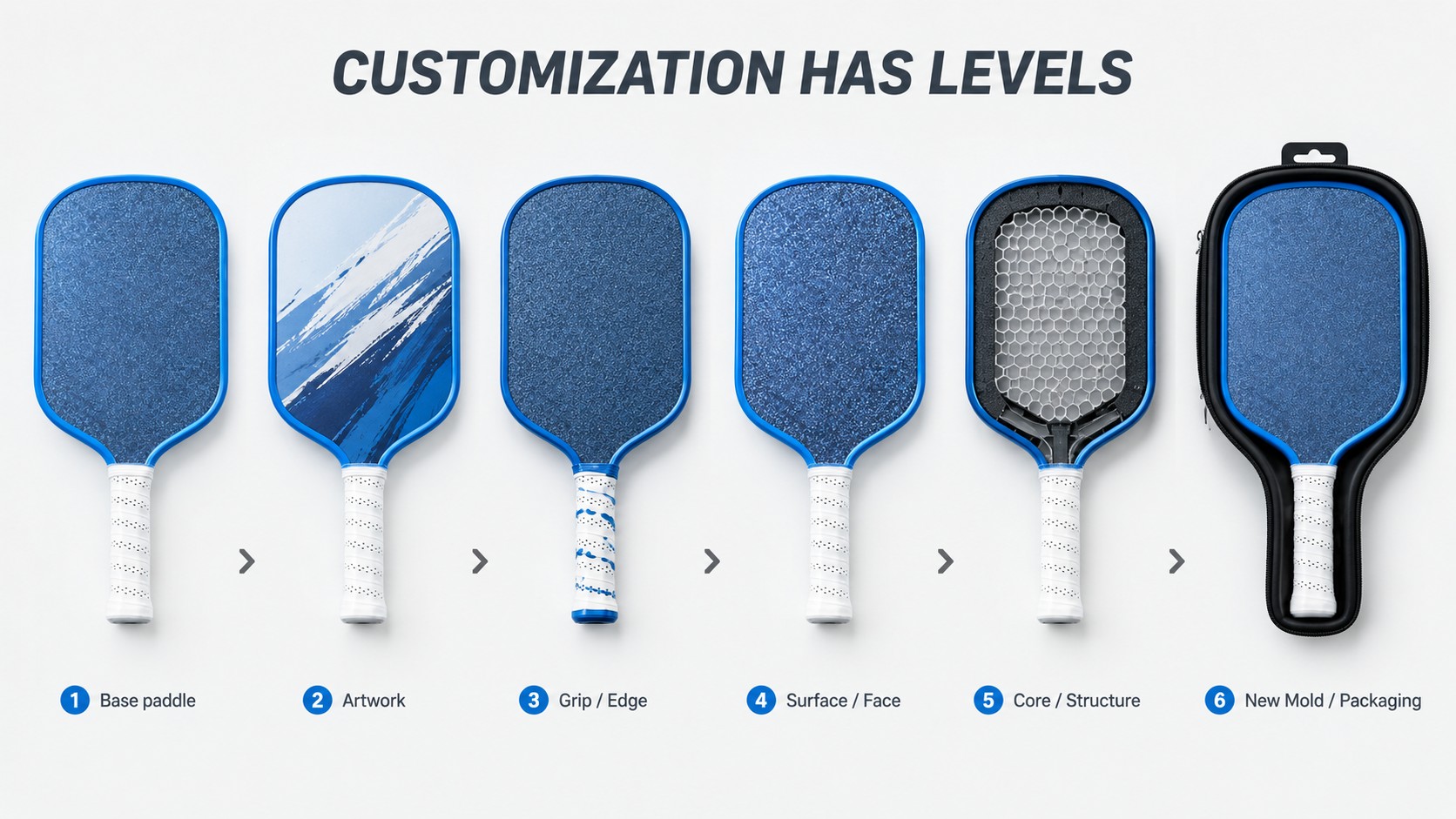
A useful RFQ defines the product and the commercial scenario. Include target shape and dimensions, thickness, face-material direction, core or construction concept, surface process, grip and handle requirements, edge guard, customization level, packaging, quantity, destination, certification target, sample needs and desired schedule.
When every supplier receives the same RFQ, you can compare quotations rather than compare sales messages.
If important specifications are still open, label them as open variables. That encourages useful engineering proposals without allowing each supplier to quote a completely different product.
Separate Product Fit From Company Profile
Supplier screening should have two layers.
The first layer asks whether the company can build the product: relevant paddle constructions, tooling, face materials, core processing, thermoforming or cold-press capability, surface processing, sample development and quality control.
The second layer asks whether the company itself is a suitable business partner: legal identity, export experience, communication, change control, production ownership, complaint handling and financial or transaction reliability.
A company can look credible but be technically unsuitable for your project. A technically capable factory can also be a poor business partner if communication and change control are weak.
Treat Platform Badges as Signals, Not Proof
Alibaba profile information, years on platform, third-party verification and transaction history can help you prioritize suppliers. They should not become the final decision.
A badge cannot tell you whether the factory controls your exact honeycomb core density, surface process, edge construction or weight tolerance. It also cannot confirm that the sample room and production floor use the same process.
Use platform signals to decide whom to investigate further, then request product-specific evidence.
Use Trade Assurance Correctly
Alibaba describes Trade Assurance as a purchasing protection system that supports secure payment, order protection and dispute mediation for issues connected to the transaction.
That is valuable, but the protection is only as useful as the order specification. If the purchase order says only “T700 pickleball paddle” and does not define weight, surface, artwork, packaging, material source or acceptance criteria, a later dispute becomes harder to evaluate.
Put measurable requirements, approved artwork, delivery terms and inspection expectations into the platform order and related documents. Do not treat Trade Assurance as a substitute for inspection, testing or a clear specification.
Verify Supplier Capability and Evidence
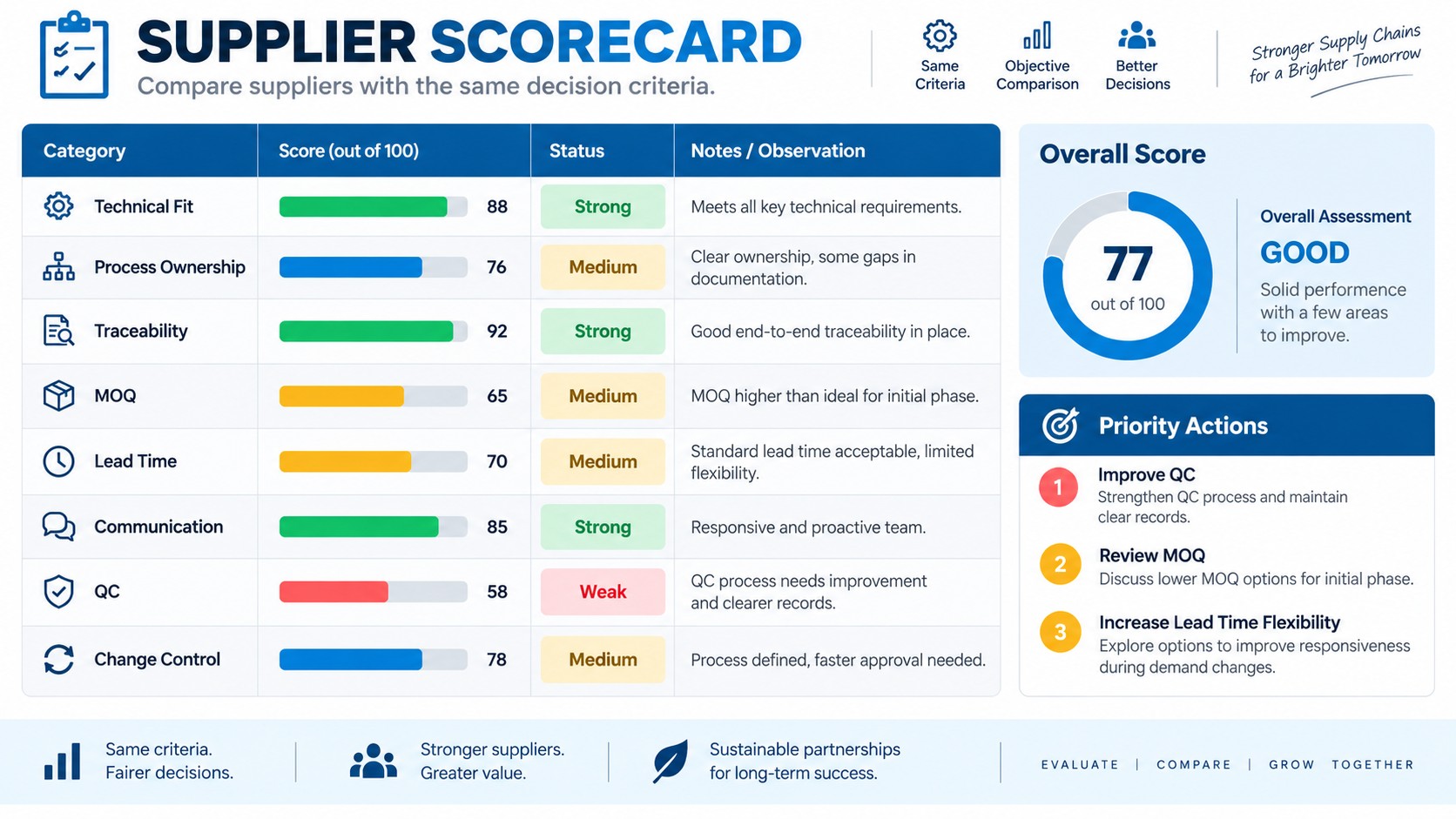
Build a Supplier Scorecard Before Samples
Score suppliers before paying for multiple samples.
A practical scorecard can include Technical Fit, Process Ownership, Material Traceability, Sample Lead Time, MOQ, Quotation Transparency, Communication, Quality System, Change Control, Certification Experience and Commercial Terms.
Weight the categories according to your project. A new custom mold may require more emphasis on engineering and tooling. A stock private-label program may place more weight on MOQ, lead time and packaging.
The scorecard prevents the cheapest quotation from automatically becoming the “winner.”
Run a Video Verification Call
Before a full factory audit, ask shortlisted suppliers for a live video walk-through.
Request the material warehouse, cutting or layup area, forming or pressing equipment, surface process, assembly, QC, retained samples and packing area. Ask the supplier to show an active production batch rather than only a showroom.
A video call is not a full audit, but it can reveal whether critical processes are performed in-house, whether traceability exists and whether the sales team can connect you with technical staff.
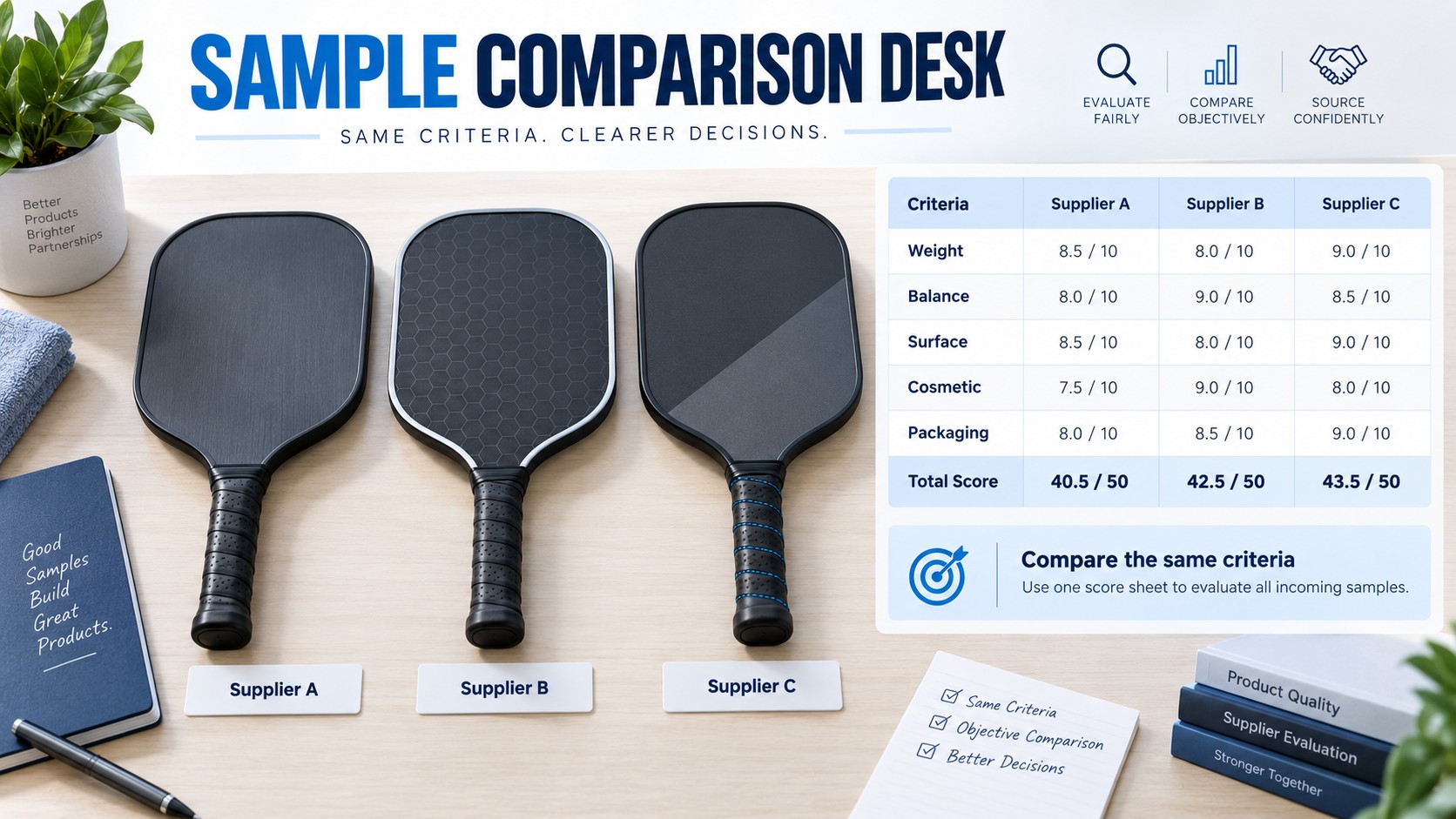
Score Samples Like Production Units
Do not judge the sample only by appearance and play feel.
Record dimensions, static weight, balance, thickness, surface consistency, handle and grip condition, edge fit, artwork, packaging and any test results that matter to your brief. If several suppliers make the same concept, use the same score sheet.
Also ask whether the sample used mass-production materials and tooling. A hand-built sample with special attention may not predict normal output.
Verify the Factory Before Scale-Up
Once one or two suppliers perform well in samples, move to factory verification.
Confirm legal identity, material controls, tooling ownership, process windows, incoming inspection, in-process QC, final inspection, lot traceability, retained samples, capacity, maintenance and corrective action.
The deeper the customization and the higher the compliance risk, the more important this step becomes.
Use Samples and Factory Evidence to Close Risk
Compare Total Project Risk, Not Unit Price
A $2 cheaper paddle is not cheaper if it creates higher air-freight cost, more rejects, certification rework, delayed launch, surface inconsistency or warranty claims.
Compare supplier price together with tooling, samples, expected yield, packaging, logistics, MOQ, inspection, lead time, payment terms and change risk.
The final sourcing decision should answer: which supplier is most likely to reproduce the approved product at the required cost and schedule?
A Practical RFQ Example for a Private-Label Paddle
A simplified RFQ can look like this: existing widebody mold; 16 mm polypropylene honeycomb; carbon-face direction with the exact fabric to be proposed and identified; controlled textured surface; target finished weight range; 5.25-inch usable handle area; black edge guard; buyer artwork; custom retail box; 500 / 1,000 / 3,000-piece price breaks; delivery to a named country; sample timing; and required USA Pickleball or UPA-A pathway.
The point is not that every project needs these exact specifications. The point is that each quotation should answer the same commercial and technical brief. If Supplier A quotes a standard fiberglass stock model and Supplier B quotes a thermoformed carbon model, the prices are not comparable even if both listings say “custom pickleball paddle.”
What to Negotiate After Technical Shortlisting
Negotiate only after the supplier has demonstrated product fit. At that stage, discuss sample charges, tooling ownership, MOQ by customization level, payment schedule, inspection rights, remake/rework responsibility, packaging overrun, approved-substitute rules and production lead time.
Do not trade away specification control only to reach a lower price. A useful cost reduction keeps the product job intact—for example using an existing mold, consolidating packaging, simplifying colorways, improving yield or committing to a rational volume ladder.
Alibaba-to-Factory Handoff Checklist
Before placing the first meaningful order, save the final RFQ, quotation, approved sample record, BOM summary, artwork, packaging files, inspection criteria and commercial terms in one project folder. Confirm which factory entity will invoice and produce the goods.
The handoff is complete only when the platform order and the manufacturing team are working from the same approved version. This reduces the common gap between what sales promised online and what production actually receives.
Score the Commercial Decision
Supplier Comparison Scorecard
| Dimension | What to Verify | Evidence | Score / Weight |
|---|---|---|---|
| Product capability | Can the supplier build the actual construction? | Production examples + process ownership | /20 |
| Material control | Can critical inputs be identified and frozen? | Supplier codes + incoming records | /20 |
| Sample discipline | Are revisions documented? | V1/V2/V3 + golden sample | /20 |
| Factory evidence | Can claims be verified? | Live process + QC + traceability | /20 |
| Commercial fit | MOQ, lead time, payment, communication | Written quotation / terms | /20 |
What an Experienced Buyer Should Verify Before Shortlisting
A marketplace shortlist should become smaller as the evidence gets better. The first filter is product fit; the second is whether the supplier can prove process ownership, material control, revision discipline and traceability. A low quotation should never be allowed to skip those gates.
Before a meaningful PO, the buyer should be able to point to the final RFQ, the approved sample/version, the material and construction assumptions behind the quotation, the inspection criteria and the person responsible for technical changes. That documentation is what converts an Alibaba conversation into a controllable manufacturing project.
- Freeze one comparable RFQ before requesting final prices.
- Require evidence for process ownership and critical materials.
- Use the first meaningful order as a controlled pilot, not an act of trust.
Frequently Asked Questions
What should an Alibaba RFQ include?
Product specification, quantity, material/construction direction, customization, packaging, destination, delivery requirement, sample needs and certification target.
Is a Verified Supplier automatically safe?
No. Verification is a screening signal. Product-specific process capability and due diligence are still required.
Does Trade Assurance replace a contract or inspection?
No. It can protect platform transactions, but clear specifications, inspection and supplier verification still matter.
How many suppliers should I sample?
There is no universal number. Shortlist enough suppliers to create real comparison, then narrow based on evidence rather than collecting many random samples.
What is the strongest final decision criterion?
Repeatability: whether the supplier can reproduce the approved construction, quality and delivery requirements at the target commercial terms.
Planning a supplier shortlist?
Mayvoci can help turn a product idea into a comparable RFQ, sample checklist and factory-verification plan before the first production order.
The End about Mayvoci
1)Design:Over 100 paddle designs and photography service to assist start-up.
2)Professional:Focus on various of paddles manufacturing for 6 years
3)Quality:Strict quality management system to provide safety and satisfaction for customers
4)Amazon:Flexible comprehensive solution to make sure each Amazon seller is well cared.
5)Excellent Team:Experienced paddle experts & dynamic sales team give you 5-star service

If you work on this topic from the brand, sourcing, engineering or channel side, I’d be interested in your experience: When you shortlist suppliers, what carries the most weight for you: price, technical capability, traceability or communication?