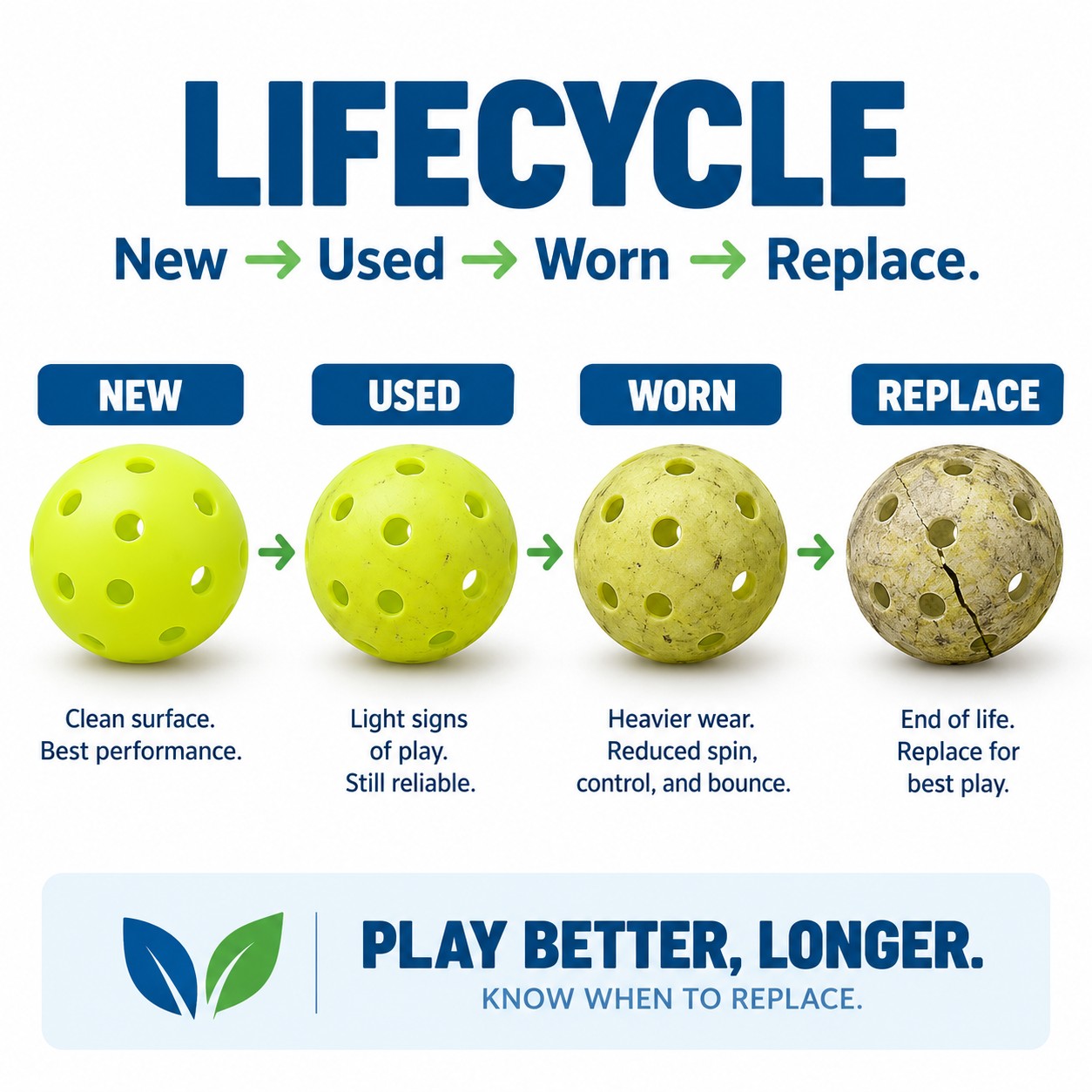
Pickleballs are wear items, but there is no universal “X games” lifespan. Outdoor temperature, material formula, court surface, player level, impact speed and storage all affect durability.
Condition is a better replacement rule than a fixed number.
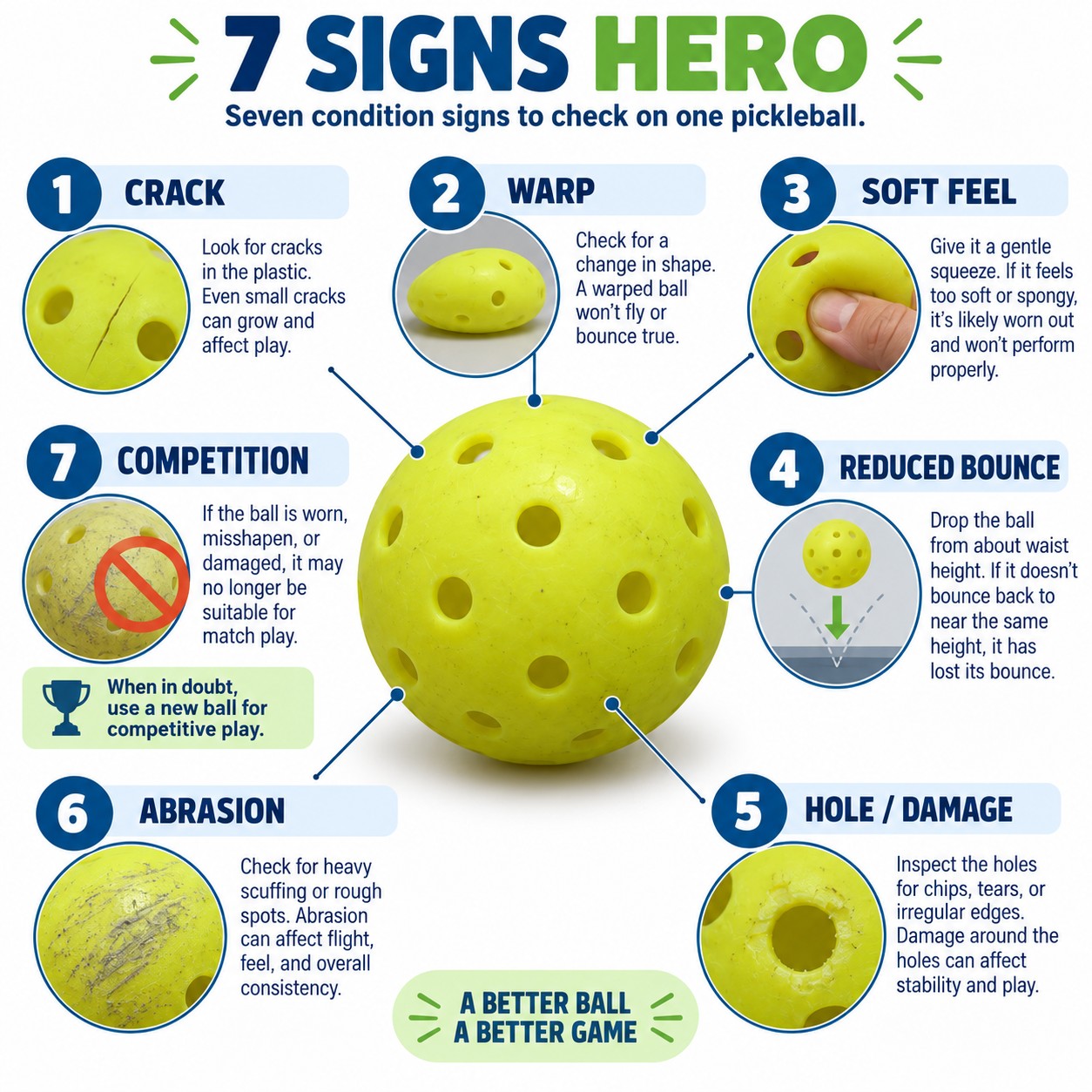
What Changes Ball Lifespan
Cracks
Any visible crack is a clear replacement sign for normal play because it can grow quickly under impact.
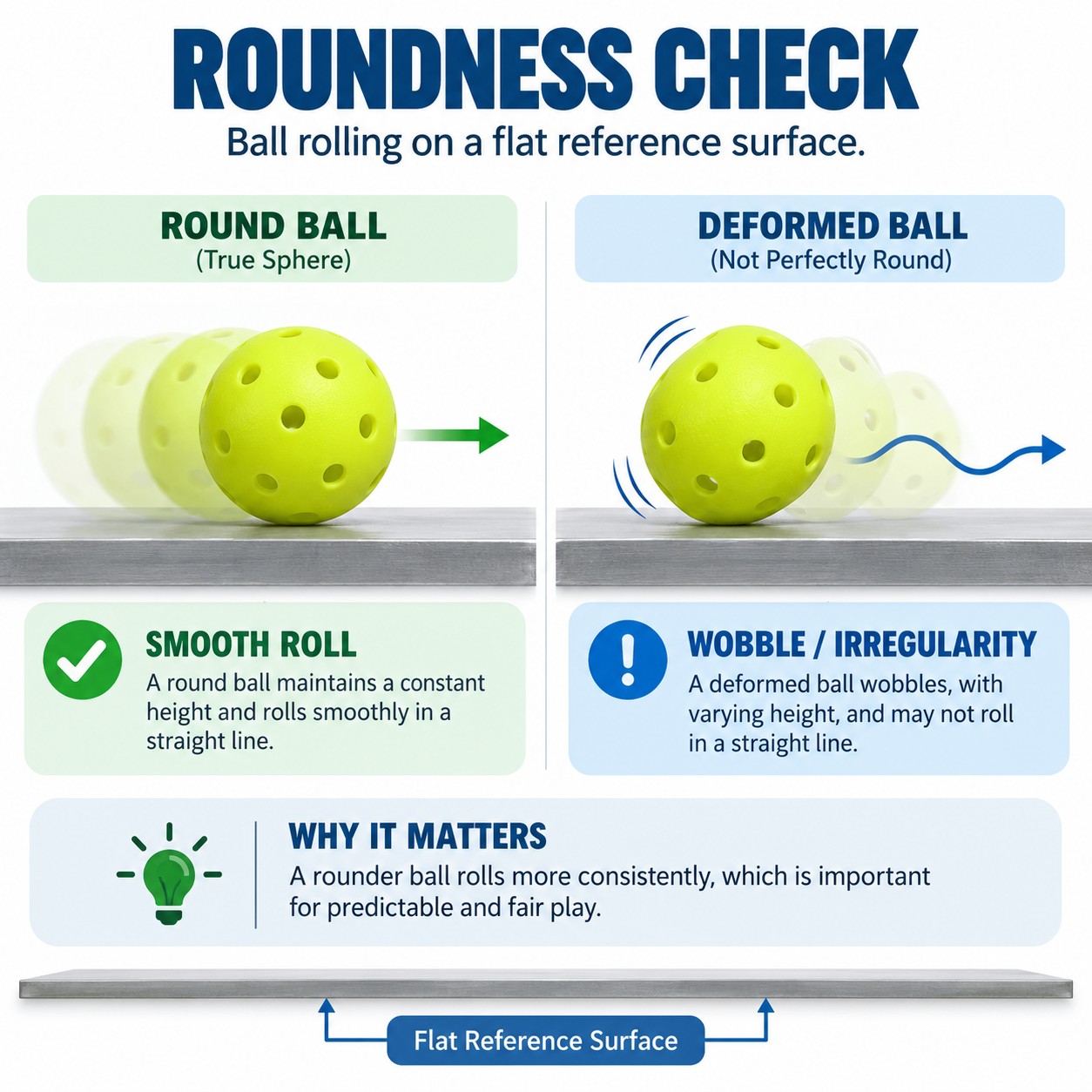
Out-of-Round Shape
Roll or spin the ball on a flat surface. Warping can create unpredictable bounce and flight.
Softening
A ball that has lost stiffness may feel slow or inconsistent. Compare with a new ball of the same model and consider temperature.
Inconsistent Bounce
Repeated irregular bounce on the same surface can indicate deformation, but check the court and temperature too.
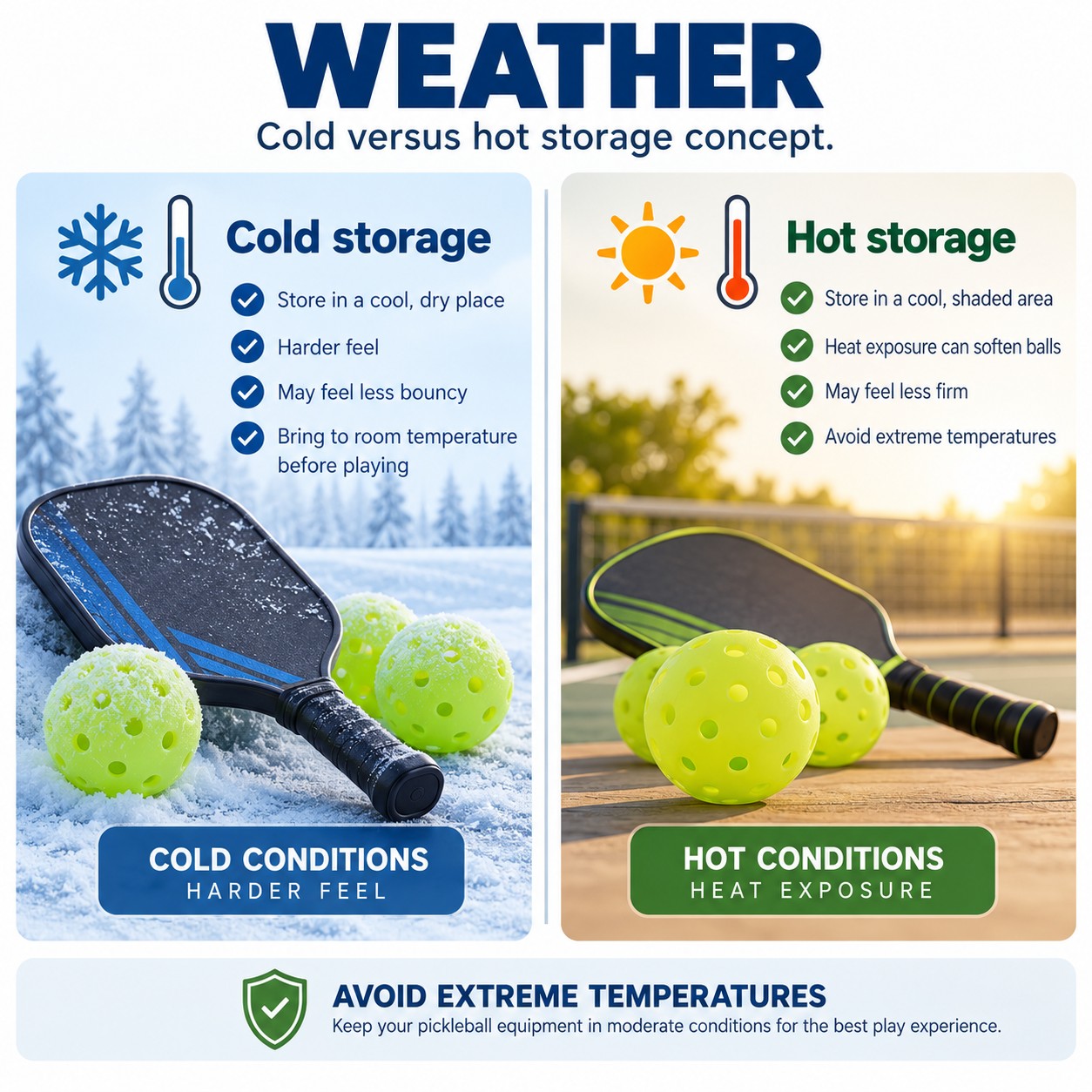
Storage, Climate and Practice Rotation
Ball Rotation for Practice
Clubs can separate newer match/practice balls from worn drill balls. This reduces waste while maintaining consistency for scoring or serious practice.
Use clear bins and discard cracked or badly deformed balls rather than mixing every condition together.
Batch Consistency
If a new box contains noticeably different roundness, hardness or hole quality, record the lot and compare several balls. A single defective ball may be isolated; repeated issues can indicate a batch problem.
Brands should use complaint data to improve incoming and production QC.
OEM Ball Quality Checks
For ball suppliers, control weight, diameter, roundness, hole count/geometry, visual molding defects and bounce-related test requirements according to the target standard.
Durability claims should come from controlled impact/temperature testing rather than casual estimates.
Practical Editorial / Decision Notes
Clubs can rotate older but structurally sound balls into drill bins while reserving more consistent balls for match play. This reduces waste without pretending all used balls are equivalent.
For supplier QC, repeated issues from one lot should trigger checks of roundness, molding quality, hole geometry and relevant bounce/durability requirements.
Storage, Climate and Practice Rotation
Ball Rotation for Practice
Clubs can separate newer match/practice balls from worn drill balls. This reduces waste while maintaining consistency for scoring or serious practice.
Use clear bins and discard cracked or badly deformed balls rather than mixing every condition together.
Batch Consistency
If a new box contains noticeably different roundness, hardness or hole quality, record the lot and compare several balls. A single defective ball may be isolated; repeated issues can indicate a batch problem.
Brands should use complaint data to improve incoming and production QC.
OEM Ball Quality Checks
For ball suppliers, control weight, diameter, roundness, hole count/geometry, visual molding defects and bounce-related test requirements according to the target standard.
Durability claims should come from controlled impact/temperature testing rather than casual estimates.
Use Ball Complaints as QC Data
Ball Condition Matrix
| Condition | Use / Action |
|---|---|
| Cracked | Replace |
| Out of round | Replace for normal play |
| Soft / inconsistent | Compare with new ball |
| Light scuffing | May remain usable |
| Older but intact | Drill / casual rotation if consistent |
Ball Lifespan Is Also a Supplier-QC Question
For players, the replacement decision is condition-based. For brands and suppliers, repeated cracking, deformation or hole-quality complaints should be grouped by lot so production patterns can be identified.
That creates a feedback loop from ownership content into incoming and manufacturing QC. A ball article can therefore support both player education and accessory-sourcing decisions.
- Separate cosmetic scuffing from structural damage.
- Rotate intact older balls into drills where appropriate.
- Escalate repeated lot-level issues into supplier QC.
Frequently Asked Questions
How many games does a ball last?
There is no universal number.
Should I replace a scuffed ball?
Not for light cosmetic scuffing alone.
Why do outdoor balls crack in cold weather?
Some plastics become less impact tolerant at low temperature.
Can heat warp balls?
Heat and storage can contribute to deformation.
What is the clearest replacement sign?
A crack or obvious deformation.
Developing a private-label pickleball program?
Mayvoci can help define ball, paddle and set-level QC requirements instead of treating accessories as unverified add-ons.
The End about Mayvoci
1)Design:Over 100 paddle designs and photography service to assist start-up.
2)Professional:Focus on various of paddles manufacturing for 6 years
3)Quality:Strict quality management system to provide safety and satisfaction for customers
4)Amazon:Flexible comprehensive solution to make sure each Amazon seller is well cared.
5)Excellent Team:Experienced paddle experts & dynamic sales team give you 5-star service