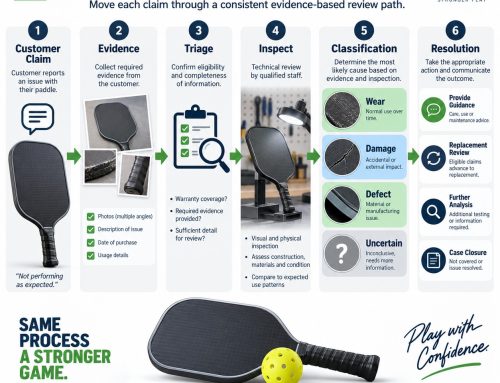
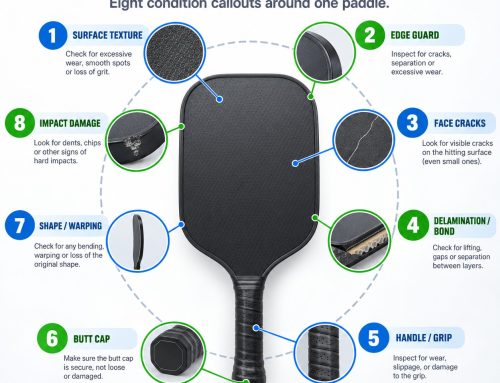
When a pickleball paddle starts to sound hollow, feel unusually hot, lose responsiveness, or develop a soft spot, many players describe the problem with one word: delamination. But in real paddle construction, “delamination” is often used too broadly. The problem may be face-to-core disbonding, carbon fiber ply separation, honeycomb core crush, edge failure, or simply surface wear. Understanding the difference matters because each failure mode has a different cause and a different solution.

This guide explains what is really happening inside a carbon fiber pickleball paddle, why thermoformed paddles receive so much attention in durability discussions, and what players, buyers, and OEM paddle brands should look for when choosing a more stable paddle construction.

What Does “Delamination” Mean in a Pickleball Paddle?

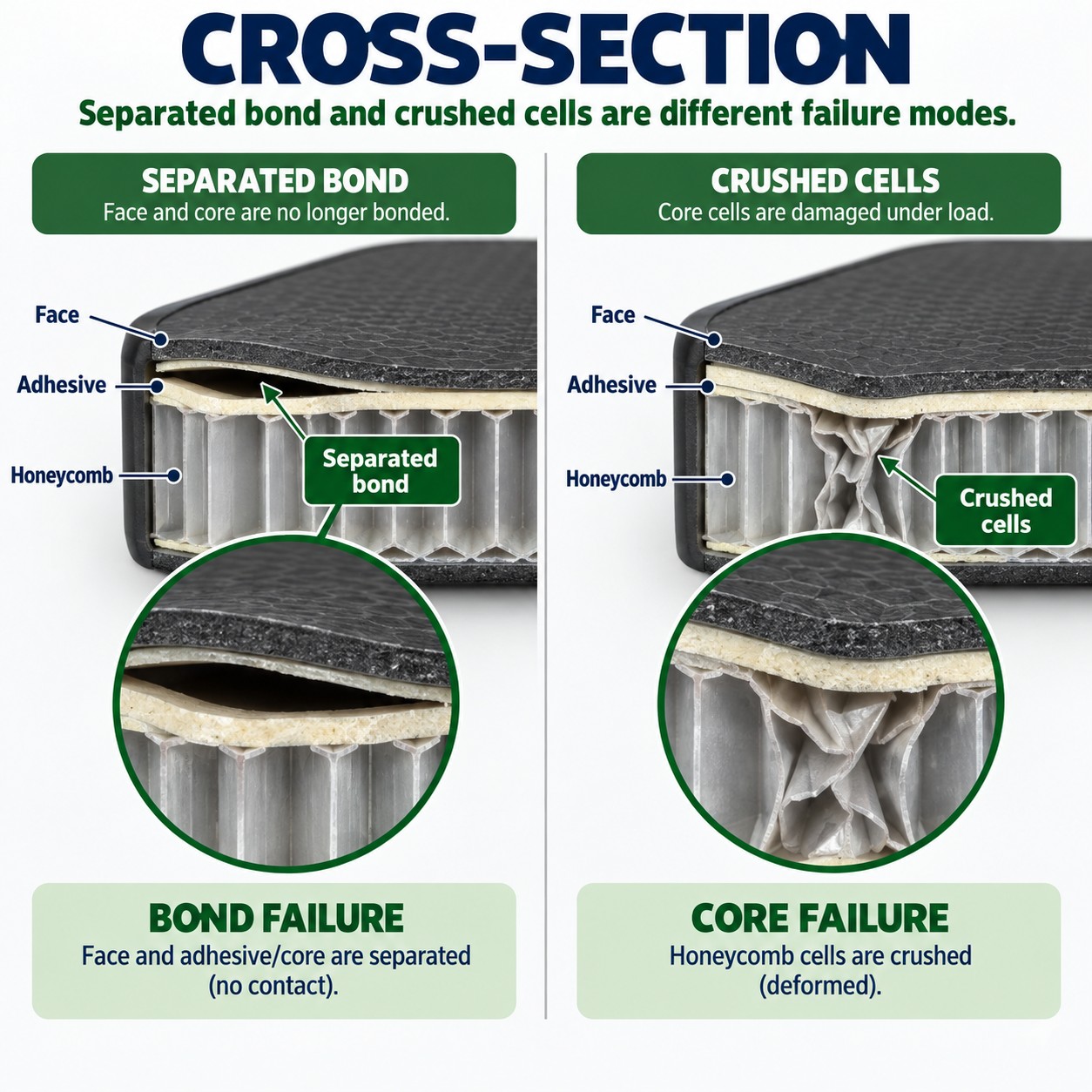
Most modern performance paddles use a sandwich structure: a front face sheet, an adhesive bonding layer, a honeycomb or foam core, another adhesive layer, and a back face sheet. The face sheets may be carbon fiber, fiberglass, aramid fiber, or a hybrid composite. The core is commonly polypropylene honeycomb, although foam and mixed-core designs are also used.

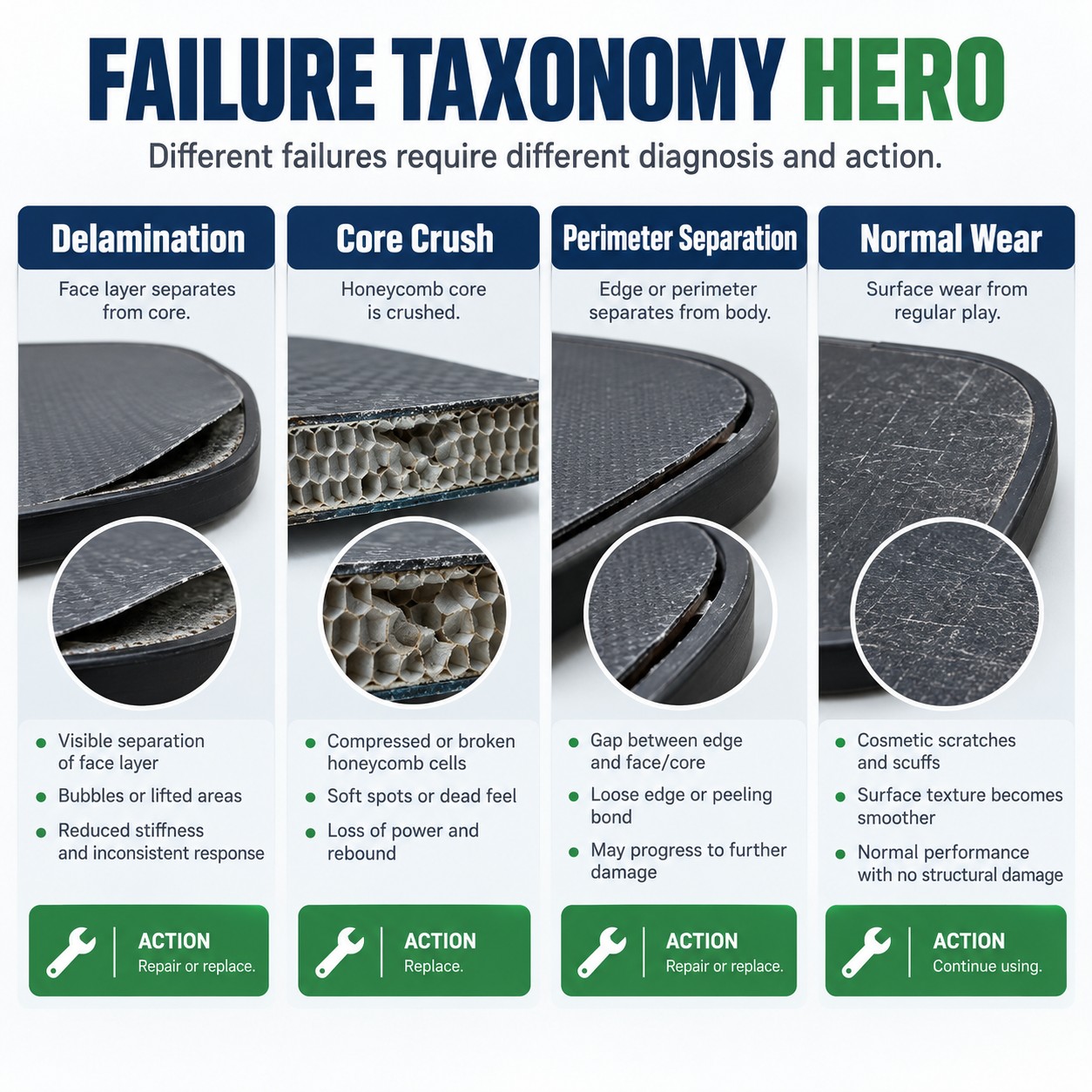
In technical terms, delamination usually means that layers of a composite material separate from each other. In paddle discussions, however, players often use the term to describe several different issues:


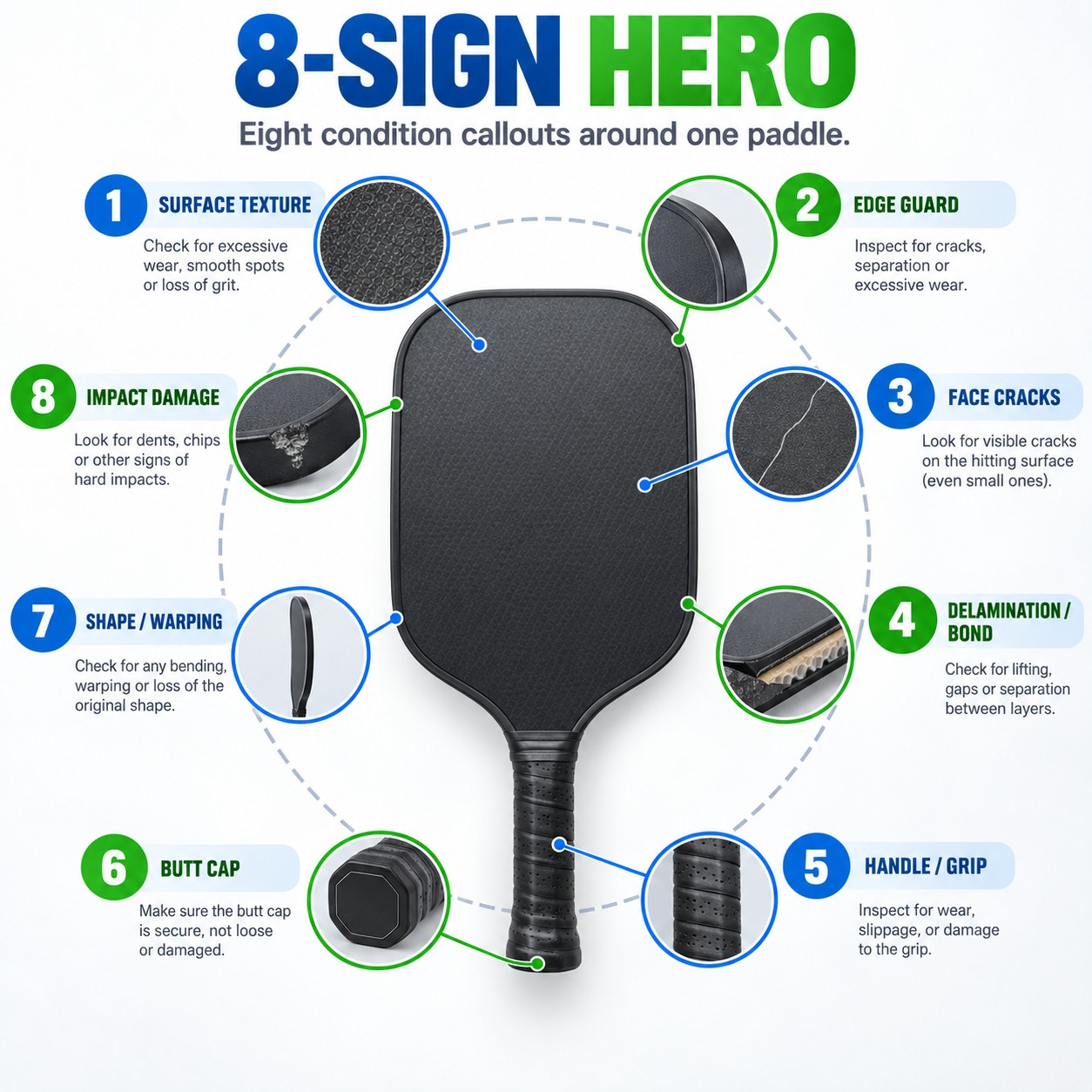
Common NameWhat It Really MeansTypical Player Symptom
Face-core disbondingThe paddle face separates from the inner core.Hollow sound, abnormal pop, inconsistent response.
Interply delaminationCarbon fiber layers inside the face sheet separate from each other.Reduced face stiffness, cracking, changing feel.
Core crushThe PP honeycomb core collapses or loses structural integrity.Soft spots, dead feel, dents, or trampoline-like pockets.
Surface wearThe grit, coating, or texture wears down.Less spin, smoother surface, but no structural failure.
Edge separationThe edge guard, foam edge, or seam fails.Visible edge gap, crack, or loose edge guard.

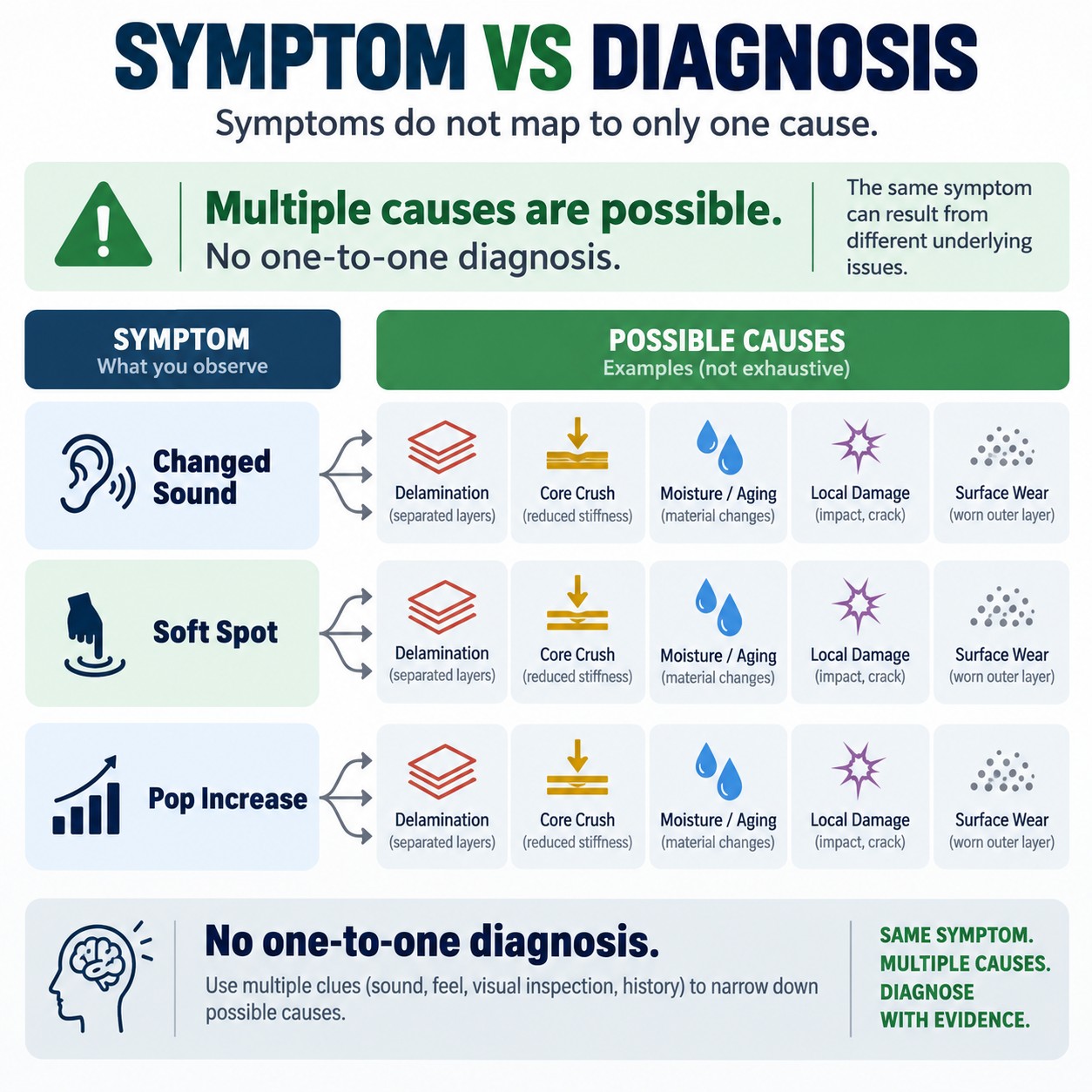
For players, the important point is simple: not every paddle that feels different is truly delaminated. A paddle can lose spin because the surface texture is worn. It can feel soft because the honeycomb core is crushed. It can sound hollow because the face has separated from the core. Correct diagnosis is the first step toward solving the problem.

Why Thermoformed Paddles Get So Much Attention

Thermoformed paddles became popular because they can create a more integrated, powerful, and stable structure. In a typical thermoforming process, the face sheets, core, edge foam, adhesive, and side structure are placed into a mold and processed under heat and pressure. This can produce a unibody-like paddle with a strong edge, a larger sweet spot, and a crisp power response.

However, thermoforming also introduces new manufacturing risks. Temperature, pressure, molding time, cooling rate, adhesive flow, core thickness variation, and internal air pressure must all be controlled carefully. If the process window is not stable, the same construction that creates more power can also create residual stress, weak bonding areas, internal pressure pockets, or honeycomb core damage.

This is why some high-power paddles may feel excellent at first but change after a period of play. The paddle may become louder, hotter, softer in one area, or more elastic than expected. These changes are not just a feel issue; they can also affect tournament compliance, consistency, and long-term product reputation.

The Main Causes of Pickleball Paddle Delamination and Core Crush

1. Weak Bonding Between the Paddle Face and Core

One of the most common causes of paddle failure is weak bonding between the face sheet and the core. In a honeycomb paddle, the carbon fiber or fiberglass face must be securely bonded to the PP honeycomb core. If the adhesive layer is too thin, too thick, uneven, poorly cured, or poorly matched to the materials, the interface can fail after repeated impact.

Polypropylene is a low-surface-energy plastic, which means it can be difficult to bond with standard adhesives. For reliable bonding, manufacturers may need proper surface preparation, suitable primers, specialty adhesive systems, or surface-treated honeycomb. Without those steps, the face may attach only weakly to the core, creating a hidden defect that appears later as hollow sound or inconsistent rebound.

2. Improper Thermoforming Temperature and Pressure

Thermoforming is a balance. Too little heat or pressure can prevent the adhesive from flowing and curing properly. Too much heat or pressure can damage the honeycomb core, over-compress the structure, or introduce excessive residual stress into the face sheets.

The paddle may look perfect from the outside, but the internal structure can already be weakened during molding. If the honeycomb walls are partially crushed, or if the face sheets contain wrinkles, voids, or resin-rich areas, the paddle may fail earlier during play.

3. Internal Pressure Trapped Inside a Unibody Paddle

A fully enclosed thermoformed paddle can trap air inside the face-core structure. During heating, that air expands. If it cannot escape, it can increase pressure inside the paddle, especially in areas where the honeycomb core thickness is not perfectly uniform. This may contribute to disbonding or core crush. Some newer construction concepts try to reduce this risk by improving edge permeability, foam-edge design, or pressure-release behavior during curing.

4. Honeycomb Core Quality and Density Variation

The core is not just filler. It supports the face sheets, controls feel, and helps distribute impact energy. A low-density honeycomb core can reduce weight but may be less resistant to compression. Large cell size, thin cell walls, uneven thickness, poor surface treatment, or batch variation can all increase the risk of crush or disbonding.

For OEM buyers, it is not enough to ask whether the paddle uses PP honeycomb. Important details include core thickness, density, cell size, wall stability, surface coating, and supplier consistency.

5. Edge Design and Stress Concentration

Edges are high-risk areas. The paddle edge receives impacts from court contact, ball strikes outside the sweet spot, and the forming stress created during thermoforming. If the edge bend radius is too tight, the foam edge is too hard or too soft, or the transition between foam and honeycomb is poorly bonded, cracks may start at the edge and move toward the playing area.

A reinforced foam edge can improve stability, but only if it is integrated correctly. A foam edge that is poorly bonded, unevenly expanded, or too rigid can create new stress points instead of solving the problem.

6. Face Sheet Layup and Composite Quality

Carbon fiber does not automatically mean durability. A paddle face sheet must have a stable layup, consistent resin content, good fiber wet-out, and controlled curing. If the face sheet has dry fiber areas, resin-rich zones, wrinkles, voids, or unbalanced ply orientation, it can become brittle or prone to internal cracking.

A very stiff face may create strong power and a crisp feel, but if the layer-to-layer toughness is poor, repeated ball impact can gradually open microcracks. Over time, these cracks can spread and change the paddle’s feel.

7. Heat, Humidity, and Storage Conditions

Even a well-made paddle can be damaged by poor storage. High heat inside a car, long sun exposure, moisture, cold-to-hot cycling, and repeated sweat or rain exposure can accelerate aging of the adhesive, coating, and edge structure. This does not mean every paddle will fail in hot weather, but it does mean storage conditions matter.

Players should avoid leaving paddles in hot vehicles, wet bags, direct sun, or under heavy pressure for long periods. For brands and distributors, storage and shipping tests are also important because paddles may experience heat and humidity before they ever reach the player.

8. Long-Term Impact Fatigue

Pickleball paddles experience thousands of repeated impacts. Hard drives, speed-up shots, off-center hits, edge impacts, ball-machine training, and high-level play all increase fatigue loading. A small weak bonding area may not be noticeable at first, but repeated impact can enlarge it until the paddle response changes clearly.

This is why durability testing should not stop at appearance checks. A paddle can pass a visual inspection and still fail after repeated dynamic impact.

How to Tell Whether a Paddle Has a Structural Problem

Players and buyers can use simple checks to identify possible issues. These checks do not replace laboratory testing, but they help separate surface wear from structural failure.


SymptomPossible Explanation
Hollow sound when tapping the facePossible face-core disbonding.
One area becomes unusually powerful or springyPossible air gap, disbonding, or crushed-core pocket.
Soft spot or dent in the playing surfacePossible core crush or local support loss.
Spin decreases but the paddle still feels solidLikely surface texture wear rather than structural delamination.
Visible edge crack or loose edge guardPossible edge impact, poor edge bonding, or foam-edge failure.
New paddle changes after only a few sessionsHigher chance of process or material defect.
Paddle changes after months of heavy useLikely fatigue, storage, and usage conditions combined.

How Manufacturers Can Reduce Delamination Risk

A durable paddle is not created by a single material claim. It requires the right combination of core, face sheet, adhesive, edge design, molding process, and quality control. The following practices are especially important for OEM and private-label buyers:

  • Use a bonding system suitable for carbon fiber or fiberglass face sheets and PP honeycomb cores.
  • Control adhesive weight, bondline thickness, application uniformity, and curing conditions.
  • Apply proper PP surface treatment or use surface-treated honeycomb materials where needed.
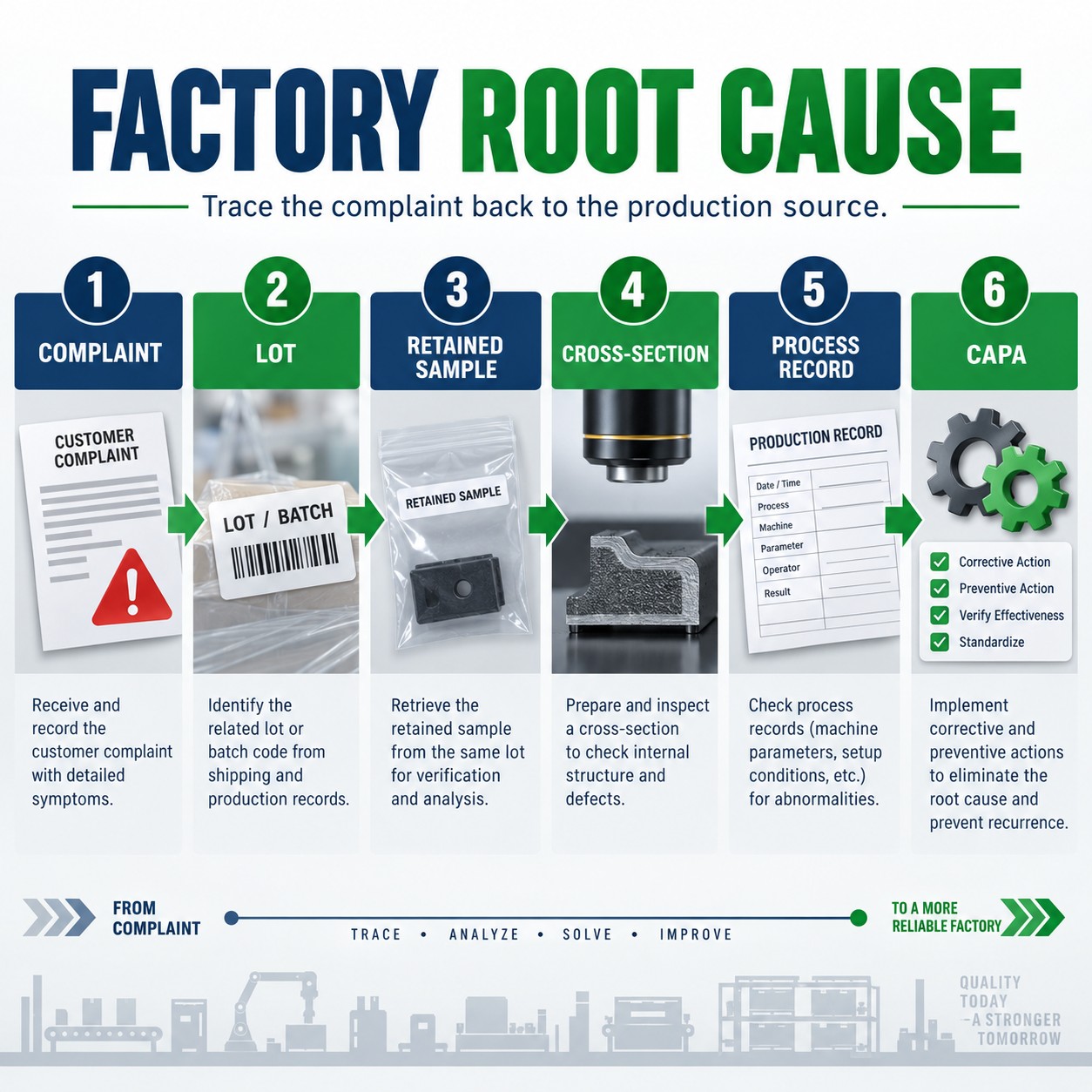
  • Record thermoforming temperature, pressure, time, and cooling parameters for each production batch.
  • Design edge foam and edge seams to reduce stress concentration and improve pressure-release behavior.
  • Verify core density, cell size, thickness tolerance, and batch consistency before production.
  • Use tap testing, weight control, surface inspection, and destructive section checks as part of QC.
  • Add accelerated aging, heat-humidity exposure, edge-impact testing, and hitting fatigue tests for higher-risk constructions.

Questions Buyers Should Ask Before Ordering OEM Pickleball Paddles

For importers, distributors, and club buyers, the best way to reduce after-sales issues is to ask technical questions before placing bulk orders.

  1. What core material, density, cell size, and thickness are used?
  2. Is the PP honeycomb surface treated, coated, or primed before bonding?
  3. What adhesive system is used, and is it suitable for PP honeycomb and composite face sheets?
  4. How are adhesive weight and bondline thickness controlled?
  5. What thermoforming temperature, pressure, and time ranges are used?
  6. Does the edge structure allow stable bonding and reduce internal pressure risk?
  7. Do you perform tap testing or internal defect checks before shipment?
  8. Do you conduct heat, humidity, or hitting fatigue tests?
  9. Can you provide production batch records and QC photos for bulk orders?
  10. Are USAP or UPA-A approval claims officially listed and current?

How to Position a Durable Paddle in Product Marketing

From a marketing perspective, durability should not be described only as “strong” or “premium.” More specific language builds buyer trust and helps differentiate a paddle from low-cost lookalikes. Useful product language includes:

  • Reinforced bonding structure
  • Stable honeycomb core support
  • Foam edge reinforcement
  • Anti-delamination construction
  • Consistent core response
  • Durable carbon fiber face bonding
  • Heat and humidity aging test
  • Tap-tested for hollow spots
  • QC-tested paddle structure
  • Balanced power and control, not unstable over-pop

Final Takeaway

Pickleball paddle delamination is not one simple problem. It can come from weak face-core bonding, carbon fiber ply separation, honeycomb core crush, edge stress, coating wear, poor storage, or long-term impact fatigue. For modern carbon fiber and thermoformed paddles, the most important factors are adhesive compatibility, PP honeycomb surface treatment, thermoforming process control, edge design, and quality testing.

For players, the best paddle is not always the one with the most power on day one. A more valuable paddle is one that keeps a consistent response over time. For OEM buyers and private-label brands, the opportunity is clear: build paddles around stable construction, reinforced bonding, controlled core support, and transparent QC. That is how a durable paddle earns trust beyond the first few sessions of play.

Suggested Soft CTA

Looking for a more durable pickleball paddle solution? Our carbon fiber pickleball paddles can be developed with reinforced bonding structure, stable honeycomb core support, foam edge reinforcement, OEM surface options, and QC-focused production for training, club, wholesale, and private-label markets.

FAQ

Is pickleball paddle delamination the same as core crush?

No. Delamination usually refers to layer separation, while core crush refers to collapse of the inner honeycomb core. Players often use the terms interchangeably, but they are different failure modes.

Why do thermoformed paddles get more delamination complaints?

Thermoformed paddles use heat and pressure to create an integrated structure. If the process is not controlled, internal pressure, core damage, or residual stress can increase the risk of performance changes.

Can surface wear be mistaken for delamination?

Yes. A paddle can lose spin because the surface grit or coating wears down, even when the internal structure is still solid.

What makes a paddle more durable?

A durable paddle needs compatible adhesive, stable core material, proper surface treatment, controlled molding parameters, reinforced edge design, and effective QC testing.

The End about Mayvoci

Mayvoci is a leading 6 years pickleball paddle supplier based in China. Below is our main 5 values. If you are interested in importing pickleball paddle, feel free to CONTACT us.

1)Design:Over 100 paddle designs and photography service to assist start-up.

2)Professional:Focus on various of paddles manufacturing for 6 years

3)Quality:Strict quality management system to provide safety and satisfaction for customers

4)Amazon:Flexible comprehensive solution to make sure each Amazon seller is well cared.

5)Excellent Team:Experienced paddle experts & dynamic sales team give you 5-star service
0 0 votes
文章评分
Subscribe
Notify of
guest
0 评论
Oldest
Newest Most Voted