When people choose a pickleball paddle, they often focus on surface material, core thickness, texture, or whether it is used by professional players. But once you actually play with it, two factors often make the biggest difference in feel: paddle weight and balance point.
Two paddles may both be listed as around 8 ounces, but they can feel completely different in your hand. One may feel powerful and solid, almost like a small hammer. Another may feel fast, light, and easy to maneuver at the kitchen line.
The difference is not only the total weight. It is also about where that weight is distributed.
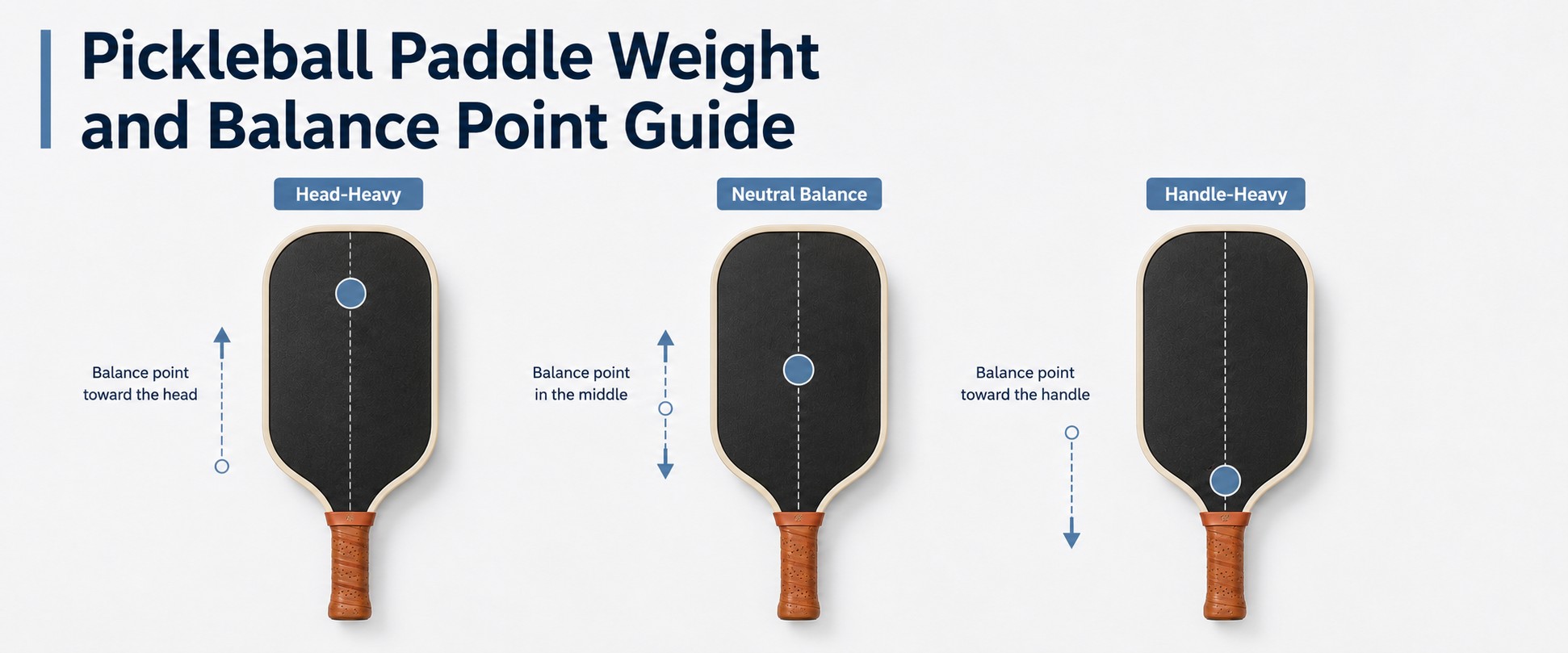
In simple terms, paddles can usually be divided into three balance styles:
Head-heavy paddles, handle-heavy paddles, and neutral-balance paddles.
None of them is automatically better than the others. The right choice depends on how you play.
1. Paddle Weight: Heavier Does Not Always Mean Better
Most pickleball paddles fall between 7.5 and 8.5 ounces. Many players assume that a heavier paddle always gives more power, while a lighter paddle always gives better control. That idea is only partly true.
A slightly heavier paddle can help you hit deeper and heavier shots. During baseline rallies, the paddle’s own momentum can help drive the ball forward. This can make your shots feel more solid and powerful.
However, there is also a trade-off. A heavier paddle can put more pressure on your wrist, elbow, and shoulder over time, especially during long sessions or fast exchanges.
A lighter paddle is easier to swing and quicker to react with. It is usually better for fast hand battles, blocks, resets, and control shots. But if the paddle is too light or lacks stability, baseline drives may feel weaker, and you may need to generate more power with your body.
That is why weight alone does not tell the full story. The real playing feel comes from the combination of weight, balance point, and swing weight.
2. Head-Heavy Paddles: More Power, Slower Reaction
A head-heavy paddle has more of its weight distributed toward the paddle head.
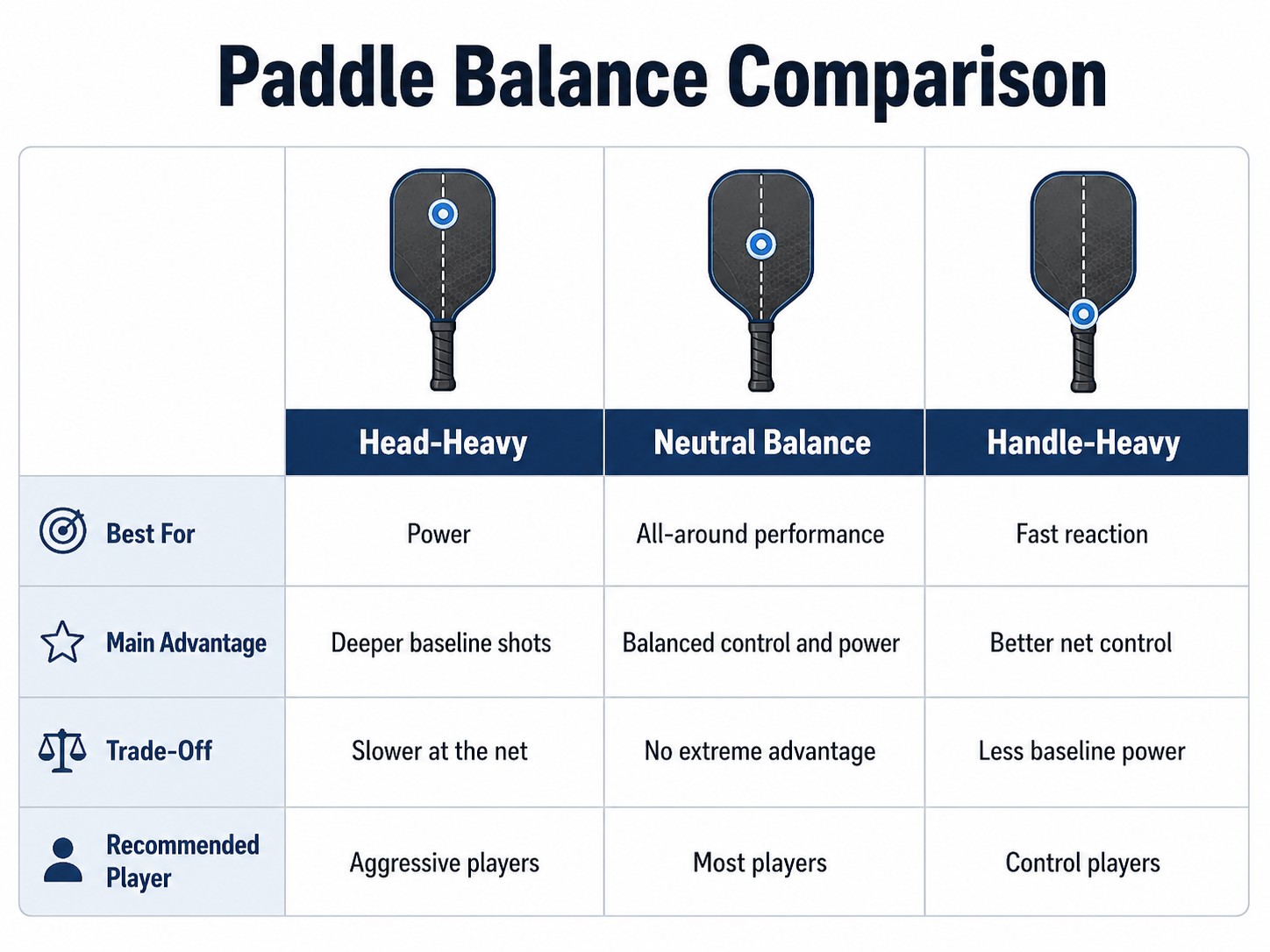
The biggest advantage is simple: more power and heavier shots.
When you swing a head-heavy paddle, the paddle head carries more momentum through the ball. This can make baseline drives, serves, and attacking shots feel stronger. If you like to hit hard from the baseline, push your opponent back, or play an aggressive style, a head-heavy paddle can be very satisfying.
It gives you that feeling of the paddle doing part of the work for you.
But head-heavy paddles also have disadvantages.
At the kitchen line, fast exchanges require quick hand speed and fast paddle positioning. A head-heavy paddle may feel slower when you need to change direction quickly. During rapid volleys or defensive blocks, the paddle head can feel like it is lagging behind your hand.
Over time, a head-heavy paddle may also put more stress on your wrist, shoulder, or elbow, especially if your technique is not stable or your arm strength is limited.
A head-heavy paddle is usually better for players who:
- Prefer baseline power
- Like hard drives and attacking shots
- Want deeper, heavier balls
- Have good strength and complete swing mechanics
- Do not rely heavily on fast kitchen exchanges
If you often feel that your shots lack depth or power, a head-heavy paddle may help you create a stronger ball.
3. Handle-Heavy Paddles: Faster Hands, Better Control
A handle-heavy paddle has more weight distributed closer to the grip.
The biggest advantage is: faster reaction and better maneuverability.
This type of paddle usually feels quicker in the hand. You can change paddle angles faster, react to speed-ups more easily, and control the paddle face with less effort. At the kitchen line, this can make a big difference.
Volleys, blocks, counters, drops, and resets often feel more natural with a handle-heavy paddle. The paddle does not feel like it is dragging your hand forward, and your wrist may feel less pressure during quick exchanges.
However, a handle-heavy paddle may not give you as much free power from the baseline.
Because the paddle head carries less momentum, you may need to use more body rotation, footwork, and complete swing mechanics to create depth and speed. If you rely mostly on the paddle to generate power, a handle-heavy paddle might feel less explosive.
A handle-heavy paddle is usually better for players who:
- Prefer control and placement
- Play a lot at the kitchen line
- Like fast hand battles and quick volleys
- Want less wrist or shoulder pressure
- Value reaction speed more than raw power
If you often feel that your paddle is too slow at the net or difficult to turn during quick exchanges, a handle-heavy paddle may feel much more comfortable.
4. Neutral Balance: The Safest Choice for Most Players
For most players, a neutral-balance paddle is often the safest starting point.
A neutral-balance paddle does not feel too head-heavy or too handle-heavy. It gives you a balanced mix of power, control, stability, and maneuverability.
It may not feel as powerful as a head-heavy paddle, and it may not feel as quick as a handle-heavy paddle, but it is usually more forgiving and easier to adapt to.
If your playing style is not fully developed yet, neutral balance is a smart choice. A paddle around 7.8 to 8.2 ounces with a balanced feel will suit many recreational and intermediate players.
After playing for a while, you can adjust based on your needs:
If your baseline shots lack depth, you may try a slightly more head-heavy setup.
If your net reaction feels slow, you may try a more handle-heavy paddle.
If your wrist, elbow, or shoulder gets tired easily, you may want a lighter paddle or a balance point closer to the handle.
If your shots feel unstable, adding a little weight near the paddle edge may improve stability.
The biggest mistake is choosing an extreme setup before you know your own style. For many players, neutral balance is not boring. It is simply practical.
5. Same Weight, Completely Different Feel
Many players only check the weight label before buying a paddle. For example, they may see “8.0 oz” and assume all 8-ounce paddles will feel similar.
In reality, two paddles with the same listed weight can feel very different.
An 8.0 oz head-heavy paddle may feel closer to an 8.4 oz paddle when you swing it.
An 8.0 oz handle-heavy paddle may feel closer to a 7.7 oz paddle in actual play.
That is because your hand does not only feel static weight. It feels how difficult the paddle is to move, turn, and accelerate. This is closely related to balance point and swing weight.
During a match, you do not experience the number printed on the spec sheet. You experience how fast the paddle reacts, how stable it feels on contact, and how tired your arm feels after repeated shots.
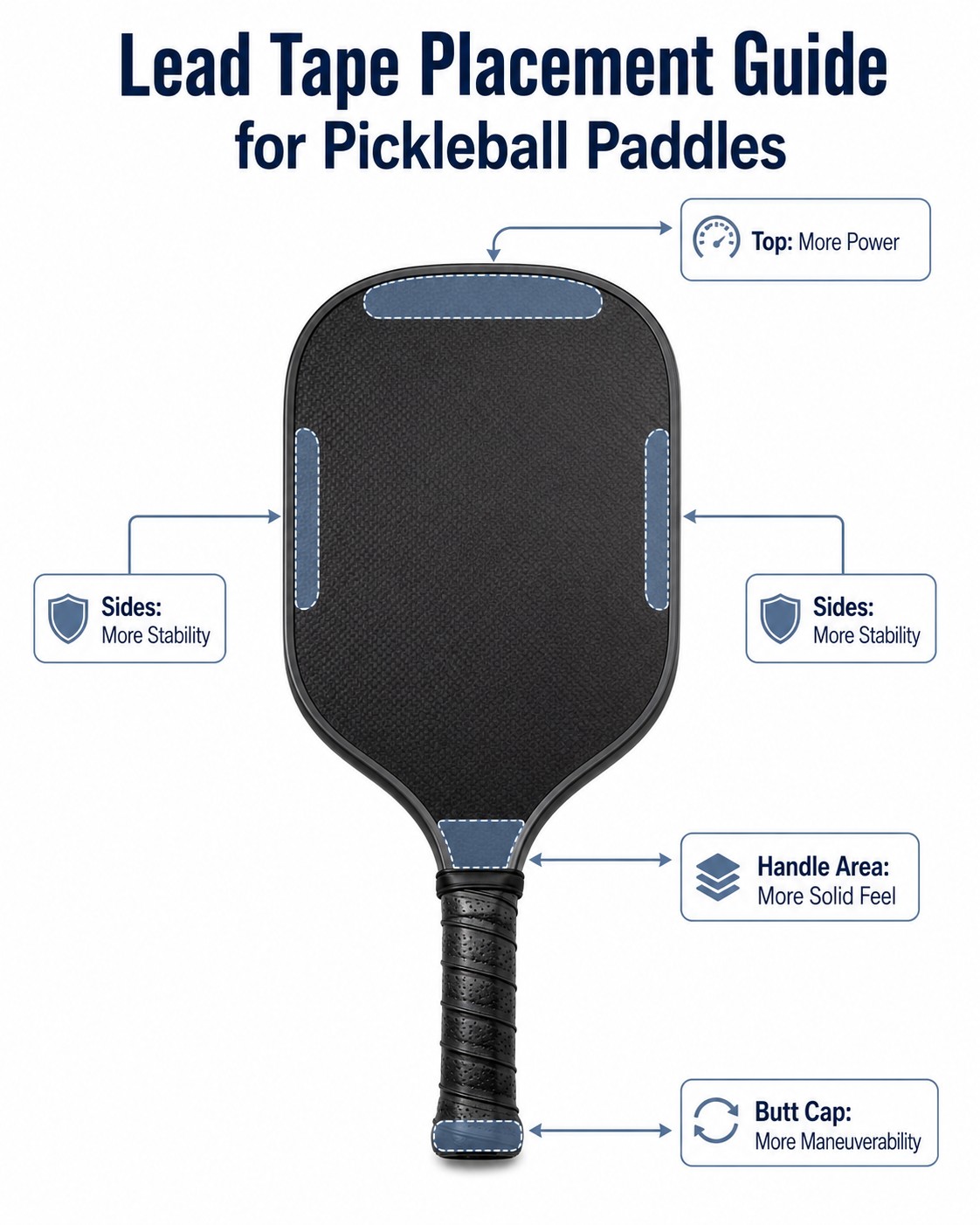
6. Lead Tape: A Low-Cost Way to Adjust Paddle Feel
If you already own a paddle but feel that something is missing, you can try using lead tape.
Lead tape is a simple adjustment tool used by many intermediate and advanced players. It is inexpensive, but it can change the feel of a paddle noticeably.
Adding lead tape near the top of the paddle can make it feel more head-heavy and increase power.
Adding lead tape to the sides of the paddle can improve stability and reduce twisting on off-center hits.
Adding weight closer to the handle can make the paddle feel more solid in the hand.
Adding weight near the butt cap can shift the balance slightly toward the handle and improve maneuverability.
The key is to adjust slowly. Do not add too much at once. Add a small amount, play a few games, and then decide whether the change feels better.
Tuning a paddle is a little like tuning a guitar string. A small adjustment can completely change the feel.
7. What Should Beginners Choose?
If you are new to pickleball, it is usually not a good idea to start with an extremely head-heavy or extremely handle-heavy paddle.
A better choice would be:
A medium-weight paddle
A neutral-balance feel
A large sweet spot
A forgiving core
A comfortable grip size
If you are still learning your swing, a lightweight or midweight paddle with good forgiveness can help you build better timing and control.
Some players may also consider paddles with foam-enhanced construction or other high-forgiveness designs, because they can make the paddle feel more stable and comfortable during the learning stage.
Once you know whether you prefer baseline attacks, soft control, quick net play, or all-court balance, you can choose a more specialized paddle.
8. How to Know Which Balance Is Right for You
Here is a simple way to decide.
If your baseline shots often feel weak or short, try a slightly head-heavy paddle.
If your net reaction feels slow or your paddle feels hard to turn, try a more handle-heavy paddle.
If you want a safe all-around choice, choose neutral balance.
If your current paddle is close but not perfect, try small lead tape adjustments before buying a new one.
A good paddle should match your playing style, not just your shopping list.
Conclusion: Specs Are Useful, But Your Hand Knows Best
There is no single best paddle weight or balance point.
Head-heavy paddles offer power and momentum.
Handle-heavy paddles offer speed and control.
Neutral-balance paddles offer stability and versatility.
The best paddle is not always the most expensive one, the newest one, or the one with the most impressive specs. It is the one that lets you swing naturally, react comfortably, and play with confidence.
Do not choose a paddle based only on numbers like 8 oz, 16mm, or carbon fiber surface. If possible, hold it, swing it, and play a few real points with it.
Because two paddles with the same listed weight can feel completely different in your hand.
At the end of the day, the spec sheet gives you information.
Your hand gives you the answer.
The End about Mayvoci
1)Design:Over 100 paddle designs and photography service to assist start-up.
2)Professional:Focus on various of paddles manufacturing for 6 years
3)Quality:Strict quality management system to provide safety and satisfaction for customers
4)Amazon:Flexible comprehensive solution to make sure each Amazon seller is well cared.
5)Excellent Team:Experienced paddle experts & dynamic sales team give you 5-star service