In the composite racket industry, materials such as carbon fiber, fiberglass, EVA foam cores, and honeycomb structures have already become widely used. As market competition continues to intensify, buyers no longer focus only on whether a racket is “carbon fiber.” Instead, they pay much more attention to the actual hitting experience, including control, spin, durability, stability, and surface feel.
Against this background, Hexgrit Diamond Particle Surface Technology has emerged as a promising upgrade direction for racket surface engineering. Hexgrit is not simply a sandblasted finish or a standard rough coating. It is a surface technology that introduces fine diamond particles during the molding process or surface treatment stage, creating a more durable, more consistent, and more functional textured hitting surface.
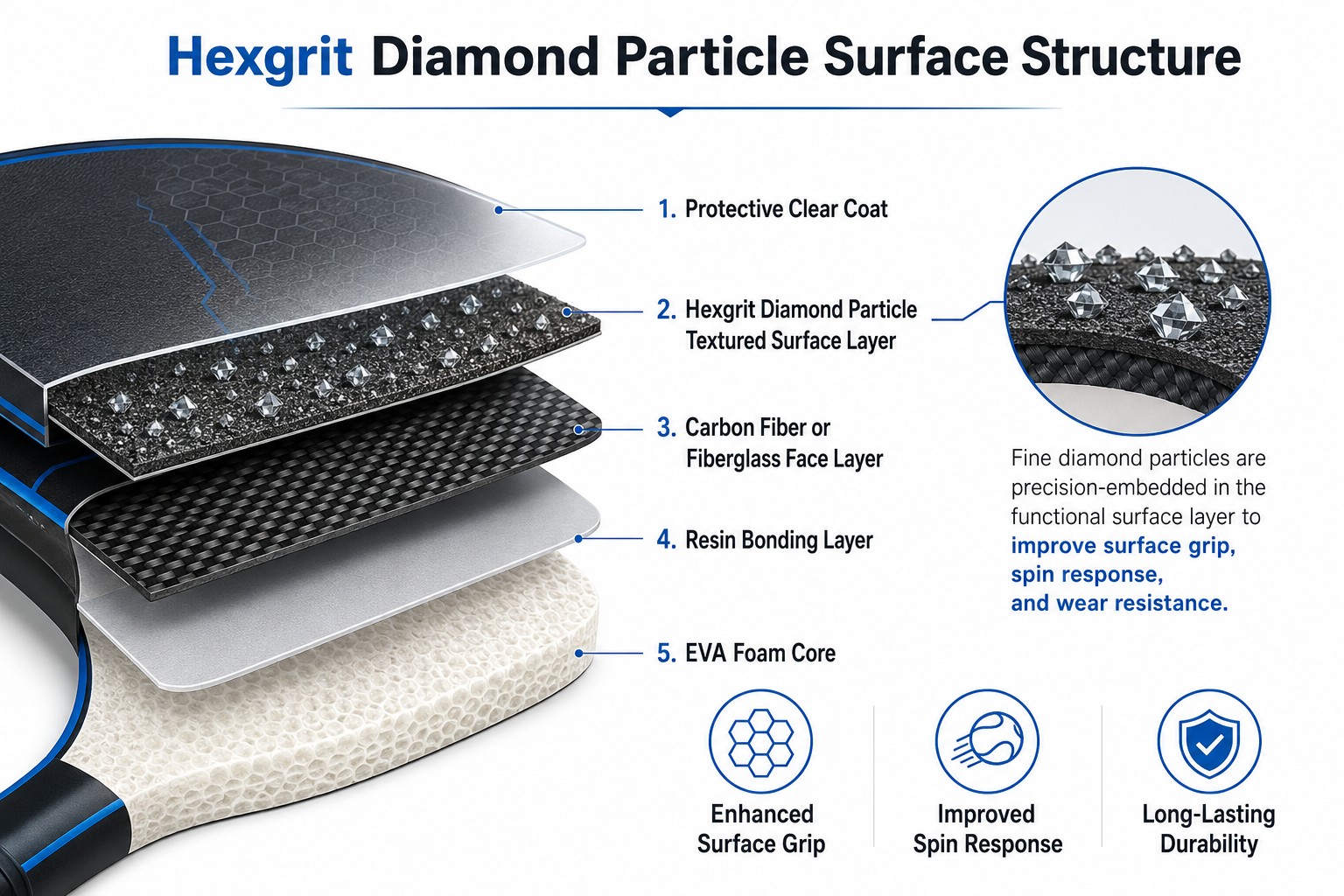
The diamond particles referred to here are not gemstone-grade diamonds, but industrial micro-scale synthetic diamond particles used for material enhancement. These particles can be incorporated into resin systems, surface coatings, or textured functional layers to create a finer and more durable friction structure on the racket face.
1. The Basic Principle of Hexgrit Technology
Traditional racket faces typically rely on carbon fiber texture, sandblasted coatings, rough finishes, or 3D embossed textures to increase surface friction. The core concept of Hexgrit is to introduce diamond particles with superior hardness and wear resistance into the racket’s surface resin or functional coating layer.
In racket manufacturing, Hexgrit can generally be achieved in three ways:
- Fine diamond particles are added directly into the top resin layer of the racket face, allowing them to distribute across the surface after compression molding.
- After the racket is molded, a secondary surface coating process is used to embed diamond particles into a transparent or semi-transparent functional layer.
- A micro-particle texture layer is added between the outer carbon fiber layer and the clear protective coating, providing improved friction performance without excessively affecting the overall appearance.
From a production perspective, the second and third methods are usually easier to control in terms of consistency and quality. If diamond particles are added too deeply into the structural layer, they may interfere with resin flow, fiber wet-out, and interlaminar bonding. By keeping the particles within the functional surface layer, the process becomes more suitable for stable mass production.
2. What Value Can Hexgrit Bring to a Racket?
The greatest value of Hexgrit is not simply making a racket “harder.” Its real advantage lies in improving the functional performance of the racket surface.
First, it can improve surface durability. Because diamond particles have extremely high hardness, they can strengthen the wear resistance of the coating or surface layer. This is especially valuable for frequent-use scenarios such as club training, rental programs, and regular player practice.
Second, it can improve surface grip and friction feel. For products such as padel rackets and pickleball paddles, the friction between the ball and the racket face affects how the player feels the contact during spin shots, slices, and touch play. A more stable and long-lasting textured surface can contribute to improved spin response and ball control.
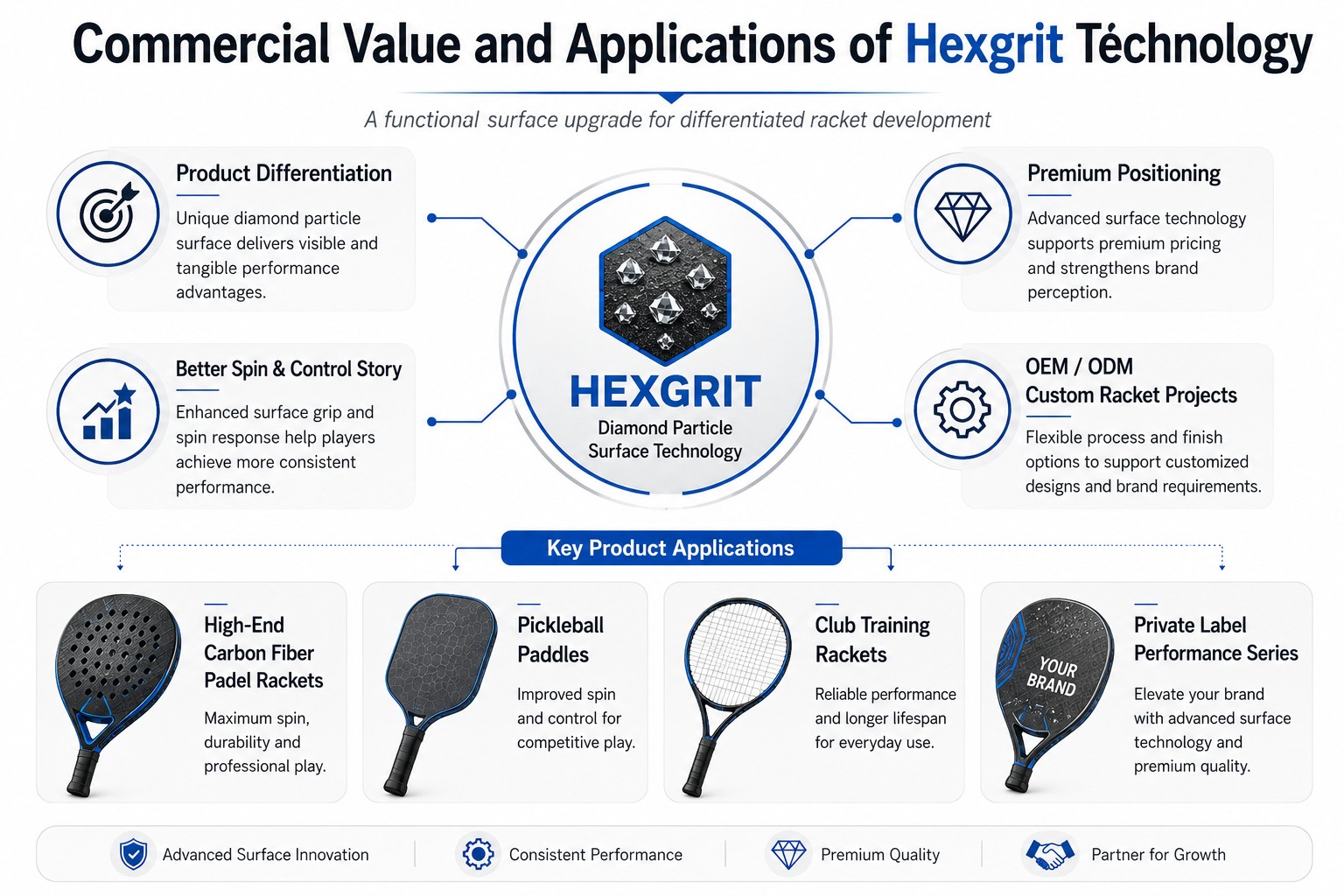
Third, it helps enhance product differentiation. Today, many rackets already promote materials like 3K carbon, 12K carbon, 18K carbon, or T700 carbon. Competing only on material names can easily lead to product homogenization. Hexgrit provides a more memorable and performance-driven selling point, making a racket easier to stand out in the B2B market.
Fourth, it adds a stronger sense of premium technology value. For brand customers, Hexgrit is not only a functional feature, but also a compelling technical story. It is especially suitable for mid-to-high-end models, tournament-oriented rackets, professional training products, and private-label series.
3. Which Types of Rackets Are Best Suited for Hexgrit?
Hexgrit is not necessarily ideal for every low-cost racket. It is more suitable for the following product categories.
The first category is high-end carbon fiber rackets. Products with 3K, 12K, or 18K carbon faces already have strong material appeal. Adding a Hexgrit diamond particle surface further strengthens the product’s professional and high-performance positioning.
The second category is spin- and control-oriented rackets. For products positioned around keywords such as Spin, Control, Precision, and Touch, Hexgrit creates a very clear and logical functional story.
The third category is club training and high-frequency-use rackets. Club buyers often care about durability as much as performance. If the racket surface remains textured for longer than a standard sand finish, that becomes a strong purchasing reason.
The fourth category is OEM/ODM custom racket projects. Brand customers do not only need a standard racket; they need a product with a clear story, clear differentiation, and stronger product-page content. Hexgrit can become a series-level technical feature used in product descriptions, packaging, branding, and promotional materials.
4. What Should Be Controlled During Production?
Although Hexgrit offers obvious market advantages, it also requires a higher level of production control.
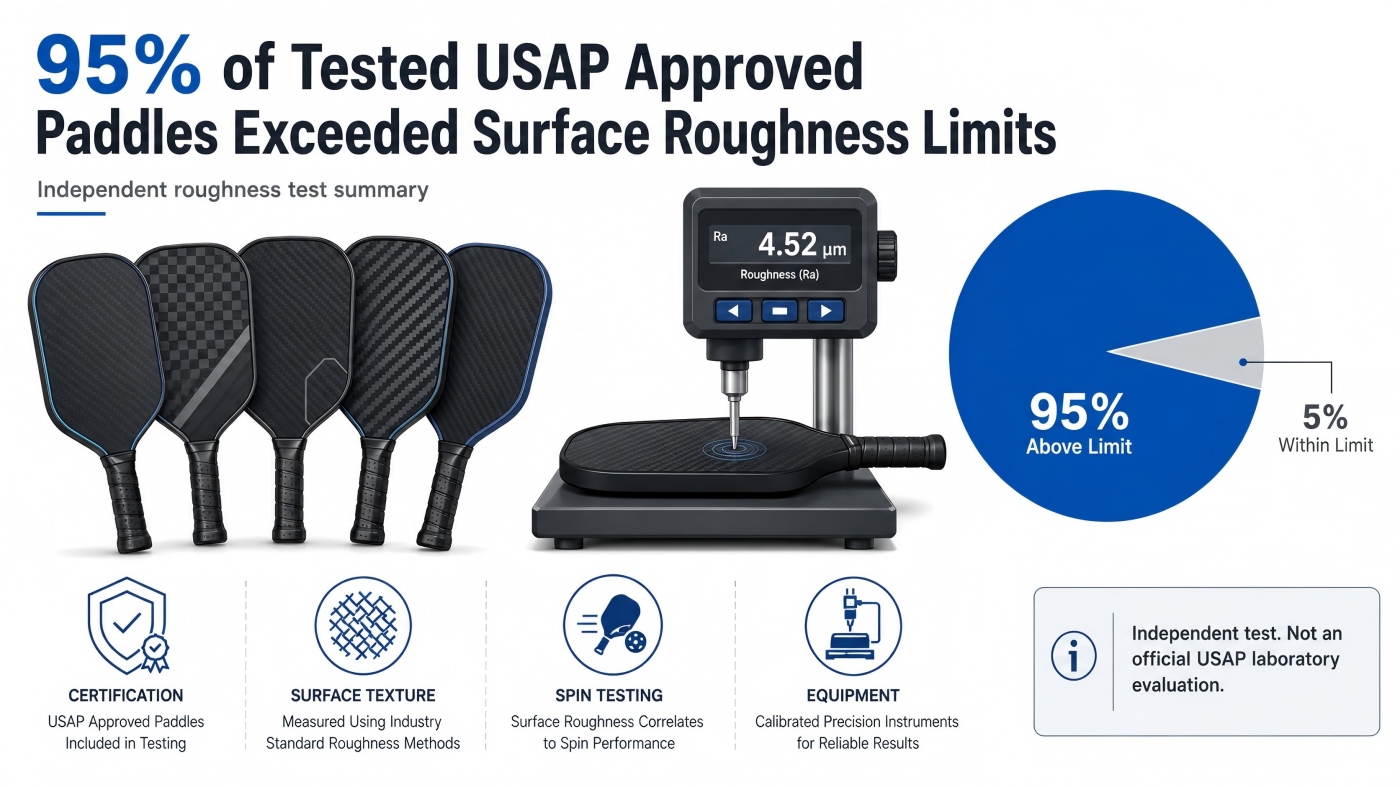
The first factor is particle size. If the particles are too large, the surface may become excessively rough, negatively affecting feel and potentially creating compliance risks. If the particles are too fine, the functional effect may be too weak to create a clear customer perception. Proper particle size selection therefore needs to be verified through sampling and testing.
The second factor is particle distribution uniformity. If the particles are unevenly distributed, some areas of the racket face may feel rough while others remain smooth, which can affect hitting consistency. For mass production, this becomes a major quality-control concern.
The third factor is bonding strength between the particles and the coating or resin layer. The particles must be firmly integrated into the surface layer. If bonding is weak, the particles may gradually fall away during use, reducing performance and negatively affecting durability.
The fourth factor is weight and balance control. Even though the total amount of diamond particles added is usually limited, a few grams can still influence overall racket balance and feel. During development, the manufacturer must therefore test total weight, balance point, and hitting feedback together.
The fifth factor is regulatory and performance compliance. Depending on the sport and target market, racket surface texture and construction may need to remain within certain acceptable ranges. Development should therefore balance functional enhancement with rule awareness and practical playability.
5. How Should Hexgrit Be Presented in Marketing?
When promoting this technology, it is better to avoid exaggerated statements such as “never wears out,” “dramatically increases speed,” or “diamond-level power.” These claims may sound overly promotional and can reduce professional credibility.
Instead, the following expressions are much more suitable:
- Hexgrit Diamond Particle Surface Technology
- Hexgrit Diamond Particle Textured Surface
- Hexgrit Reinforced Surface Layer
- Enhanced Spin Texture
- Durable Rough Surface
- Improved Surface Grip
- Long-Lasting Texture Feel
- Designed for Better Control and Spin
A B2B product-page description could read like this:
“Our Hexgrit diamond particle textured surface is designed to improve surface grip, spin response, and long-lasting texture performance. Fine diamond particles are integrated into the surface layer to create a durable and consistent hitting feel for training, club, and private-label racket projects.”
This kind of language is technical enough to sound credible, but still clear and easy for buyers to understand.
6. The Commercial Value of Hexgrit
From a product development perspective, the commercial value of Hexgrit can be summarized in three key points.
First, it helps a racket stand out from ordinary carbon fiber products. In today’s market, “carbon fiber racket” alone is no longer enough to create strong differentiation. By adding a functional surface technology like Hexgrit, the product gains a more independent and marketable identity.
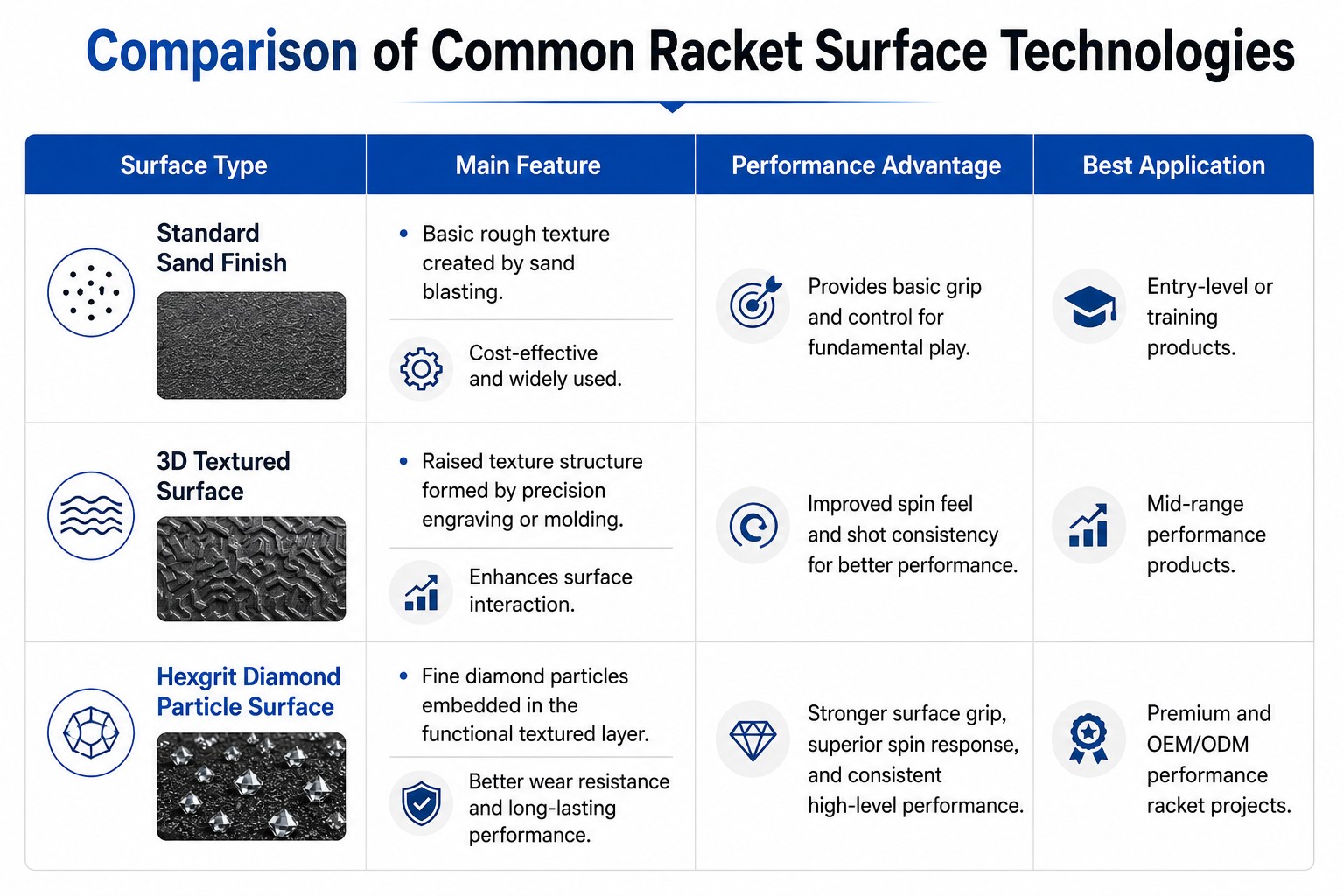
Second, it is suitable for tiered product development. A brand can build a product range with three surface levels: standard sand finish, 3D textured finish, and Hexgrit diamond particle textured finish. This makes it easier for customers to understand the upgrade path and gives the supplier clearer price segmentation.
Third, it can help support a higher selling price. Buyers are generally more willing to pay a premium for clearly defined performance features and advanced surface treatments, especially in the mid-to-high-end segment. For OEM/ODM customers, Hexgrit also provides stronger content for product pages, brochures, and marketing campaigns.
7. Conclusion: Hexgrit Is More Than a Marketing Concept
Adding diamond particles during racket molding or surface treatment is not just a marketing concept. The logic behind Hexgrit is to improve surface wear resistance and friction performance through the use of high-hardness micro-particles, thereby enhancing spin, control, and long-term durability.
However, Hexgrit should be presented primarily as a surface functional-layer technology, rather than as a complete structural reinforcement system. The success of the technology depends not simply on whether diamond particles are used, but on how well particle size, distribution, bonding strength, surface feel, weight control, and production consistency are managed.
For brands and buyers looking to develop more differentiated racket products, Hexgrit diamond particle surface technology represents a valuable upgrade direction. It is especially suitable for high-end carbon fiber rackets, spin-oriented control rackets, club training models, and OEM/ODM private-label series.
As a professional composite racket manufacturer, we are able to provide Hexgrit Diamond Particle Surface Technology for OEM and ODM racket projects. We can apply this technology to padel rackets, pickleball paddles, and other composite racket products, while also supporting customization in surface texture, material structure, graphic design, logo application, and packaging.
If you are looking for a more differentiated and performance-driven racket solution, Hexgrit can become a key technology feature in your next racket series.
The End about Mayvoci
1)Design:Over 100 paddle designs and photography service to assist start-up.
2)Professional:Focus on various of paddles manufacturing for 6 years
3)Quality:Strict quality management system to provide safety and satisfaction for customers
4)Amazon:Flexible comprehensive solution to make sure each Amazon seller is well cared.
5)Excellent Team:Experienced paddle experts & dynamic sales team give you 5-star service