
A confidentiality agreement is useful, but it is not an intellectual-property strategy by itself.
Pickleball product development can involve CAD files, mold drawings, face artwork, layup specifications, core data, packaging, test results, supplier lists and launch timing. If a brand shares all of that with a manufacturer, protection depends on contract language, ownership records, access control, subcontractor management and the law that applies to the relationship.
This page is operational guidance, not legal advice. International manufacturing agreements should be reviewed by qualified counsel in the relevant jurisdiction.
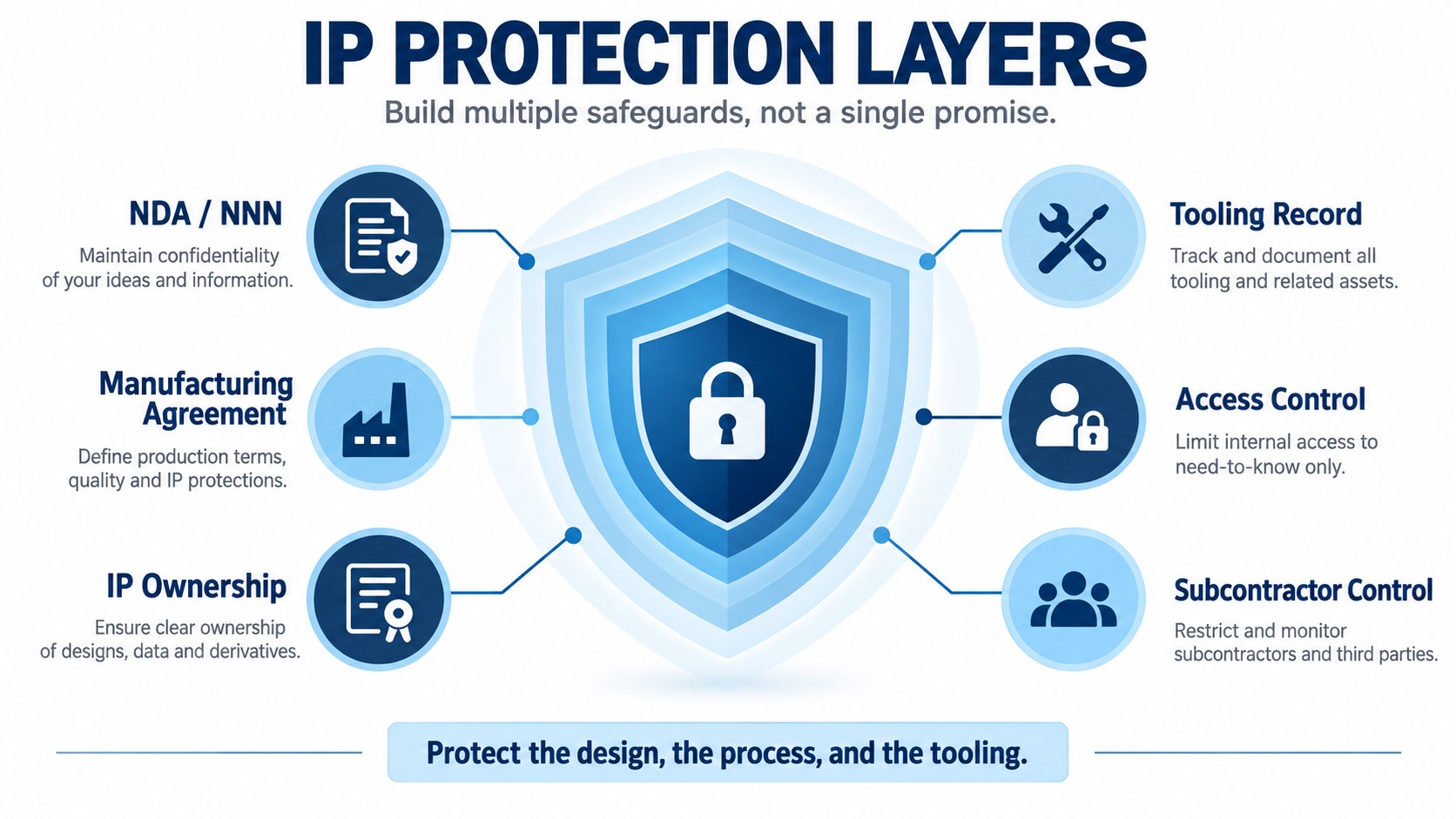
Define What Must Be Protected
NDA and NNN Are Not the Same Concept
An NDA focuses on non-disclosure of confidential information.
In sourcing practice, “NNN” is often used as shorthand for non-use, non-disclosure and non-circumvention obligations. It is not a universal magic form or a single globally standardized legal category.
What matters is the actual agreement: who is bound, what information is protected, permitted use, exclusions, duration, remedies, governing law and dispute mechanism.
Define Confidential Information Clearly
Do not rely only on a broad sentence that says “all information is confidential.”
List the types of information likely to be shared: CAD, drawings, mold files, BOM, material codes, fabric layups, surface recipes, test reports, packaging, artwork, pricing, customer names and launch plans.
Then define how oral or visually disclosed information is treated and how confidential documents should be marked or controlled.
Separate Confidentiality From IP Ownership
An NDA can stop disclosure without clearly deciding who owns the resulting design.
The manufacturing agreement should separately address pre-existing IP, brand-owned artwork, newly created drawings, mold design, improvements, derivative work and rights to use the design for other customers.
Do not assume that paying for a sample automatically answers those ownership questions.
Tooling and Mold Ownership
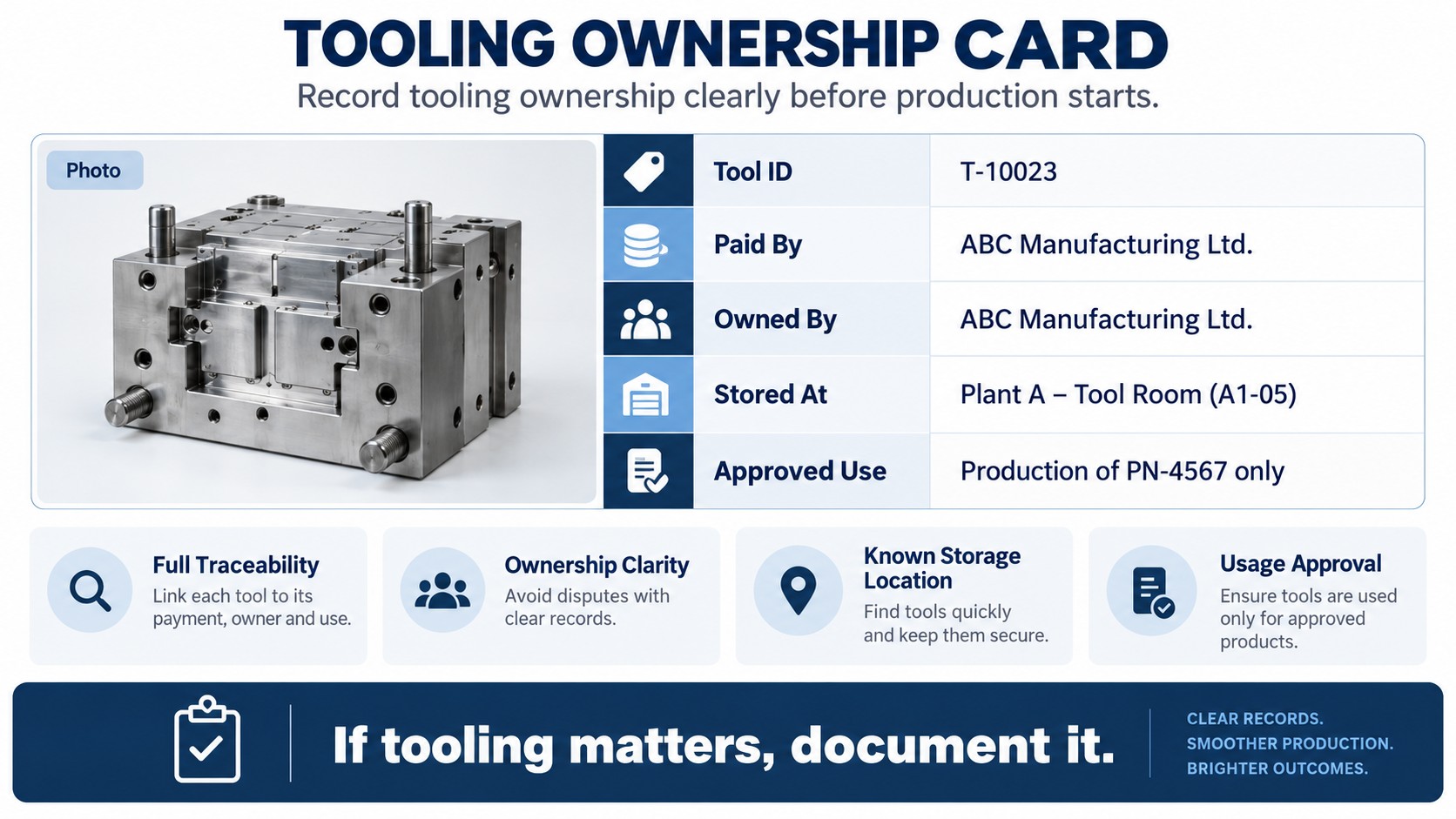
For custom molds, record who paid, who owns the physical tool, who owns the design data, where the tool is stored, whether the supplier can use it for others and what happens if the relationship ends.
Use tool IDs and photographs. Link the mold to the relevant product version.
Operational evidence reduces future ambiguity.
Control Disclosure, Tooling and Subcontractors
Control Subcontractors
A supplier may outsource printing, coatings, machining, packaging or another process.
The agreement should address whether subcontracting is allowed, which processes require approval and whether confidentiality/IP obligations flow down to subcontractors.
The buyer should also know where critical product data is being sent.
Use Trade-Secret Hygiene
WIPO identifies NDAs and controlled access as practical measures for protecting trade secrets.
Limit access internally and externally to people who need the information. Use controlled file-sharing, version numbers, permission settings and document logs. Avoid sending the full technical package to every potential supplier during the first quotation stage.
Legal rights are stronger when the company can show that it actually treated information as confidential.
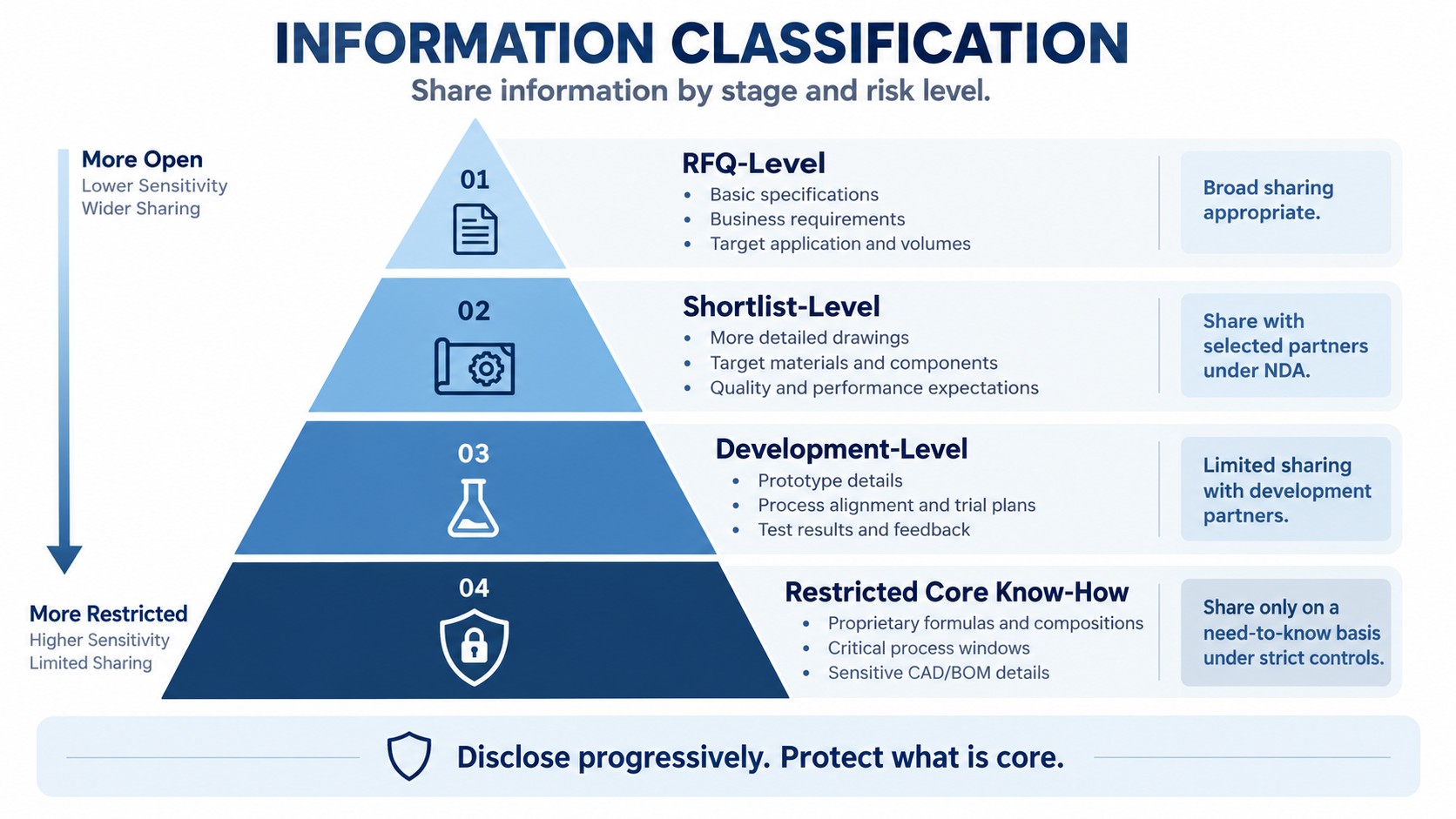
Stage Information Disclosure
During initial RFQ, disclose enough for a supplier to assess capability and quote.
After shortlist and confidentiality controls are in place, disclose deeper material, process and drawing information. Release the most sensitive details only when they are genuinely required for development.
This reduces exposure without blocking supplier evaluation.
Governing Law and Dispute Resolution Need Professional Review
International manufacturing contracts can involve multiple legal systems.
Governing law, court jurisdiction, arbitration, language, service of process, remedies and enforceability are not boilerplate fields to copy from a random online form.
Have qualified counsel structure these provisions for the countries and transaction at issue.
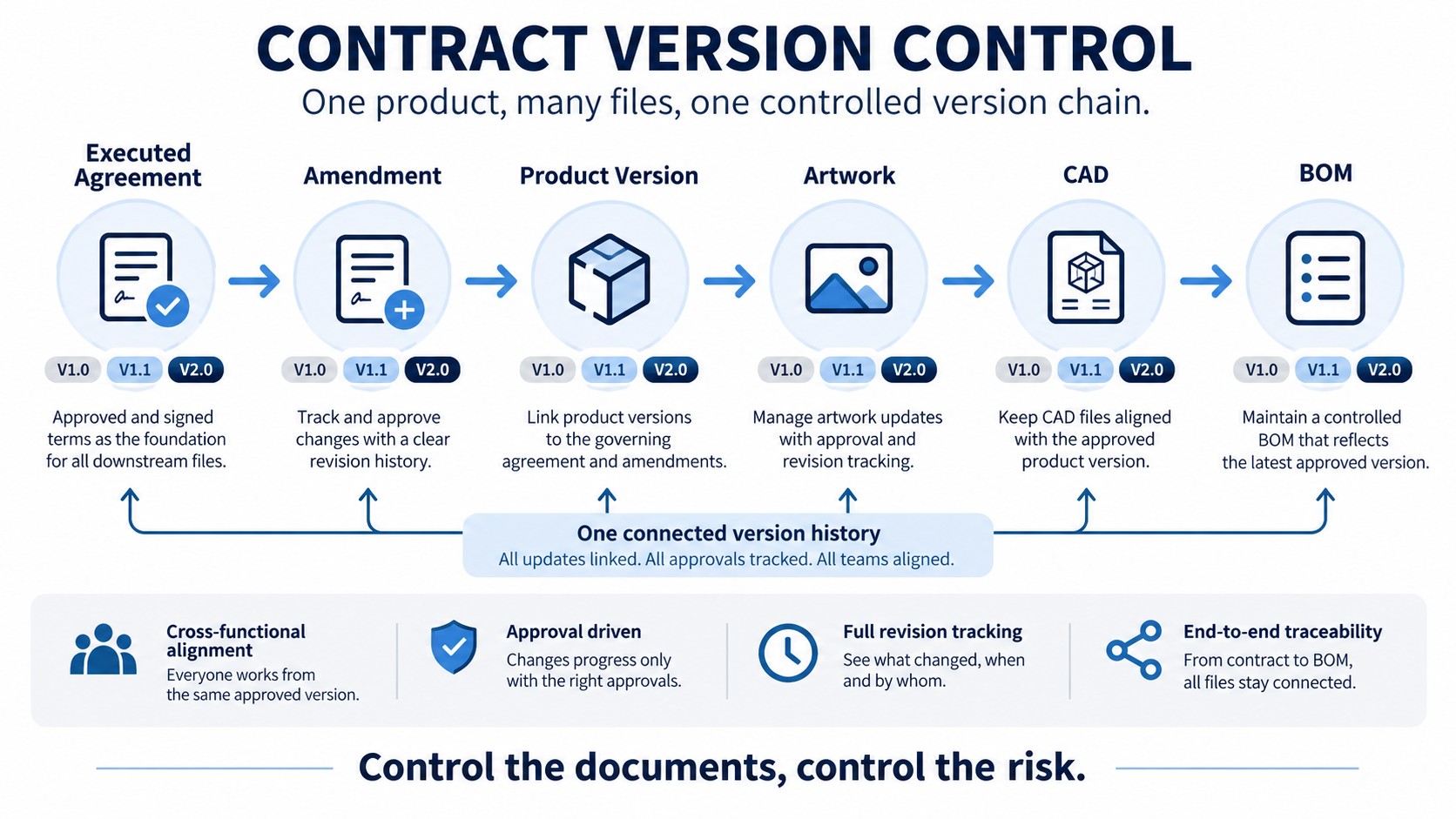
Digital Signatures and Document Version Control
The operational problem is often not whether a contract exists, but which version was signed.
Keep executed PDFs, signer identity, effective date, amendment history and the linked product or project name. Use controlled file names and avoid critical terms living only inside chat messages.
The same discipline should apply to artwork and engineering approvals.
Use Documents and Access Rules Together
Build an IP Protection Package, Not One Form
A stronger system combines the confidentiality agreement, manufacturing agreement, IP ownership clauses, tooling records, supplier-access controls, subcontractor rules, version control and internal security.
No single document removes all risk.
The goal is to make ownership, permitted use and evidence clear before the relationship becomes commercially important.
Create an Information-Ownership Matrix
For every project, list the asset, owner, creator, storage location, permitted users and whether the supplier may reuse it. Typical rows include brand logo, paddle face artwork, CAD, mold drawing, BOM, test data, packaging dieline and custom process specification.
This matrix catches questions that a generic NDA does not answer. For example, the supplier may be allowed to use a common mold design while the buyer owns only the artwork; another project may involve a buyer-funded proprietary mold that cannot be used for third parties.
Plan for the End of the Relationship
Agreements should address what happens when a project ends: return or destruction of confidential files, continued confidentiality, tooling release, remaining raw materials, obsolete packaging, production records and access credentials.
Exit planning matters most when the relationship is already difficult. Decide it while the project is cooperative.
Red Flags in Supplier IP Discussions
Slow down if the supplier refuses to identify subcontractors for sensitive processes, cannot say who has access to your CAD files, wants to place your proprietary product in a public catalog before launch, or treats a buyer-funded mold as general factory property without discussion.
These are not automatic proof of wrongdoing. They are reasons to clarify ownership and controls before more information or money is committed.
Build an IP-Risk Workflow
NDA / NNN / IP Asset Matrix
| Asset | Main Risk | Control | Evidence |
|---|---|---|---|
| Drawings / CAD | Unauthorized reuse | Need-to-know access + agreement | File/version log |
| Mold / tooling | Ownership dispute | Ownership + custody terms | Tool ID / invoice / register |
| Supplier list / BOM | Leakage / substitution | Confidential scope + change approval | Controlled BOM |
| Artwork / brand | Copying / counterfeit | Trademark / file access | Approved artwork files |
| Subcontractor data | Uncontrolled disclosure | Flow-down obligations | Approved subcontractor list |
Protect the Project Before the First Drawing Leaves Your Team
The strongest IP workflow starts before documents are shared. Classify what is genuinely sensitive—mold geometry, internal construction, supplier list, artwork, test data, tooling and commercial terms—and decide who actually needs access. Contract language is stronger when it is paired with controlled disclosure.
For OEM paddle development, tooling ownership and subcontractor access deserve explicit attention. A factory can sign an NDA while a mold maker, printing supplier or material converter still receives sensitive information. The operating system should therefore cover the people and companies that touch the project, not only the company named on the first agreement.
- Create an asset list before disclosure.
- Tie tooling IDs and ownership records to the project file.
- Require approval before sensitive work moves to a new subcontractor.
Frequently Asked Questions
Is an NDA enough to protect a new paddle design?
Usually not by itself. Ownership, tooling, subcontractors, access control and applicable law also matter.
What does NNN mean?
In sourcing practice it commonly refers to non-use, non-disclosure and non-circumvention obligations. The actual contract language and local law matter.
Who owns a mold if I paid for it?
Do not assume. State ownership, storage, permitted use and end-of-relationship handling explicitly in the agreement.
Should every supplier receive the full CAD package?
No. Stage disclosure according to sourcing progress and need-to-know access.
Is this article legal advice?
No. Cross-border agreements should be reviewed by qualified legal counsel.
Developing proprietary paddle construction or tooling?
Mayvoci can organize the technical disclosure, revision and tooling-control side of a project; market-specific legal documents should still be reviewed by qualified counsel.
The End about Mayvoci
1)Design:Over 100 paddle designs and photography service to assist start-up.
2)Professional:Focus on various of paddles manufacturing for 6 years
3)Quality:Strict quality management system to provide safety and satisfaction for customers
4)Amazon:Flexible comprehensive solution to make sure each Amazon seller is well cared.
5)Excellent Team:Experienced paddle experts & dynamic sales team give you 5-star service

If you work on this topic from the brand, sourcing, engineering or channel side, I’d be interested in your experience: Which asset creates the most IP concern in your projects: drawings, tooling, supplier data, artwork or subcontractor access?