The handle is one of the most mechanically demanding transitions in a cold-pressed paddle.
The player repeatedly bends, twists and impacts the paddle through a narrow section connecting the face to the hand. At the same time, the handle must remain comfortable, dimensionally consistent and compatible with the grip system.
A strong handle design therefore cannot be reduced to “add more foam” or “use more carbon.” It requires a clear load path, controlled interfaces and repeatable assembly.
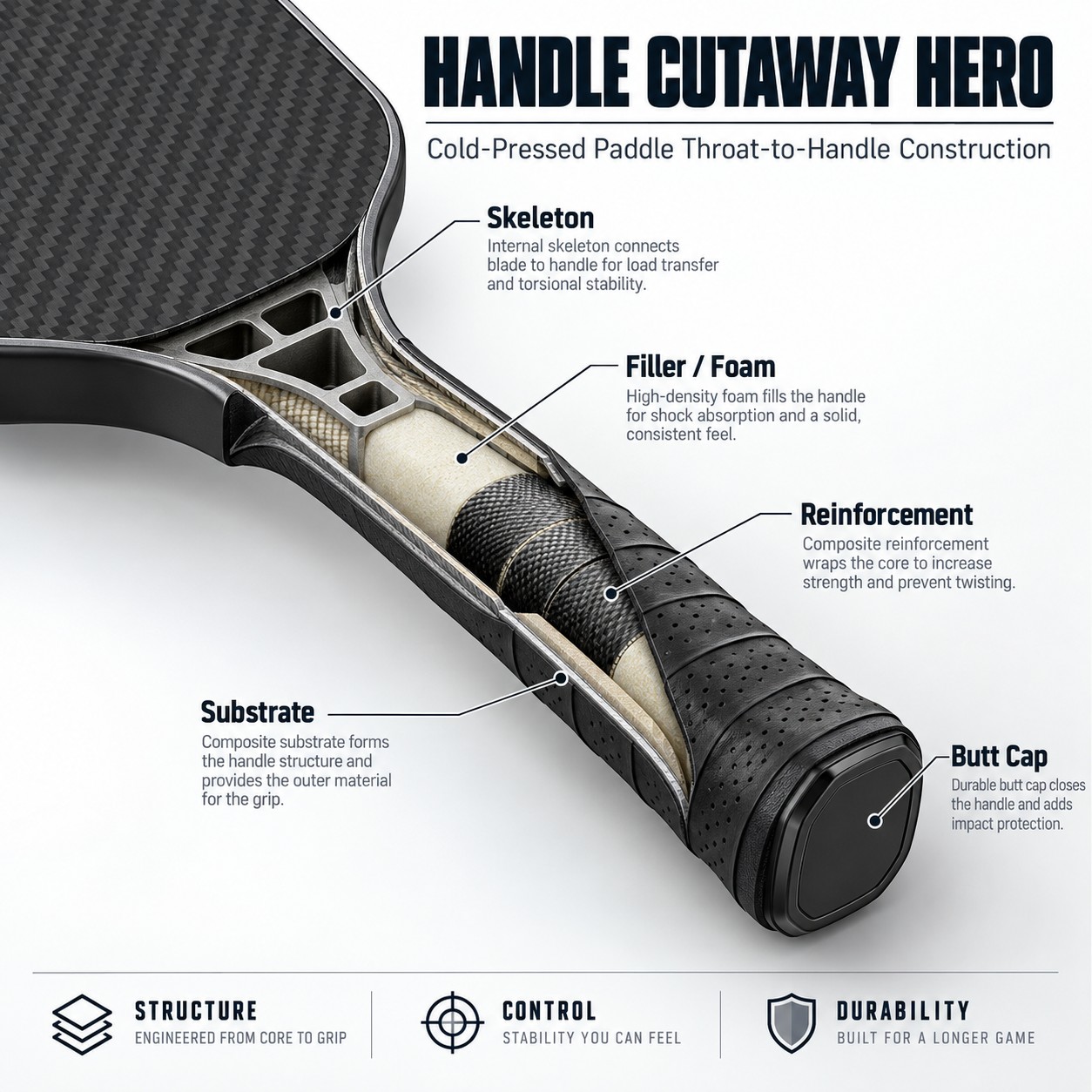
Define the Handle Construction
Map the Handle Stack
Document the face/core continuation, throat transition, handle insert or skeleton, foam or filler, side reinforcement, butt-cap connection, grip substrate and outer grip.
Different factories use wood, polymer, foam, composite laminates or combinations.
The exact material matters less than whether every layer has a defined structural role.
Load Path Through the Throat
The throat/handle junction transfers bending and torsion from the paddle head into the hand.
Sharp geometry changes, unsupported gaps or weak bond lines can concentrate stress.
A cross-section and bending test are more useful than cosmetic inspection alone.
Handle Skeleton and Inserts
An internal insert can provide shape, stiffness and a bonding surface.
If wood is used, moisture and dimensional consistency matter. If polymer or foam is used, stiffness and adhesion matter. If composite reinforcement is used, orientation and edge finishing matter.
Avoid treating any one insert material as universally superior.
Foam and Gap Filling
Foam can fill voids, support sidewalls, damp vibration or stabilize the grip shape.
It should not be used to hide poor dimensional control.
Specify foam type, density or hardness where relevant, placement and acceptable voids.
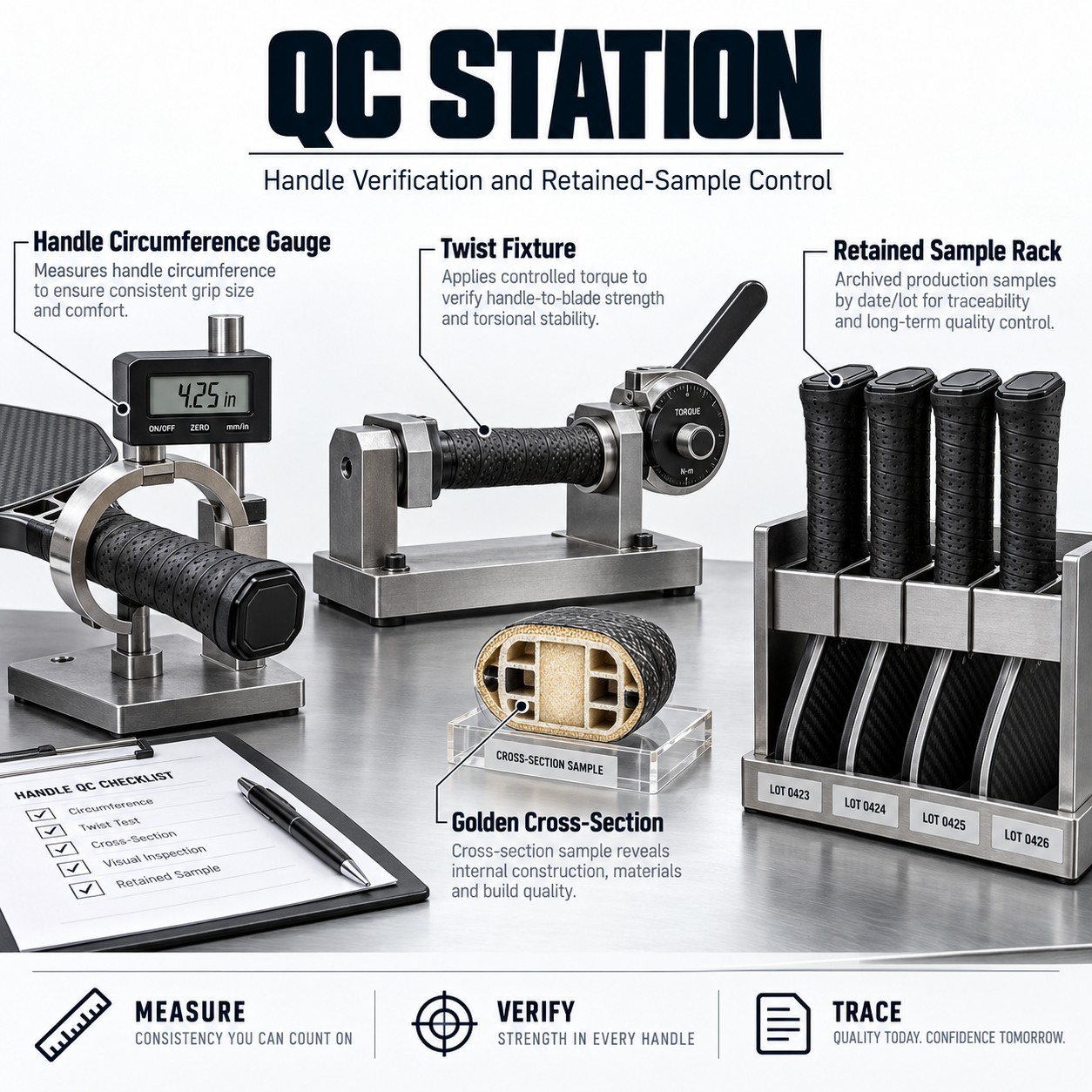
Materials, Bonding and Structural Risks
Bonding and Surface Preparation
Many handle failures begin at interfaces.
Control adhesive selection, surface cleanliness, application amount, assembly pressure and cure. Record which surfaces are bonded and whether roughening or primers are required.
A strong material with weak adhesion is still a weak handle.
Grip Substrate and Final Dimensions
The internal structure determines the final handle shape before grip tape.
Control circumference, flatness of bevels, taper, butt-cap transition and usable grip length.
Players can feel small dimensional differences even when the composite body is identical.
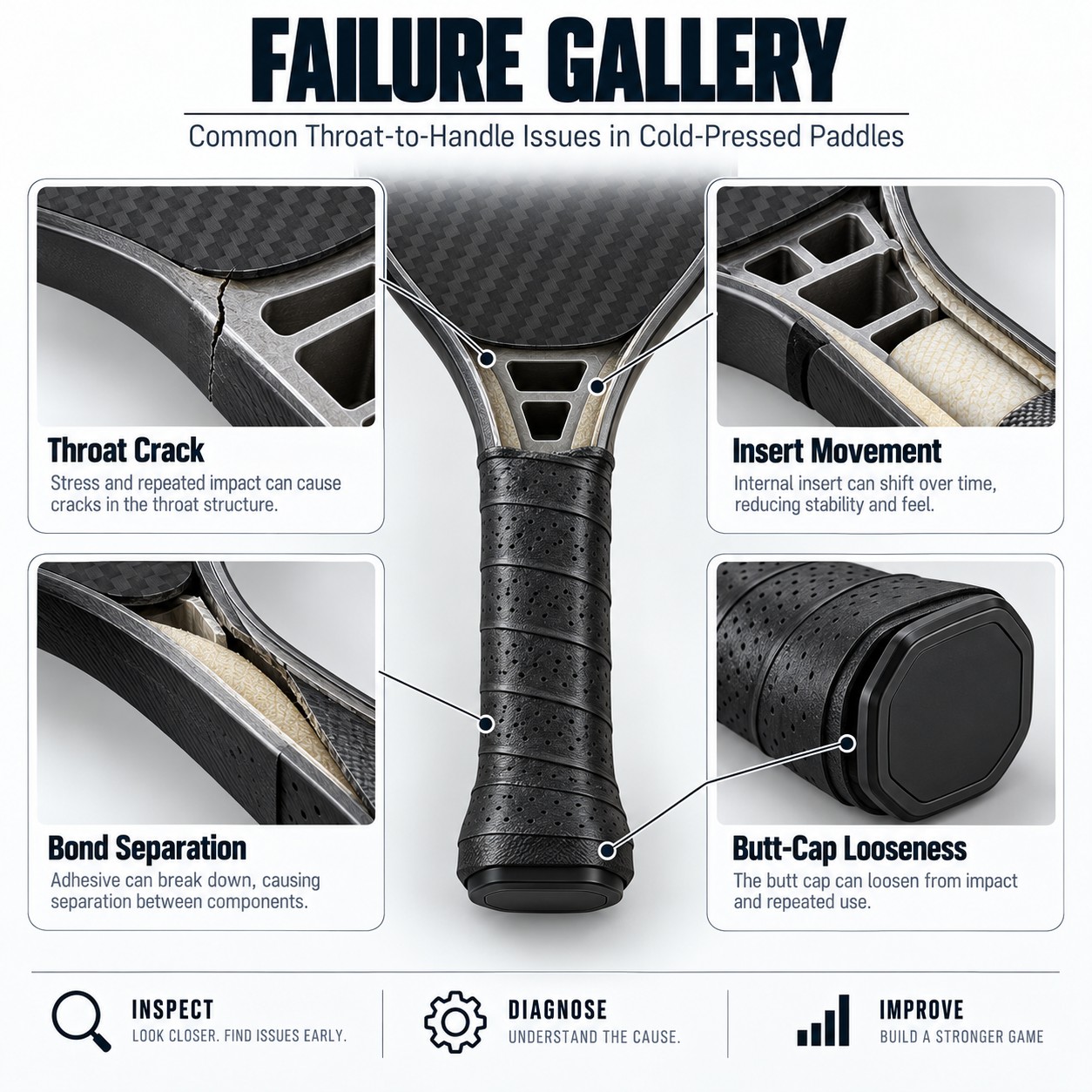
Common Failure Modes
Watch for throat cracks, insert movement, loose butt caps, grip substrate collapse, sidewall separation, bond failure and abnormal vibration.
Cut failed samples to identify the interface rather than guessing from exterior symptoms.
Separate design failure from assembly variation.
QC and Validation
Use dimensional checks, pull/twist tests where appropriate, visual inspection, retained samples and controlled destructive checks.
For new designs, test after repeated impact and after environmental exposure relevant to normal shipping/storage.
The handle must be validated as part of the whole paddle, not as a decorative component.
Prototype and QC the Interface
Handle Comfort Is Not Only Vibration
Players experience handle shape, circumference, bevel definition, grip compression, butt-cap transition and local stiffness together. A handle can be structurally strong yet uncomfortable if the geometry is inconsistent.
For development, create a dimensional drawing for the finished handle and add a tactile review to structural testing. The goal is a repeatable interface, not maximum stiffness.
Prototype Matrix for Handle Development
Build a small matrix using the same paddle body while changing one handle variable at a time: insert type, filler/foam, reinforcement layer or grip substrate. Produce multiple units per condition.
Compare twist, bending, weight, balance, grip circumference and player feedback. The result will show which variable actually improves the target rather than relying on factory habit.
Production Change Control
Handle materials are easy for factories to substitute because many components are hidden under the grip. That makes them a change-control risk.
List the approved insert, foam/filler, adhesive and grip substrate in the BOM. Require approval before substitution and retain periodic cut samples. Hidden components need stronger documentation, not weaker documentation.
Practical Editorial / Decision Notes
Handle design deserves its own drawing and finished-handle inspection standard. Circumference, bevel definition, insert position, grip compression and butt-cap transition together create the interface the player actually feels.
Hidden handle components are a change-control risk because the buyer cannot see them after wrapping. The BOM should therefore identify the approved insert, filler/foam, reinforcement and grip substrate.
Control Production Changes
Handle Failure & QC Matrix
| Risk | Evidence | QC / Test | Action |
|---|---|---|---|
| Insert movement | Section / assembly record | Bend / twist comparison | Fix interface |
| Grip circumference drift | Finished measurement | Defined measurement point | Control wrap |
| Butt-cap movement | Assembly inspection | Pull / visual | Component/process action |
| Bonding inconsistency | Section / adhesive control | Multi-unit check | Process review |
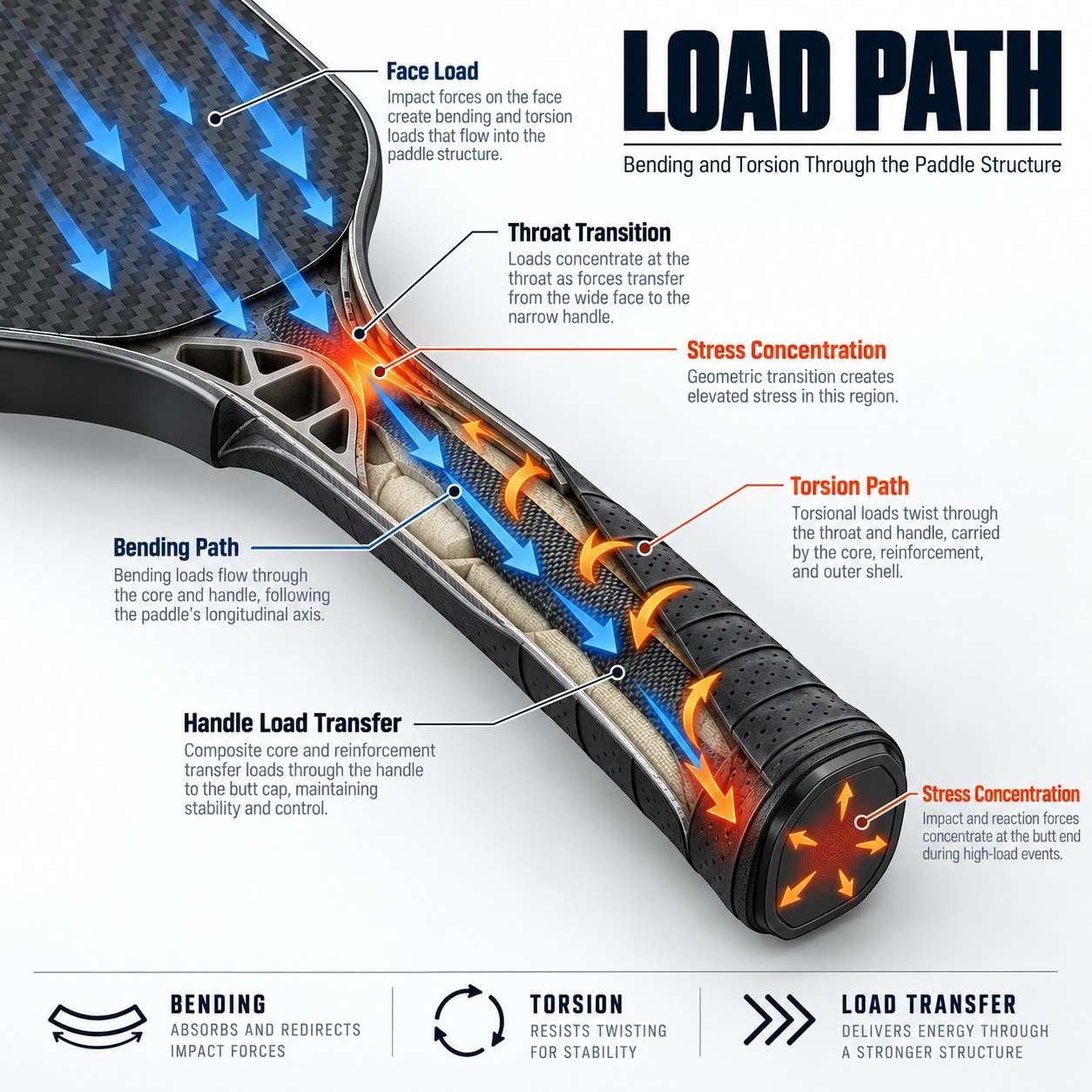
Treat the Handle as a Structural Subassembly
The handle is hidden after grip wrapping, which makes it an easy place for unapproved substitutions or inconsistent assembly. A robust OEM file therefore controls the insert/skeleton, filler or foam, reinforcement, adhesive, finished circumference and butt-cap system.
QC should connect structural integrity with player fit. A handle can survive bending and still fail the product if circumference, bevel shape or usable grip length drifts across a production lot.
- Create a finished-handle drawing and measurement method.
- Retain cross-sections when hidden components change.
- Control wrap tension and final circumference as production variables.
Frequently Asked Questions
Is a foam-filled handle automatically stronger?
No. Foam can support the structure, but load path and bonding are still critical.
Is wood bad in a paddle handle?
Not inherently. Material choice must be evaluated with moisture, geometry, bonding and design requirements.
What is the most common hidden risk?
Poorly controlled interfaces and unsupported transitions.
Should handle circumference be checked before or after grip?
Both can matter; control the structural substrate and the final finished grip dimension.
What should OEM QC retain?
Approved handle cross-section, material specs, dimensions, test method and retained production samples.
Developing a new handle construction?
Mayvoci can help define the hidden component stack, fit targets and QC checkpoints before the grip covers the structure.
The End about Mayvoci
1)Design:Over 100 paddle designs and photography service to assist start-up.
2)Professional:Focus on various of paddles manufacturing for 6 years
3)Quality:Strict quality management system to provide safety and satisfaction for customers
4)Amazon:Flexible comprehensive solution to make sure each Amazon seller is well cared.
5)Excellent Team:Experienced paddle experts & dynamic sales team give you 5-star service