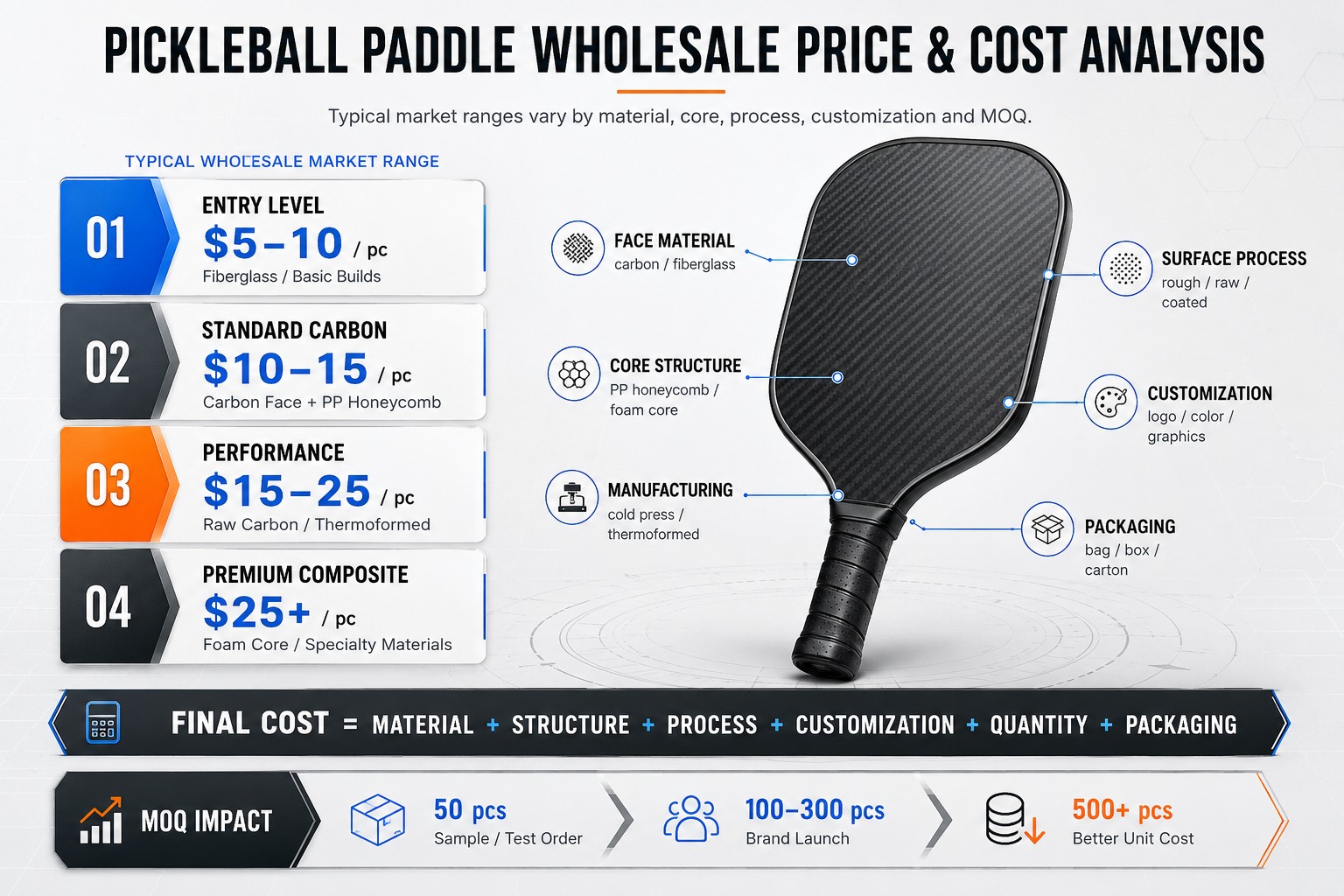
If you are sourcing pickleball paddles for a brand, sports store, club, or distribution business, you may have noticed something confusing: wholesale prices for seemingly similar paddles can be surprisingly different.
One supplier may quote $9 per paddle, another $12, and another $18 or more.
Why?
It is easy to assume that the more expensive supplier simply has a higher profit margin. In reality, the wholesale price of a pickleball paddle is influenced by much more than the manufacturer’s markup. Materials, core construction, manufacturing process, customization, order quantity, packaging, and even shipping efficiency can all change the final cost.
More importantly, two paddles that look almost identical in a product photo may be completely different from a manufacturing perspective.
So if you want to reduce your pickleball paddle wholesale price, the best approach is not simply to ask a factory for a bigger discount.
You need to understand what is actually driving the cost and which parts of the product or order can be optimized.
Why Do Pickleball Paddle Wholesale Prices Vary So Much?
A wholesale price is not simply the cost of the raw materials plus a manufacturer’s profit.
A simplified cost structure looks like this:
Raw Materials + Manufacturing + Labor + Quality Control + Packaging + Factory Overhead + Profit = Wholesale Price
For an international buyer, the actual procurement cost can be even higher after adding freight, customs, taxes, and other logistics expenses.
The biggest reason prices vary is that manufacturers may be quoting different products, even when the paddles look similar.
Consider two paddles with the same shape and thickness.
One might use fiberglass with a standard PP honeycomb core and a relatively simple cold-pressing process.
The other might use T700 carbon fiber, a more advanced core structure, foam injection, thermoforming, a customized mold, and premium packaging.
They are both pickleball paddles, but their manufacturing costs are obviously not the same.
This is why the first rule of wholesale sourcing is:
Never compare pickleball paddle prices without comparing the specifications behind those prices.
A lower quotation may simply represent a lower-cost construction.
A higher quotation may reflect more expensive materials, more complicated manufacturing, or a higher level of customization.
The question is not which supplier has the lowest number.
The question is which supplier can provide the specification you actually need at the most competitive total cost.
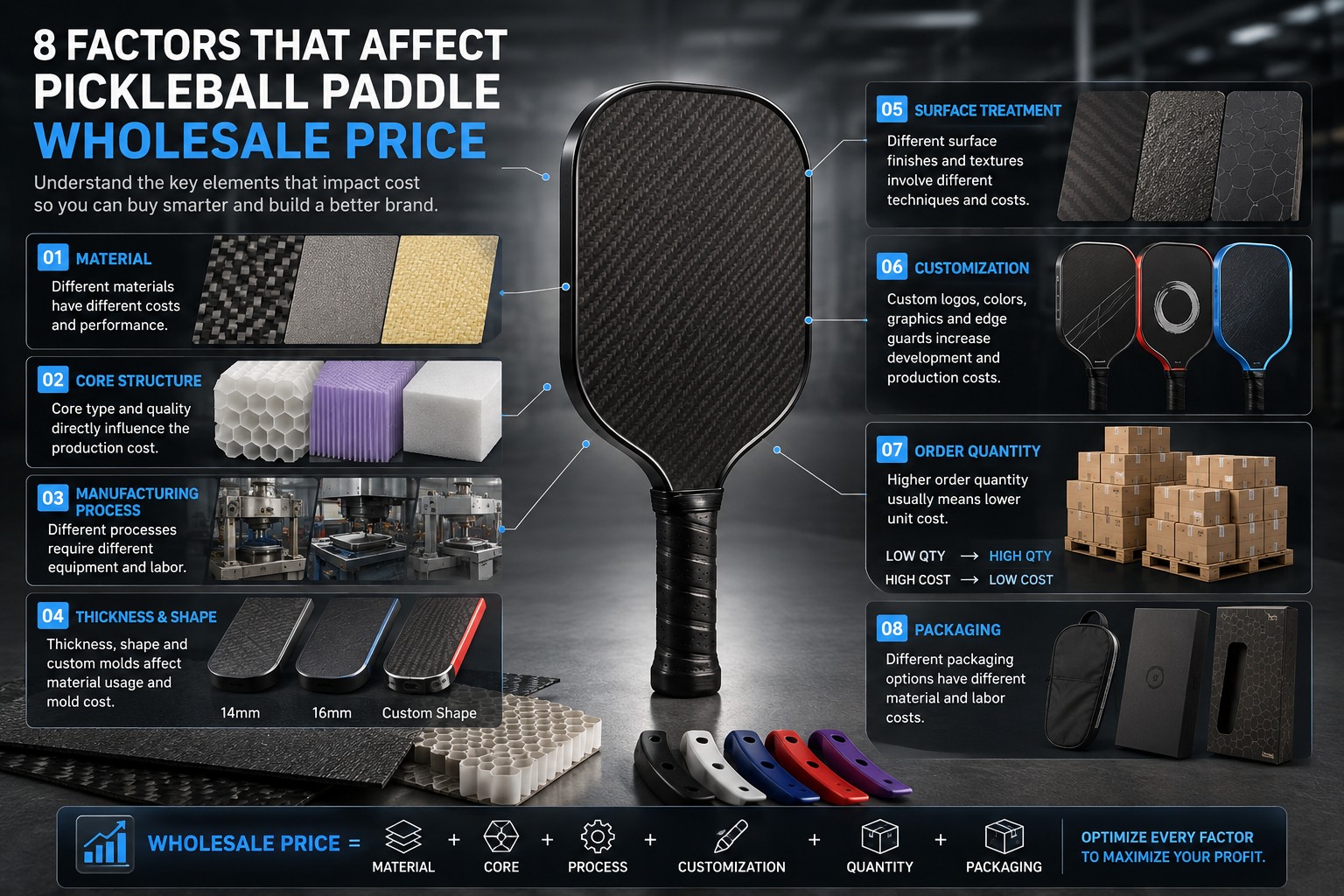
What Actually Drives the Cost of a Pickleball Paddle?
Several factors work together to determine the wholesale price.
Materials and Core Construction
The paddle face is one of the most visible cost differences.
Common face materials include fiberglass, T300 carbon fiber, T700 carbon fiber, T800 carbon fiber, different carbon fiber weaves, and natural-fiber options such as flax.
Fiberglass is generally a more cost-effective choice, while premium carbon fiber constructions can require substantially more expensive materials.
But the face is only one part of the paddle.
The core also has a major influence on cost and performance. Common options include PP honeycomb, aramid honeycomb, aluminum honeycomb, EPP, MPP, PET foam, full-foam constructions, and multi-layer sandwich structures.
A simple PP honeycomb construction and a more complex multi-layer foam structure should not be expected to have the same manufacturing cost.
The more complicated the structure becomes, the more likely it is that you will also have additional assembly steps, processing requirements, materials, adhesives, and quality-control procedures.
This is why buyers should think about performance-to-cost ratio, rather than simply choosing the most expensive material available.
A premium material only makes commercial sense if it provides enough additional value for your target market.
Thickness and Manufacturing Process
Paddle thickness also affects cost.
Common options include 11 mm, 13 mm, 14 mm, 16 mm, and 19 mm.
Thickness can influence material consumption, weight, stability, power, control, vibration, and overall playing feel.
Manufacturing process matters as well.
Cold-pressed paddles and thermoformed paddles can have different production requirements. A thermoformed construction may require controlled heating, pressure, cooling, molds, foam injection, or specialized edge construction.
Therefore, two paddles made with similar face materials can still have different wholesale prices because their manufacturing processes are different.
When a quotation seems high, a better question is:
“Which part of the construction or manufacturing process is creating the additional cost?”
That question gives you something concrete to optimize.
Customization and Tooling
Customization is another major cost driver.
A buyer may request a custom paddle shape, new mold, custom artwork, branded grip, custom edge guard, special handle length, unique surface finish, retail packaging, accessories, or other details.
Each request may seem relatively small, but together they can significantly increase the cost.
Custom molds are particularly important because they represent a fixed cost.
Suppose a new mold costs $1,000.
If you order only 100 paddles, that tooling cost represents $10 per paddle.
If you order 1,000 paddles, it represents only $1 per paddle.
The mold did not become cheaper. Its cost was simply distributed across more units.
This is one of the fundamental reasons why highly customized products with small order quantities can have surprisingly high unit prices.
Packaging and Accessories
Packaging is another cost that is easy to overlook.
A paddle may require:
- Retail box
- Printed carton
- Protective insert
- Individual bag
- Barcode
- Hang tag
- Instruction card
- Paddle cover
- Additional accessories
For a large order, these costs may be relatively small on a per-unit basis.
For a small order, however, customized packaging can add a meaningful amount to the total cost.
If you are launching a new brand and primarily want to test the market, you may not need to invest heavily in premium packaging from the beginning.
A simpler packaging solution can allow you to put more of your budget into the actual product.
Why Does Order Quantity Have Such a Big Impact on Wholesale Price?
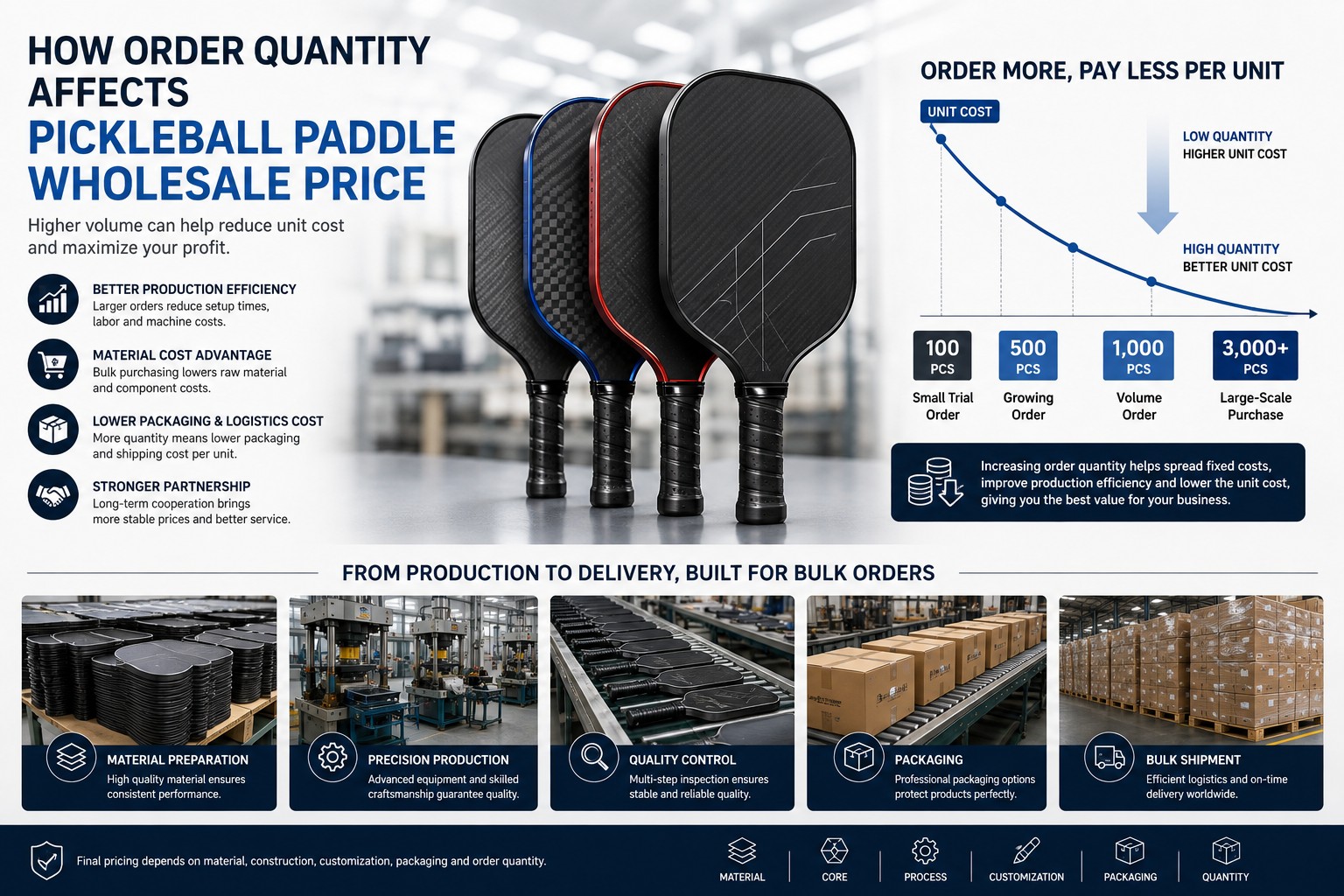
Among all the factors buyers can control, order quantity is one of the most powerful.
Manufacturing contains both variable costs and fixed costs.
Variable costs increase with every additional paddle, such as raw materials and certain production labor.
Fixed costs, however, may exist regardless of whether the factory produces 100 or 1,000 paddles.
These can include:
- Mold setup
- Production setup
- Artwork preparation
- Machine adjustment
- Quality-control preparation
- Packaging preparation
- Production scheduling
The more units you order, the more efficiently these fixed costs are distributed.
For example, imagine a project has $1,000 in fixed costs.
At 100 units:
$1,000 ÷ 100 = $10 per paddle
At 500 units:
$1,000 ÷ 500 = $2 per paddle
At 1,000 units:
$1,000 ÷ 1,000 = $1 per paddle
This is why manufacturers usually provide different prices at different quantities.
Instead of asking only for the “best price,” ask the supplier for a quantity-based quotation.
For example:
| Order Quantity | Example Unit Price |
|---|---|
| 100 pcs | $15.00 |
| 300 pcs | $12.50 |
| 500 pcs | $11.80 |
| 1,000 pcs | $10.90 |
These figures are only illustrative. Actual pricing depends on the product specification.
The important point is that a quantity ladder lets you see where the meaningful price breaks occur.
However, there is an important warning for new brands:
Do not purchase excessive inventory simply to obtain a lower unit price.
If 300 paddles cost $12.50 and 1,000 paddles cost $11, the larger order looks attractive because you save $1.50 per paddle.
But you also need to invest thousands of additional dollars into inventory.
If the products sell slowly, become outdated, or need to be redesigned, that lower unit price may actually increase your overall business risk.
The right question is therefore not:
“What quantity gives me the lowest price?”
It is:
“What quantity gives me the best balance between unit cost, inventory, cash flow, and expected sales?”
How Can You Lower Your Wholesale Paddle Cost Without Sacrificing Quality?
The most effective cost reduction usually does not come from simply pressuring the factory to reduce its profit margin.
It comes from optimizing the product specification and purchasing structure.
Start With the Product Specification
Ask yourself whether every premium feature is actually necessary for your target market.
Do you need T700 instead of T300?
Do you need a completely new mold?
Do you need a highly complex core construction?
Do you need a custom grip and custom edge guard for the first order?
Do you need premium retail packaging immediately?
If a feature adds significant cost but little customer value, it may be a good candidate for optimization.
This does not mean choosing the cheapest possible material.
It means choosing the material and construction that provide the best balance of performance, durability, positioning, and cost.
Use Existing Production Platforms When Possible
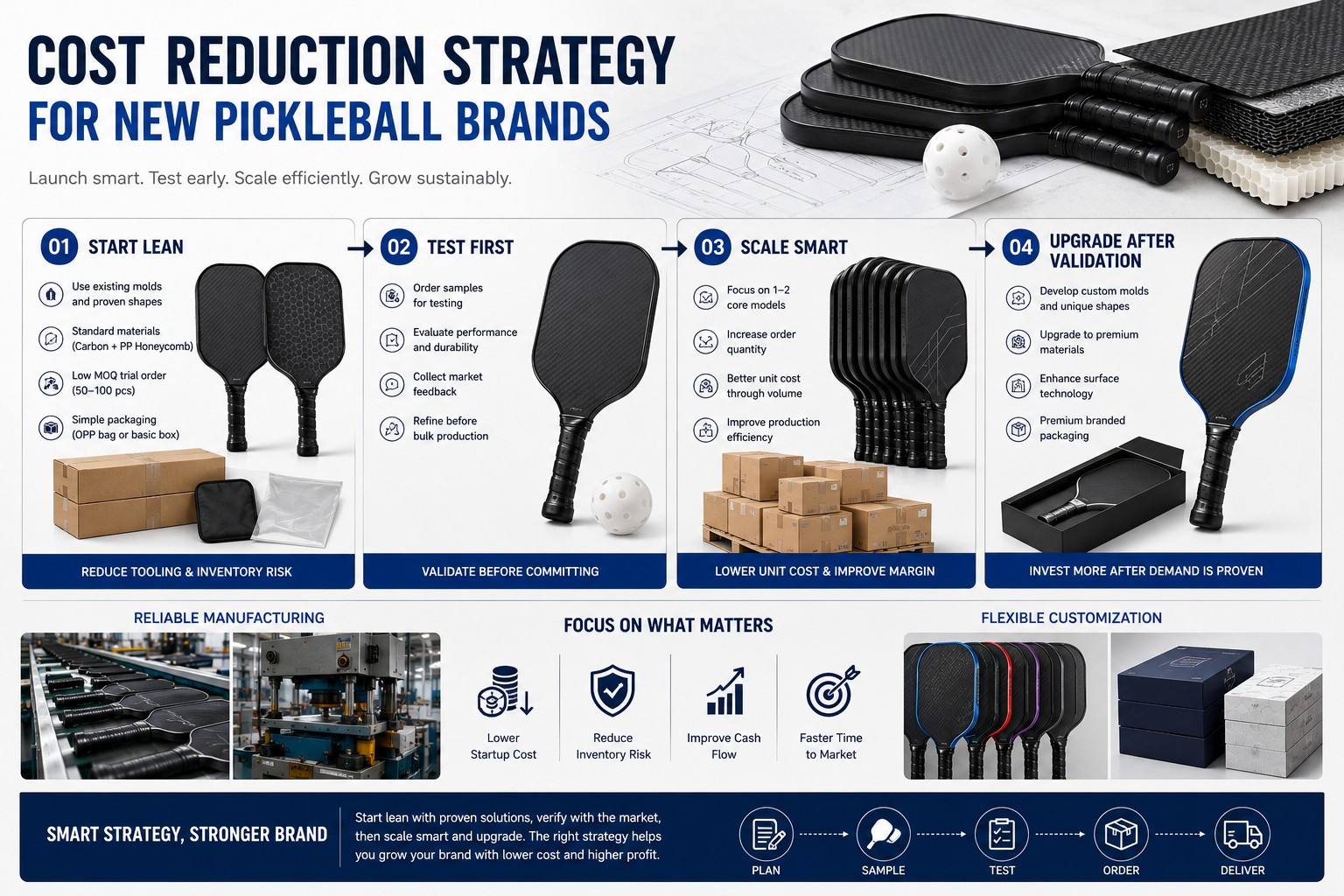
For a new brand, one of the easiest ways to reduce development costs is to use an existing mold and proven production structure.
You can still customize:
- Artwork
- Logo
- Branding
- Colors
while keeping certain production components standardized.
This can significantly reduce tooling costs and simplify production.
Once the product has proven itself in the market, you can invest in a completely custom mold or more advanced construction.
Standardize Components
Standardization can also reduce costs.
Instead of creating a completely unique:
- Grip
- Edge guard
- Handle
- Packaging
- Accessory system
for every product, consider using standard components where they do not affect your brand’s competitive advantage.
Then concentrate your customization budget on the features customers actually notice and value.
Optimize Packaging
If the paddle is being sold primarily online, your packaging requirements may be different from those of a premium sporting-goods retailer.
A new brand may benefit from starting with simple, functional packaging and upgrading to premium retail packaging after sales volume increases.
This is particularly useful when the initial order is small.
How Should You Compare Wholesale Quotes?
Once you start contacting multiple manufacturers, you will probably receive very different quotations.
The biggest mistake is to create a spreadsheet with only one column:
Unit Price
That is not enough.
A proper comparison should include:
| Factor | Why It Matters |
|---|---|
| Unit Price | Direct product cost |
| Quantity | Determines price level |
| Face Material | Affects performance and cost |
| Core | Affects construction and durability |
| Manufacturing Process | Affects production cost |
| Customization | Affects tooling and production |
| Packaging | Affects product and shipping cost |
| MOQ | Determines inventory commitment |
| Lead Time | Affects replenishment |
| Quality | Affects returns and customer satisfaction |
| Shipping | Affects landed cost |
Most importantly, make sure suppliers are quoting the same product specification.
If Supplier A quotes a fiberglass paddle and Supplier B quotes a T700 carbon fiber paddle, their prices are not directly comparable.
Likewise, if one quotation includes a paddle cover, custom box, and special surface finish while another does not, the unit prices cannot be compared fairly.
Compare Landed Cost, Not Just Factory Price
For international sourcing, the final cost can be represented approximately as:
Landed Cost = Product Cost + Packaging + Freight + Duties/Taxes + Other Import Costs
For example, Supplier A may offer a paddle at $10.50 while Supplier B offers $11.20.
Supplier A appears cheaper.
But if Supplier A uses less efficient cartons and has significantly higher freight costs, Supplier B may actually provide the lower landed cost.
This is why experienced buyers look beyond the factory quotation.
A Practical Cost-Reduction Strategy for a New Pickleball Brand
Imagine a new brand wants to launch its first paddle.
The original plan might look like this:
- 100 paddles
- New custom mold
- T700 carbon fiber
- Complex core construction
- Custom grip
- Custom edge guard
- Premium retail box
- Paddle cover
- Multiple accessories
From a product-development perspective, this sounds attractive.
From a procurement perspective, however, it creates a lot of fixed costs while spreading those costs over only 100 units.
A more conservative launch strategy might be:
- 300 paddles
- Existing production mold
- T300 carbon fiber
- Proven core construction
- Standard grip
- Standard edge guard
- Custom artwork
- Simplified packaging
This approach may not create the most technically advanced paddle on the market.
But it can dramatically reduce the financial risk of the first order.
More importantly, it allows the brand to test:
- Market demand
- Selling price
- Customer feedback
- Product durability
- Return rate
- Sales velocity
- Repeat purchase potential
If the product sells well, the next order can introduce more advanced specifications.
This is often a much smarter strategy than spending heavily on customization before you know whether customers will buy the product.
The Cheapest Wholesale Price Is Not Always the Best Deal
There is one final principle that every pickleball paddle buyer should remember:
The cheapest unit price does not necessarily mean the lowest total cost.
Suppose Supplier A offers $10 per paddle and Supplier B offers $11.
Supplier A looks better.
But if Supplier A has:
- Higher defect rates
- Inconsistent surface finish
- Poor durability
- Longer lead times
- Higher shipping costs
- Weak after-sales support
the apparent $1 saving may disappear very quickly.
A reliable $11 paddle may ultimately be more profitable than an unreliable $10 paddle.
This is especially important for brands.
A poor-quality paddle can lead to:
- Customer complaints
- Returns
- Replacements
- Negative reviews
- Lost repeat customers
- Damage to your brand reputation
Therefore, your objective should not be to find the cheapest factory.
It should be to find the most commercially suitable supplier and product configuration.
Final Takeaway
Pickleball paddle wholesale prices are determined by much more than the factory’s profit margin.
The biggest cost factors usually include:
- Face material
- Core construction
- Paddle thickness
- Manufacturing process
- Mold and tooling
- Customization
- Packaging
- Order quantity
- Quality requirements
- Logistics
If you want to lower your wholesale cost, start by understanding these variables.
Then decide which specifications are essential to your product and which can be standardized or simplified.
For a new brand, a practical starting strategy is often:
Proven production platform + manageable quantity + carefully selected materials + limited customization + efficient packaging
As your sales volume increases, you can gradually invest in custom molds, advanced materials, more complex constructions, and premium packaging.
The goal is not to make the paddle as cheap as possible.
The goal is to achieve the best balance between:
Cost + Quality + Performance + Brand Positioning + Inventory Risk.
And once you understand how wholesale pricing works, the next question becomes:
How do you actually compare multiple pickleball paddle suppliers and determine which quotation is worth choosing?
That is where Alibaba sourcing becomes important.
Read Next
How to Compare Pickleball Paddle Suppliers on Alibaba: RFQ, Pricing & Supplier Screening Guide
In the next article, we will focus specifically on how to use Alibaba to:
- Compare supplier prices correctly
- Send an effective RFQ
- Ask for comparable quotations
- Screen potential manufacturers
- Identify important supplier differences
- Avoid choosing a supplier based only on the lowest price
This article explains why the price is what it is. The next article explains how to compare the suppliers behind those prices.
FAQ
Why are pickleball paddle wholesale prices so different?
Because suppliers may use different face materials, core constructions, manufacturing processes, molds, customization, packaging, and order quantities. Always compare the complete specification rather than the unit price alone.
Does ordering more pickleball paddles reduce the wholesale price?
Usually, yes. Larger orders allow fixed production and setup costs to be distributed across more units. However, you should balance the lower unit price against inventory and cash-flow risk.
What is the biggest factor affecting pickleball paddle wholesale price?
There is no single factor for every paddle. Face material, core construction, manufacturing process, customization, and order quantity can all have a major impact.
How can a new pickleball brand reduce its first-order cost?
Consider using an existing mold, proven construction, standard components, simplified packaging, and a manageable order quantity. Customize the elements that are most important to your brand rather than customizing everything.
Should I always choose the supplier with the lowest price?
No. You should also consider quality, MOQ, lead time, materials, manufacturing capability, shipping, warranty, and total landed cost.
How should I negotiate a lower pickleball paddle wholesale price?
Instead of simply asking for a discount, ask the supplier which specifications can be changed to reduce cost. Increasing quantity, using an existing mold, simplifying packaging, or changing a non-critical specification can often be more effective than asking for a direct price reduction.
The End about Mayvoci
1)Design:Over 100 paddle designs and photography service to assist start-up.
2)Professional:Focus on various of paddles manufacturing for 6 years
3)Quality:Strict quality management system to provide safety and satisfaction for customers
4)Amazon:Flexible comprehensive solution to make sure each Amazon seller is well cared.
5)Excellent Team:Experienced paddle experts & dynamic sales team give you 5-star service