
A good prototype is not the same thing as a production-ready paddle. The original Mayvoci article correctly frames sample development as a progression from idea to documented production reference; V2 turns that workflow into a working project-control system.
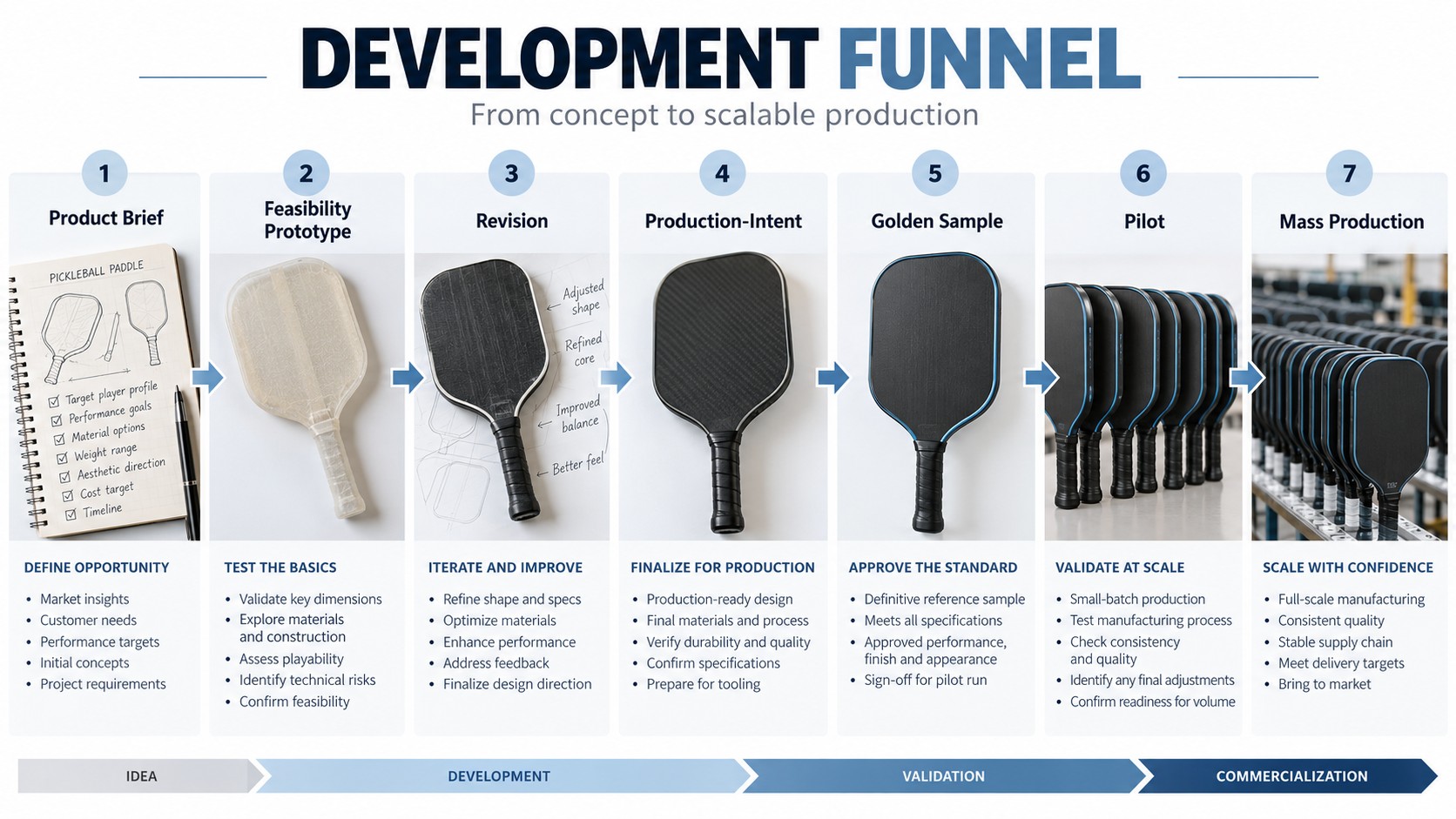
Define the Product Job Before Building V1
The brief should identify target player, geometry, thickness, target weight/balance direction, face/core concept, surface process, grip, edge system, cosmetics, packaging, compliance path, target cost and launch timing.
Separate frozen requirements from development variables. If the team has not decided which variables remain open, every prototype risks becoming an accidental “final” sample.
Use Five Development Gates
| Gate | Primary Question | Typical Evidence | Release Decision |
|---|---|---|---|
| V1 · Feasibility | Can the concept be built? | first prototype + issue list | Revise / stop / continue |
| Controlled Revision | Did the intended change create the intended result? | change log + A/B samples | Continue / reverse / new test |
| Production-Intent | Are material sources and process close to mass production? | production-intent BOM + sample | Close remaining exceptions |
| Golden Sample | Is the approved product frozen? | physical sample + BOM + artwork + dimensions | Approve reference |
| Pilot Run | Can normal production reproduce it? | multi-unit QC + retained samples | Release / corrective action |
Not every project needs exactly the same number of sample rounds. The principle is that each round should close a known risk rather than simply produce “another sample.”
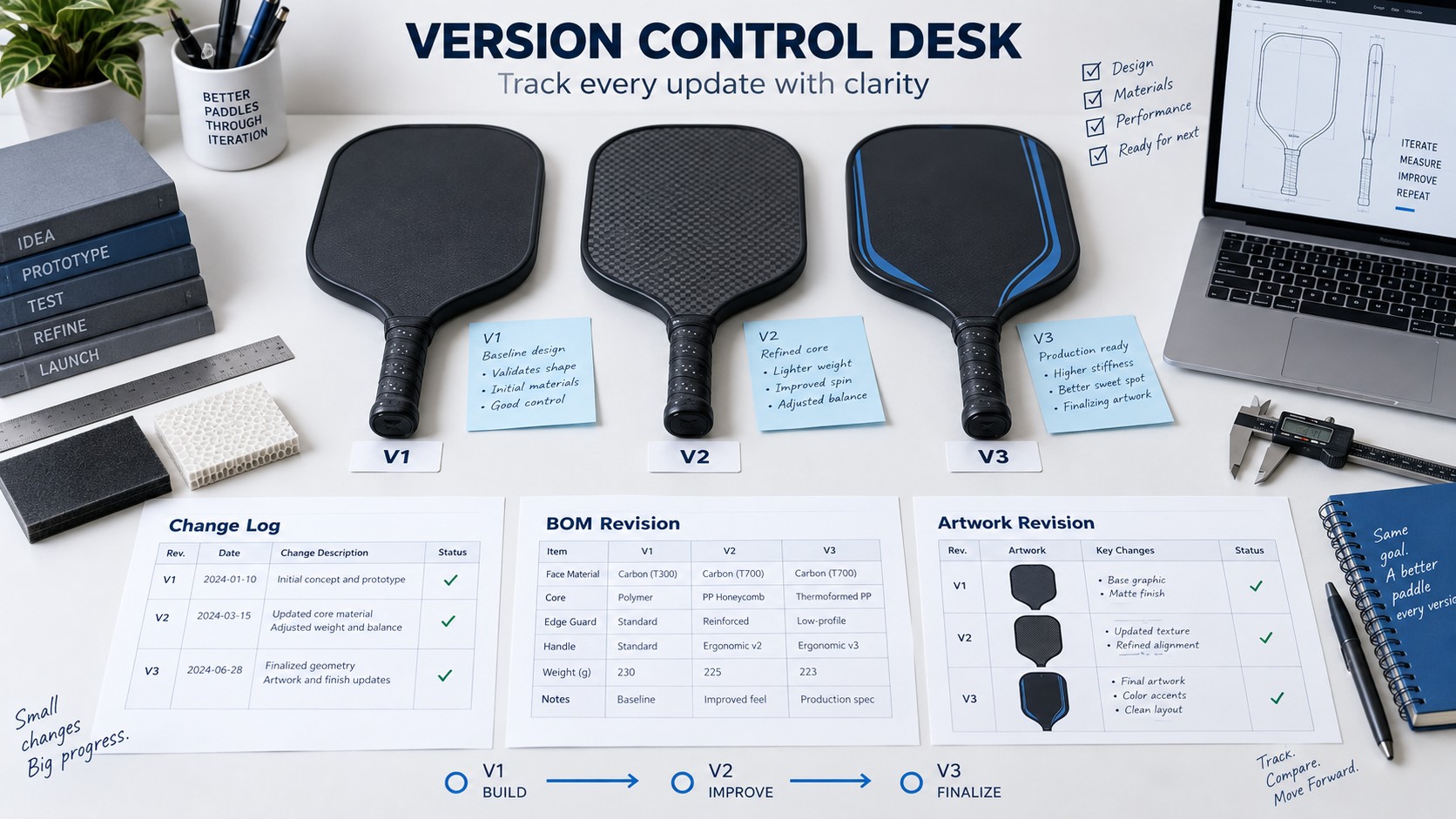
Make the Change Log the Center of Communication
Chat messages are not a reliable version-control system. Every new sample should arrive with a short change summary that identifies what changed, why, which files/BOM were used and what result was observed.
Illustrative structure only. Replace the example changes with the real project history.
| Version | Change | Reason | Evidence / Result | Status |
|---|---|---|---|---|
| V1 | Initial construction | Feasibility | Issue list created | Revise |
| V2 | Example: surface process changed | Target adjustment | A/B test recorded | Review |
| V3 | Example: grip / mass distribution update | Buyer fit request | dimensions + play check | Production-intent candidate |
| PI | Production-intent materials/process | Scale validation | full check completed | Golden sample candidate |
| GS | Frozen approved build | Production reference | signed sample + frozen docs | Approved |
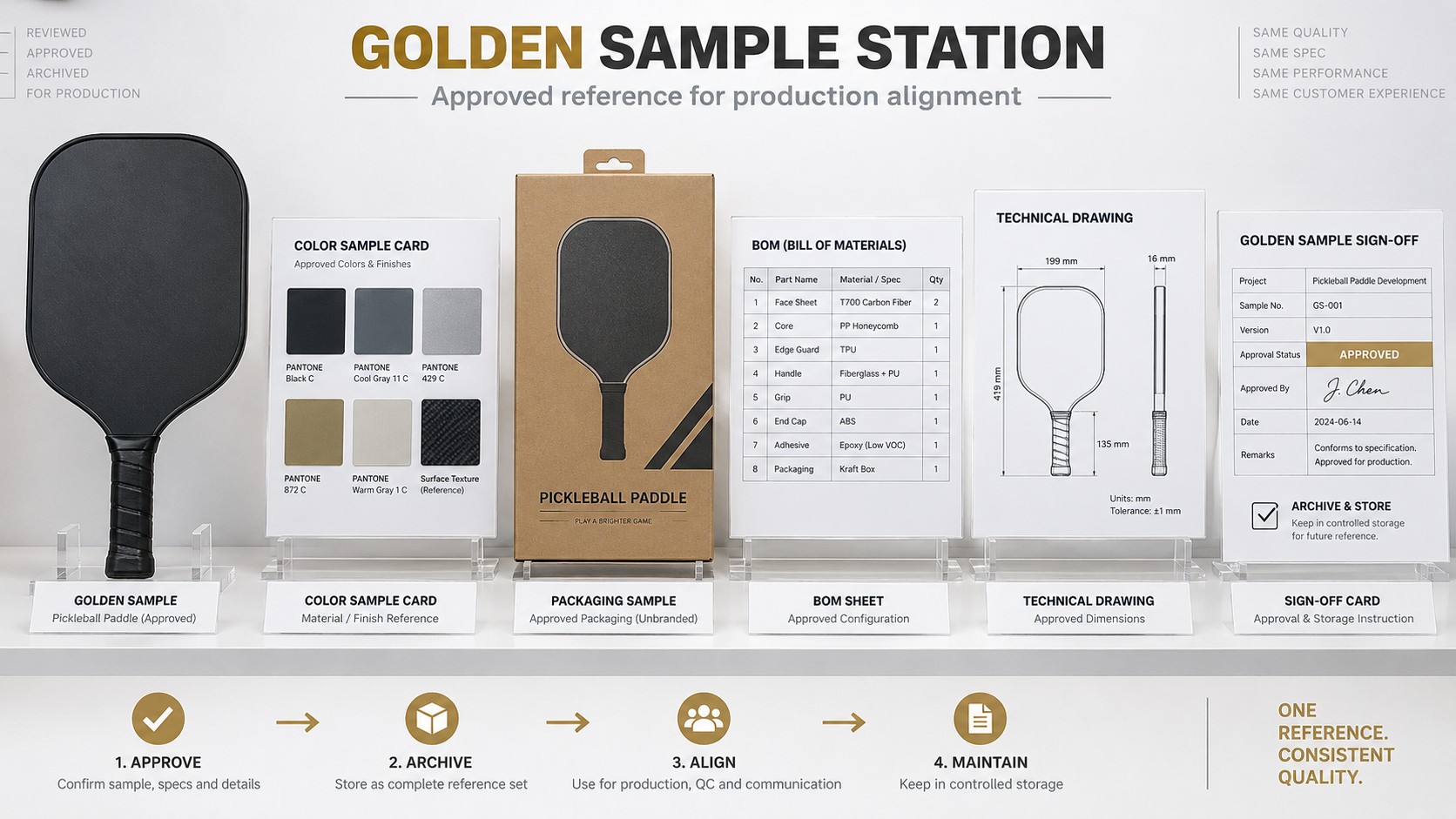
Define What a Golden Sample Actually Controls
The golden sample is a physical reference linked to controlled documents. It should not exist as a photograph floating in a chat thread.
| Golden-Sample Item | Required Control |
|---|---|
| Physical paddle | Unique ID / sign-off / storage location |
| BOM | Approved material and component version |
| Dimensions | Drawing or measurement specification |
| Artwork | Final file revision and color reference |
| Packaging | Approved dieline / insert / label version |
| Process-critical notes | Only the parameters/conditions needed for repeatability and approval |
| Exceptions | Any item not yet production-intent must be explicitly closed |
When the paddle uses a compliance-sensitive construction, the certification sample and manufacturing reference also need a clear relationship so later changes can be reviewed.
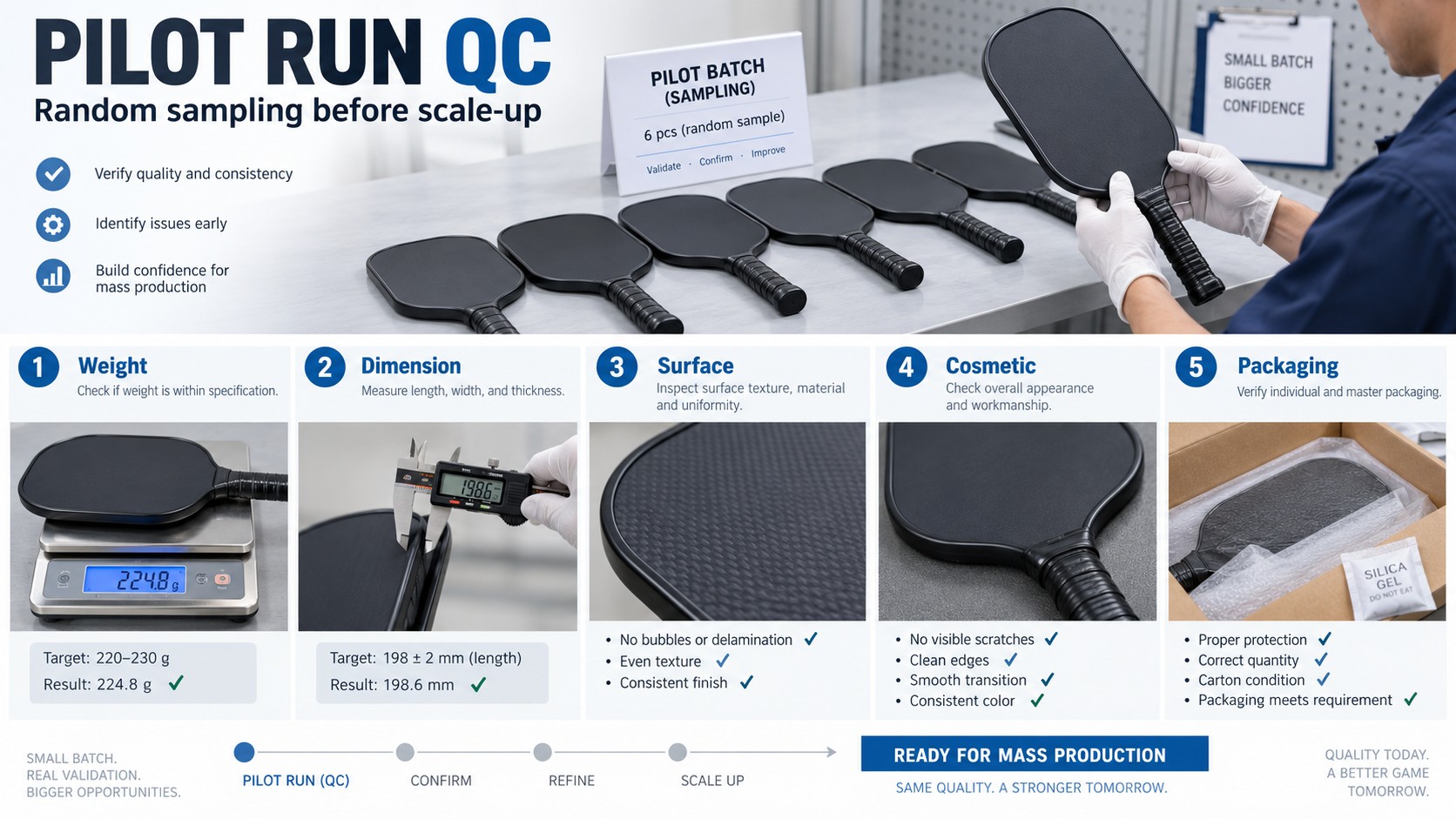
Use the Pilot Run to Test Repeatability, Not Beauty
A pilot lot asks whether normal production can reproduce the product across multiple units. Inspect the distribution, not one “best” sample.
Measure the agreed production variables—such as weight, dimensions, surface/cosmetics, grip, assembly and packaging—and retain several units. If performance or compliance metrics are important, sample multiple paddles under the same method.
Define Mass-Production Release and Change Control
Release production only when the remaining development risks are closed and the buyer/factory agree which changes require approval. The first production lot should be compared with the golden sample and retained for future complaint investigation.
After release, a material or process change is no longer “just another sample.” It is a controlled change to an approved product.
Use a One-Page Project Dashboard
| Project Field | Current Status |
|---|---|
| Current version | V__ / Production-Intent / Golden / Pilot |
| Open technical risks | List 1–5 only |
| Open commercial risks | MOQ / tooling / packaging / lead time / cost |
| Files frozen? | BOM / artwork / drawing / packaging |
| Compliance status | Not started / pre-check / submitted / approved |
| Next decision | What must be decided, by whom, by what date |
Mayvoci First-Party Evidence to Add Before “Authority” Positioning
These are evidence tasks, not claims. Do not publish them as “our process” until the real photo, record or test exists.
Real sample history
Capture: One real V1→V2→V3 project laid out physically
Record: change, date, owner and result for every version
After evidence exists: Turn the article’s revision log into a true Mayvoci case example.
Golden sample station
Capture: Signed paddle + BOM/artwork/packaging references
Record: sample ID and document revisions
After evidence exists: Show what ‘approved reference’ means physically.
Pilot-lot QC
Capture: A real small production batch and QC sheet
Record: sample count and checked variables
After evidence exists: Demonstrate repeatability rather than one selected sample.
Change request
Capture: One sanitized post-approval change record
Record: old/new item, reason, validation and approval
After evidence exists: Show how changes are controlled after sample approval.
Frequently Asked Questions
How many sample rounds are normal?
There is no universal number. Use enough controlled rounds to close design and production risks.
What is a production-intent sample?
A sample built with the intended mass-production materials, process route and components as far as practical.
What makes a golden sample valid?
A uniquely identified physical reference linked to the frozen BOM, dimensions, artwork and other approved documents.
Why run a pilot batch?
To test repeatability across normal production units instead of approving one hand-selected sample.
What is the simplest way to reduce revision mistakes?
Require a written change summary with every sample version.
The End about Mayvoci
1)Design:Over 100 paddle designs and photography service to assist start-up.
2)Professional:Focus on various of paddles manufacturing for 6 years
3)Quality:Strict quality management system to provide safety and satisfaction for customers
4)Amazon:Flexible comprehensive solution to make sure each Amazon seller is well cared.
5)Excellent Team:Experienced paddle experts & dynamic sales team give you 5-star service

If you work on this topic from the brand, sourcing, engineering or manufacturing side, I’d be interested in your experience: What creates the most sample-development mistakes in your projects: changing too many variables, unclear approvals, weak version control or skipping the pilot run?