
A supplier quote is not the final cost of a pickleball paddle. For an importer, the useful number is landed cost: the total cost required to move the goods from the agreed supplier point to the location where the inventory is commercially usable.
The exact components vary by Incoterm, country, freight mode and customs treatment, but a serious model should connect product cost, packaging, freight, duties or additional trade measures, brokerage, destination charges and foreign-exchange exposure in one worksheet.
This article explains the model. It does not provide a fixed duty rate for pickleball paddles because U.S. tariff treatment depends on the correct HTS classification, country of origin and current trade measures.
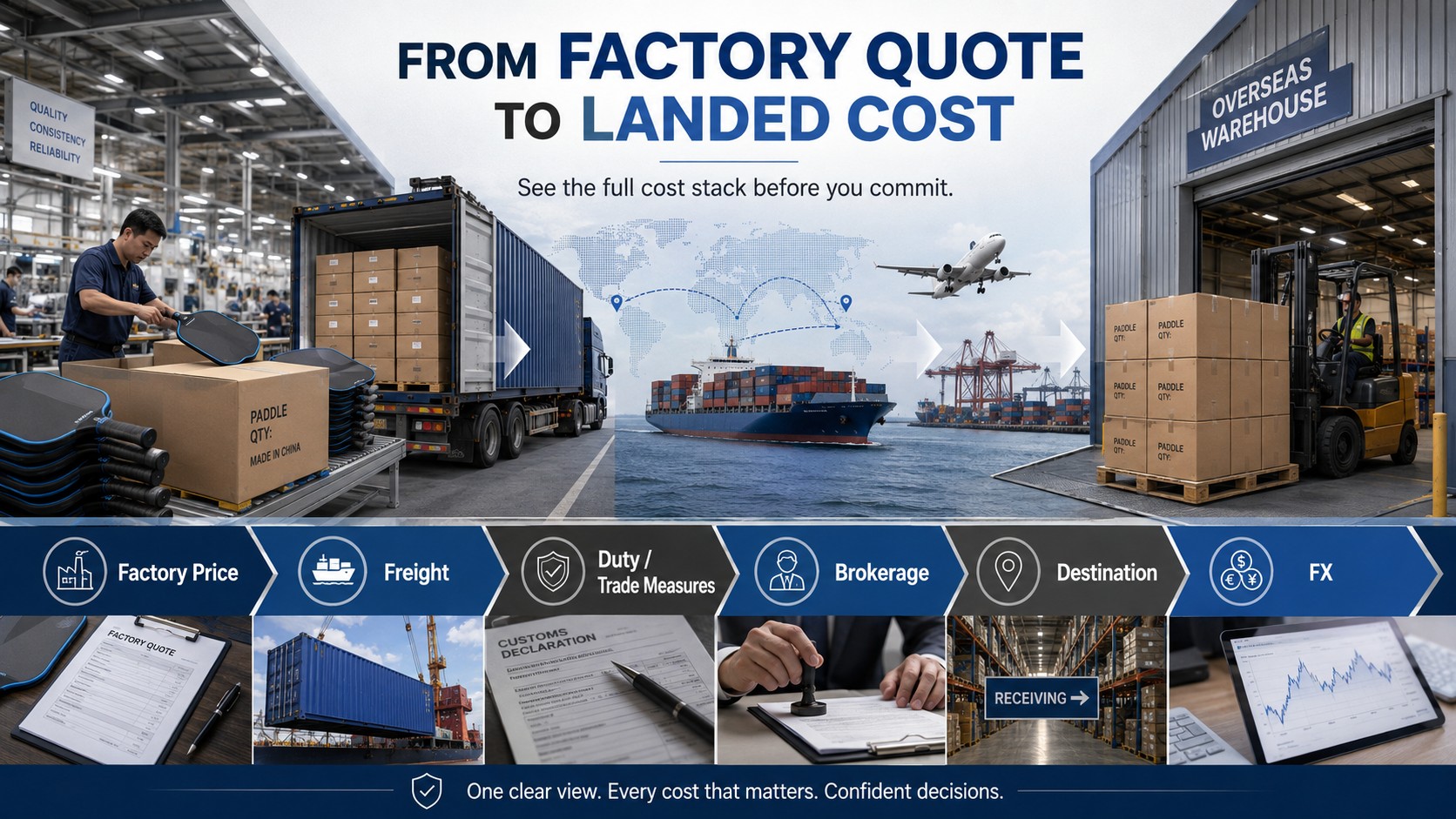
Set the Commercial Basis and Build the Full Cost Stack
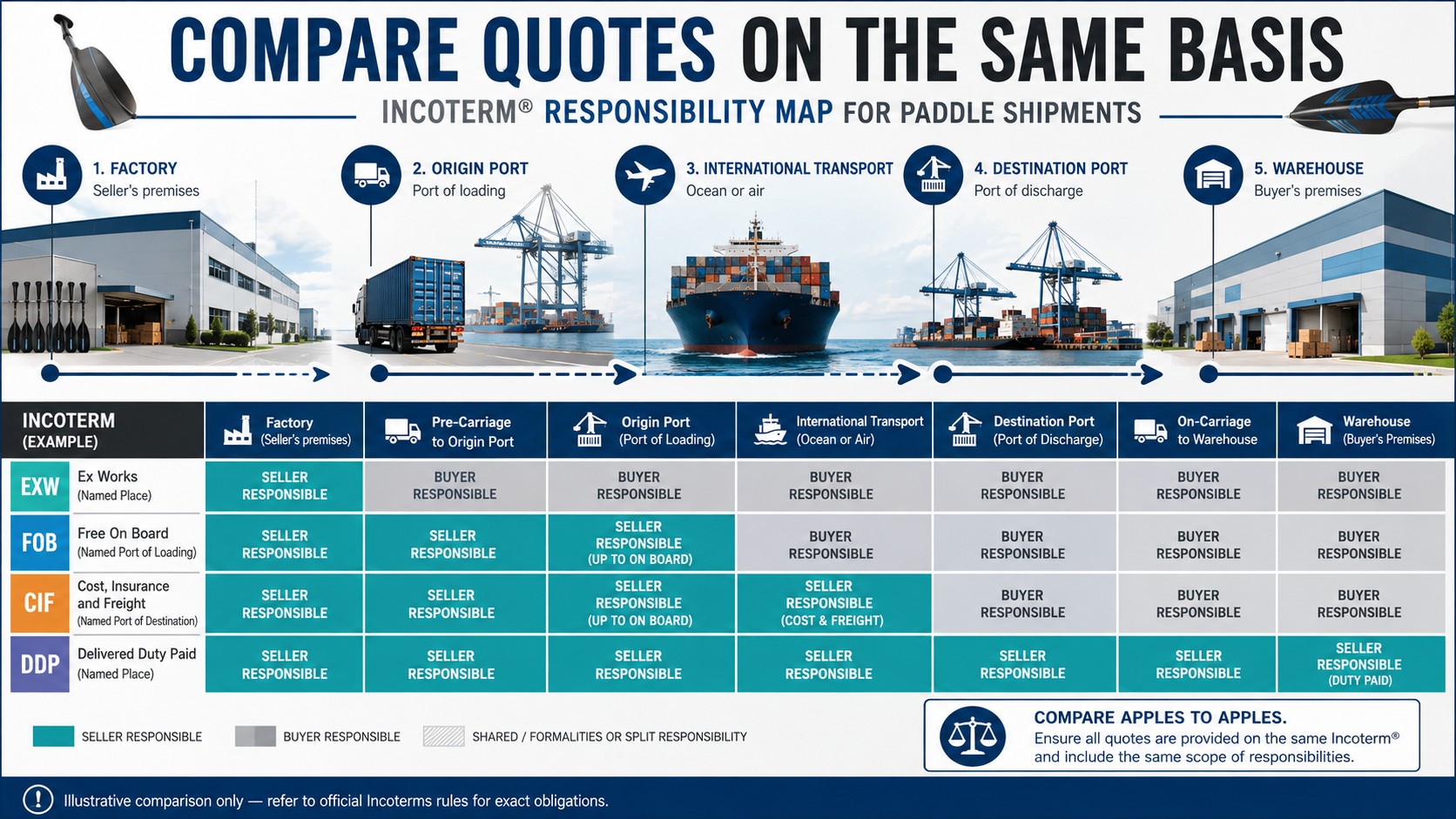
Before comparing two quotes, make sure they are quoted on the same basis. An EXW quote and an FOB quote are not directly comparable because the responsibility and cost handoff occur at different points.
Document the Incoterm, named place or port, currency, packaging assumption, quote validity and what is included. If the supplier says “shipping included,” ask where the responsibility ends.
- Unit product cost
- Retail and export packaging
- Origin pickup and export handling when applicable
- International freight
- Insurance when applicable
- Customs duties and other applicable trade measures
- Brokerage and entry-related charges
- Port, terminal or destination handling
- Domestic delivery to the warehouse
- Foreign-exchange variance or buffer
The point is to prevent costs from disappearing between departments because each person is looking at a different slice.
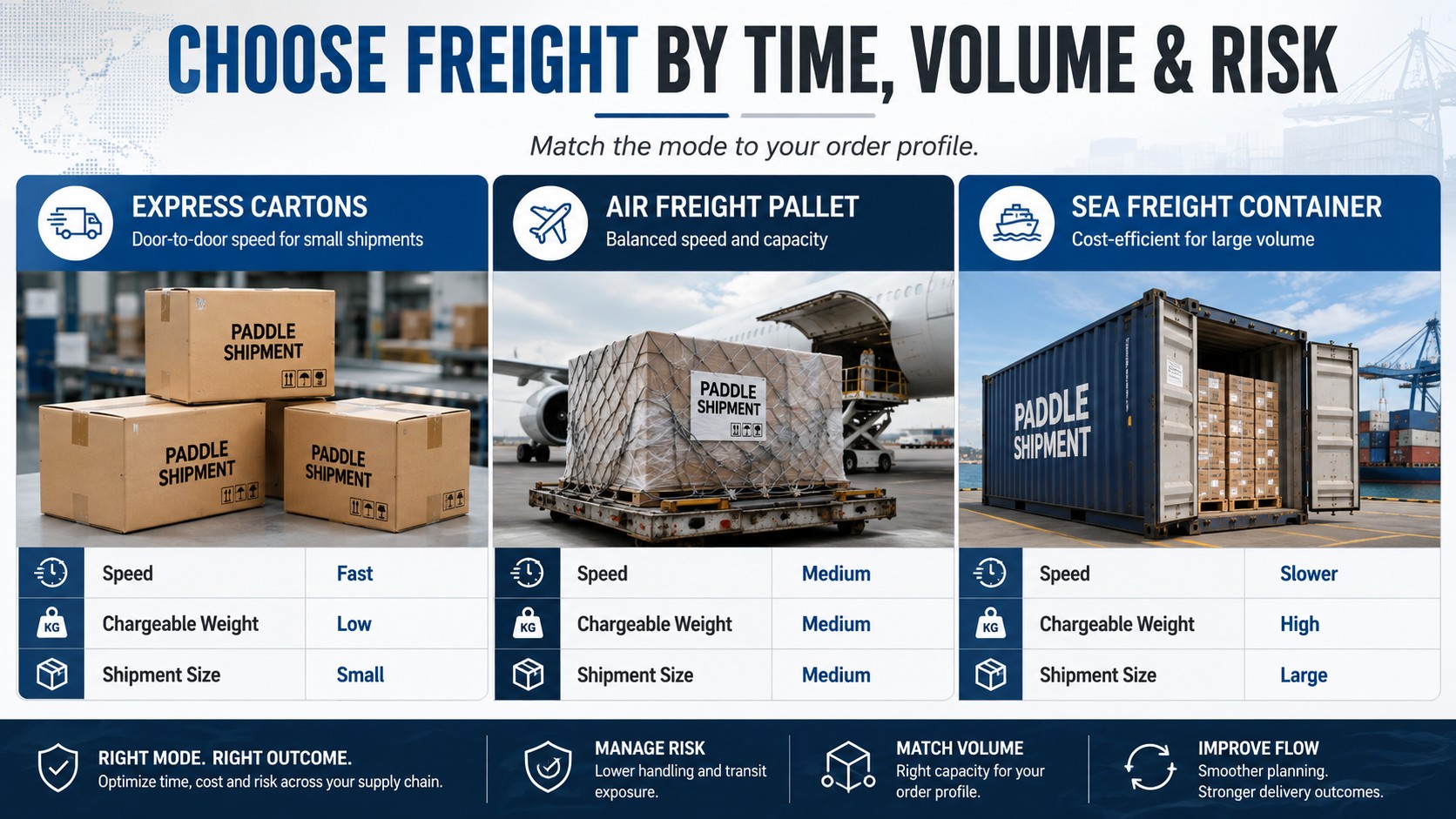
Model Freight and Packaging Together
Express is useful for samples and small urgent shipments. Air freight can fit time-sensitive replenishment or launches. Sea freight often becomes more economical for larger shipments, but planning must include booking, origin handling, transit, customs clearance and destination delivery.
Do not evaluate freight only as “cost per kilogram.” Paddle cartons can be volume-sensitive. Packaging dimensions, master-carton count, palletization and chargeable-weight rules can change the outcome.
A premium retail box may increase perceived value, but it can also increase carton cube and damage risk. A small reduction in retail-box volume can sometimes create a larger logistics saving than negotiating a few cents from the paddle itself.
When final packaging is not frozen, use at least two freight scenarios: development packaging and production-intent packaging.
Verify Classification, Customs Value and Destination Charges
For U.S. imports, the Harmonized Tariff Schedule of the United States is maintained by the U.S. International Trade Commission. The HTS sets out tariff rates and statistical categories for imported merchandise. Classification should be confirmed for the actual product rather than copied from a competitor or an old shipment.
As of August 2026, the USITC is publishing 2026 HTS revisions, and USTR continues to maintain China Section 301 tariff actions and review processes. That is why a blog article should not hard-code one permanent “pickleball paddle tariff.”
For purchase orders or launch budgets, verify the current HTS entry and any applicable additional measure with appropriate customs expertise.
U.S. Customs and Border Protection explains that transaction value is generally based on the price actually paid or payable for merchandise sold for export to the United States, plus certain required additions. The commercial invoice should not simply use the future retail price.
Customs valuation can become more complex when there are assists, royalties, related parties, tooling, molds or other additions. When those issues are material, use a customs broker or qualified adviser.
Depending on the shipment, an importer may encounter customs brokerage, port or terminal handling, documentation, delivery, warehouse appointment charges, demurrage or other destination costs. A good forwarder quotation should make included and excluded items visible.
Add FX Risk and Scenario Planning
If the supplier quote is in one currency and the brand sells in another, effective landed cost can change between quotation, deposit and balance payment.
Record the quotation currency, the exchange rate used in the model, the payment schedule and a reasonable scenario range. The goal is not to predict currency markets. It is to understand how sensitive the product margin is to exchange-rate movement.
- Base case: current quote, expected freight and current trade assumptions.
- Higher-cost case: more expensive freight, unfavorable FX movement or extra destination charges.
- Launch case: includes expedited samples, smaller first shipment, certification, packaging setup or other non-recurring costs.
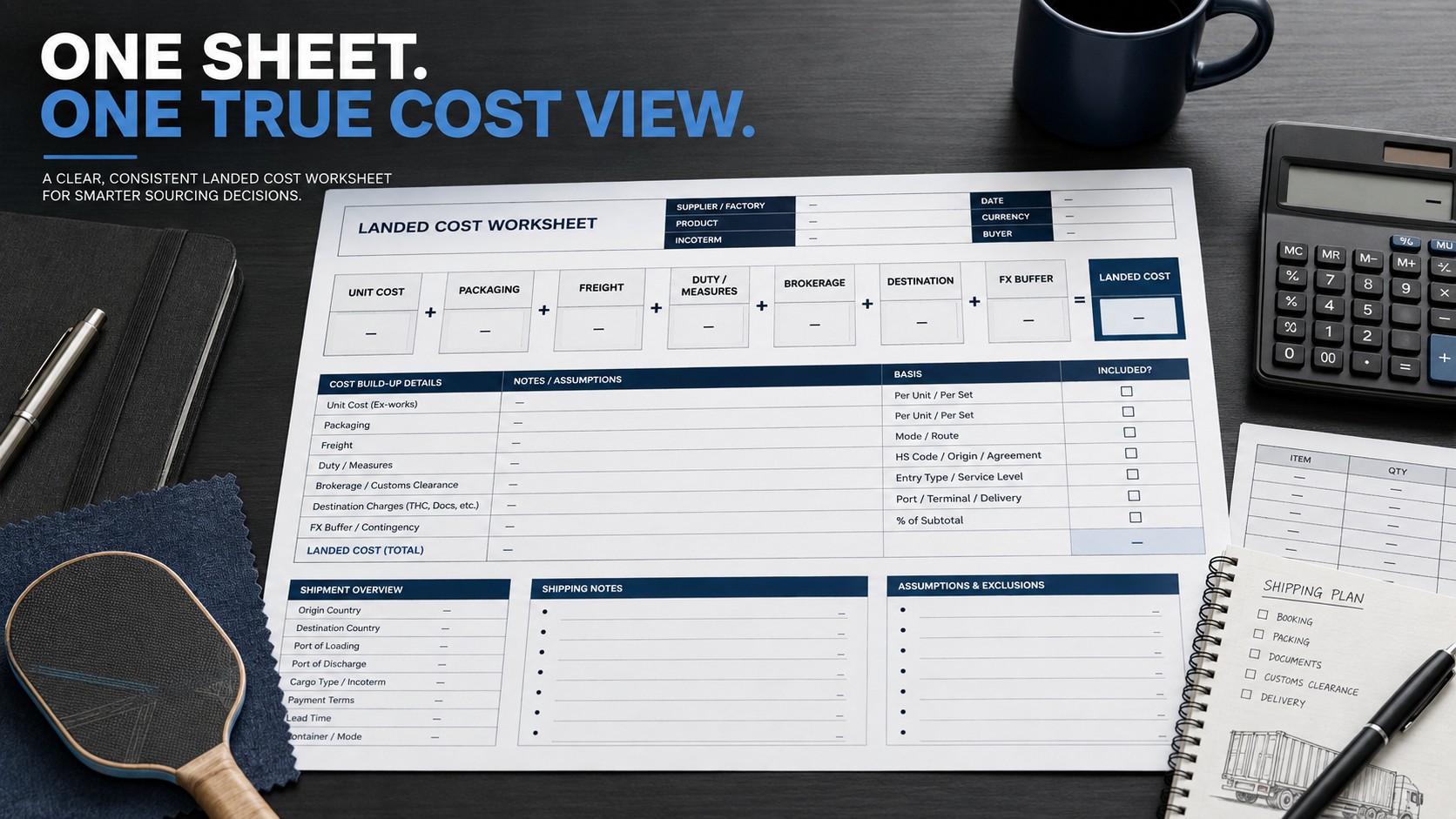
Illustrative Landed-Cost Worksheet
| Line Item | How to Model It | Editorial Rule |
|---|---|---|
| Supplier basis | EXW/FOB/other named term + quote date | Never compare unlike Incoterm bases |
| Packaging & origin | Retail box, master carton, pickup/export handling | Use production-intent dimensions |
| International freight | Express/air/sea quote + validity date | Do not hard-code freight rates into evergreen copy |
| Customs & trade measures | Current HTS/origin/current measures | Verify current official sources; do not assume one permanent paddle rate |
| Destination | Brokerage, terminal/handling, domestic delivery | Show inclusions/exclusions |
| FX | Quoted currency, payment schedule, scenario rate | Model sensitivity rather than predicting FX |
Convert Shipment Cost Into a Per-Unit Commercial Decision
Divide shipment-level costs by saleable units, not simply units ordered. If damage allowance, samples, warranty replacements or promotional inventory are planned, model them explicitly.
Then connect landed cost to wholesale margin, distributor margin, retailer economics, marketing and warranty.
- Comparing EXW and FOB quotes as if they are the same.
- Using sample-carton dimensions for mass-production freight estimates.
- Copying an HTS number without verifying the actual product.
- Assuming “freight prepaid” means no destination charges.
- Ignoring FX movement between quote and payment.
- Using a consumer retail price as customs value.
- Building margin from factory price instead of landed cost.
Keep the Worksheet Auditable—and Use It to Negotiate the System
A landed-cost sheet should show the date of every external assumption. Record the supplier quote date, freight quote date, HTS version checked, exchange-rate assumption and the person or adviser who confirmed any customs treatment that materially affects the order.
This turns the spreadsheet into a decision record. Three months later, the team can see whether a margin change came from the product, freight, currency or a new trade measure instead of blaming the factory quote.
Once the cost stack is visible, negotiation becomes more intelligent. A factory may be able to reduce carton volume, consolidate packaging materials, adjust order frequency or quote a different Incoterm. A forwarder may be able to improve routing. The finance team may decide that a slightly larger shipment reduces freight per unit but creates too much inventory risk.
The goal is not to push every cost back to the supplier. It is to optimize the complete system.
Every new paddle SKU should have one dated landed-cost worksheet with clear assumptions. When freight, tariff treatment, origin, packaging or FX changes, update the model instead of debating the old quote.
FAQ
Is freight included in landed cost?
Yes, but landed cost is broader than freight and can include duties, brokerage, destination handling and delivery.
What HTS code should a pickleball paddle use?
The correct classification must be determined for the actual product using the current USITC HTS and qualified customs guidance.
Should I calculate margin from FOB price or landed cost?
A realistic commercial model should start from the cost of having saleable inventory at the point your business uses it.
How often should I update landed cost?
Update it whenever a material assumption changes—freight, Incoterm, tariff treatment, origin, packaging, currency or destination charges.
Can I use DDP to avoid customs planning?
DDP can shift responsibilities commercially, but the brand should still understand importer-of-record responsibilities and what charges are included.
The End about Mayvoci
1)Design:Over 100 paddle designs and photography service to assist start-up.
2)Professional:Focus on various of paddles manufacturing for 6 years
3)Quality:Strict quality management system to provide safety and satisfaction for customers
4)Amazon:Flexible comprehensive solution to make sure each Amazon seller is well cared.
5)Excellent Team:Experienced paddle experts & dynamic sales team give you 5-star service




What’s the most unexpected cost you’ve encountered when importing sporting goods? Was it a destination handling fee, a tariff surprise, or something else? Drop your experience below—let’s help the community avoid the same pitfalls! 👇