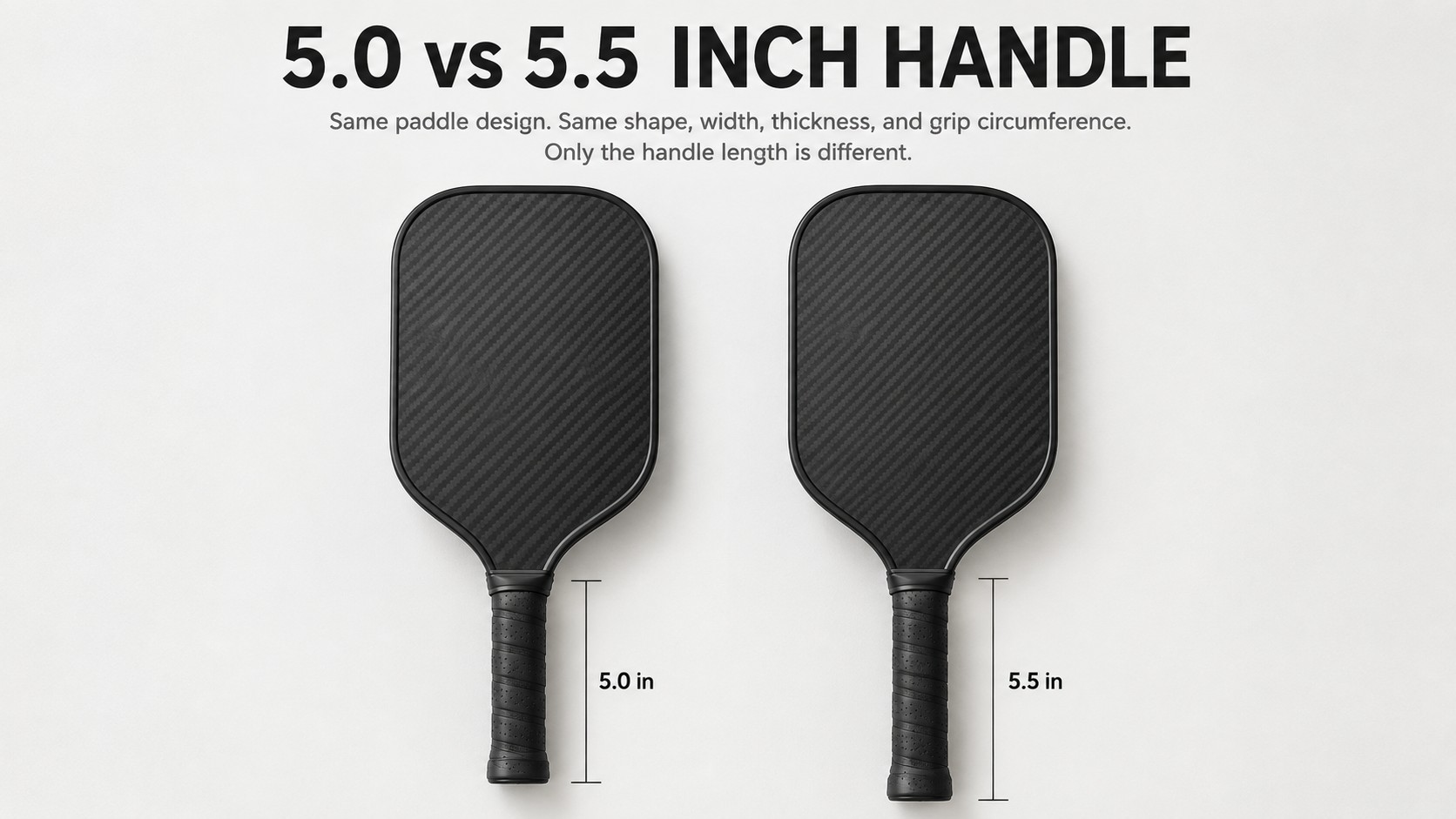
Five inches versus 5.5 inches sounds like a small difference. On a pickleball paddle, that half inch can change how much usable hand space is available, how naturally a two-handed backhand fits, how much room remains for the face, and how mass is distributed around the player’s hand.
There is no universal “best” handle length. The right choice depends on stroke style, hand size, grip build-up, total paddle geometry and what the designer is trying to prioritize.
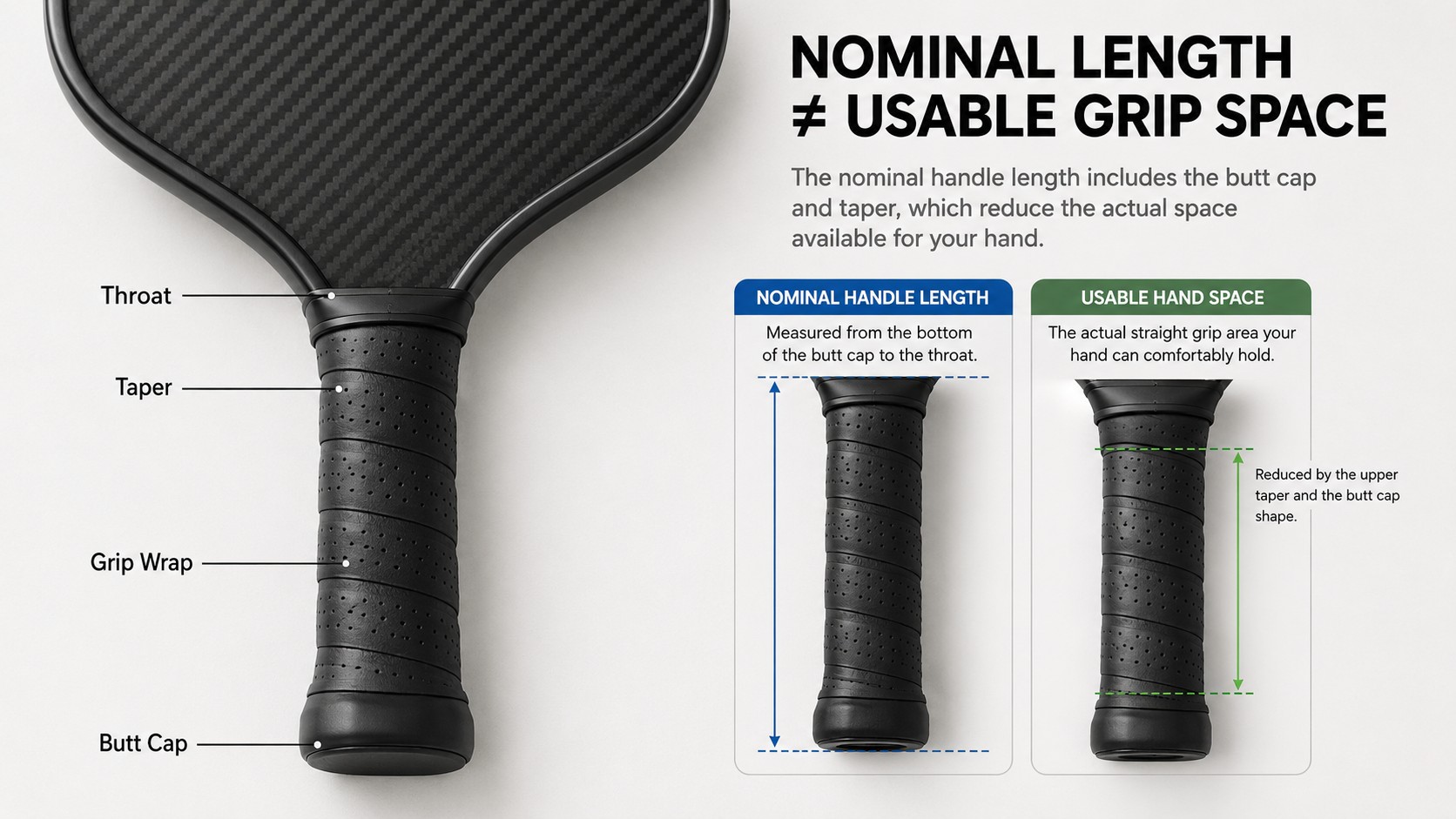
Nominal Handle Length vs Usable Hand Space
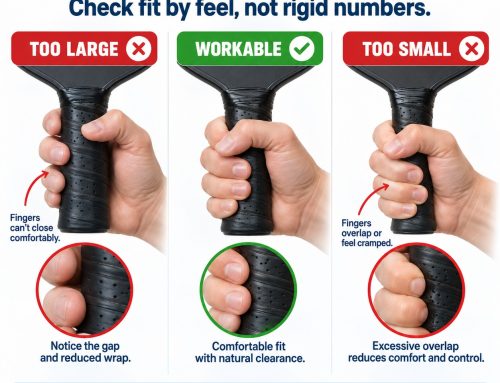
Published handle length is a geometric dimension, but players feel usable grip space. Butt-cap height, taper, grip wrap, flare and the transition into the throat can all reduce or change the area where a hand can sit comfortably.
Two paddles both listed at 5.5 inches can provide different real hand space. Look at the full handle and throat shape rather than the number alone.
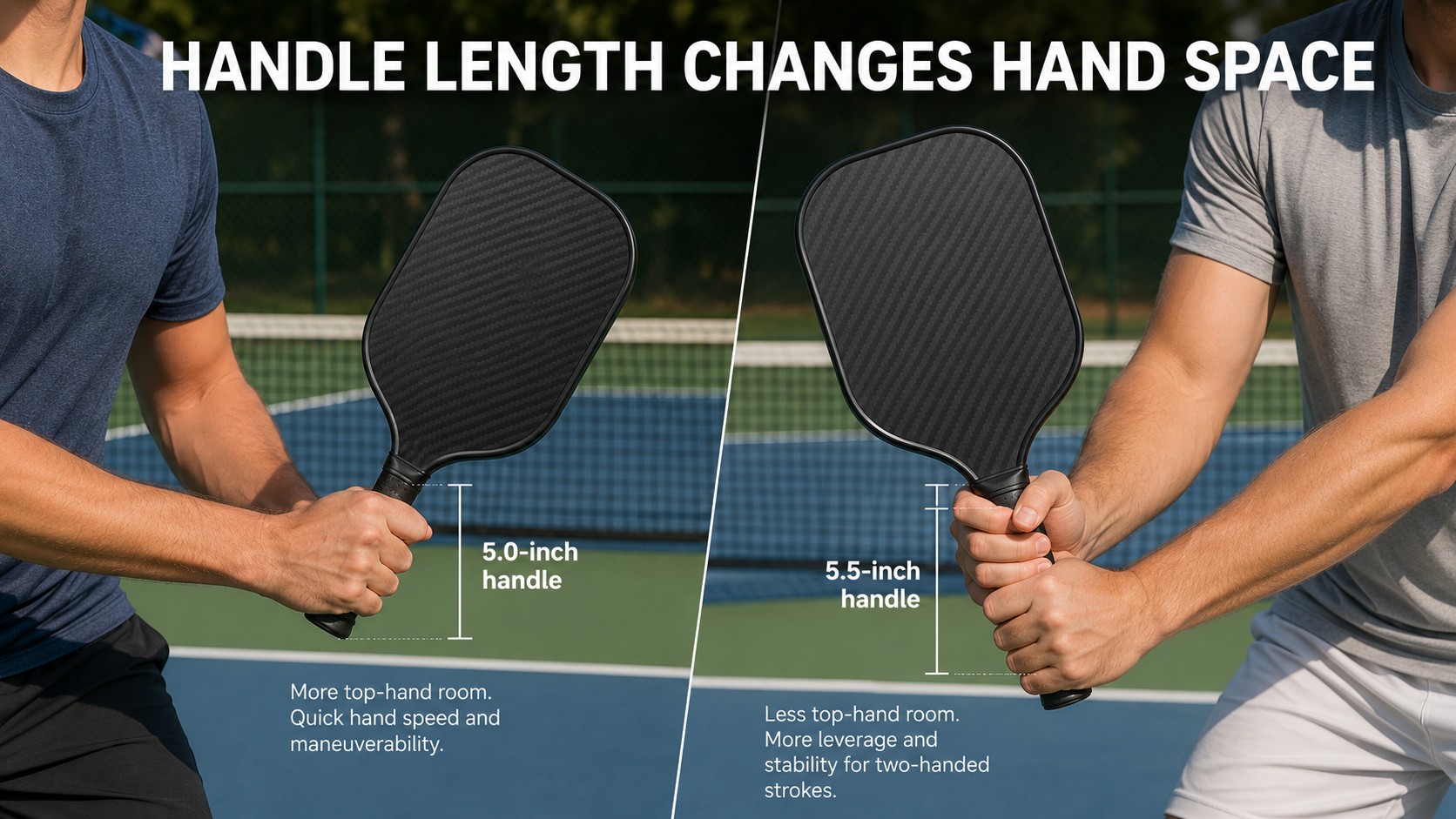
One-Handed and Two-Handed Backhands Need Different Space
A two-handed backhand places the second hand above the primary hand. If the grip is too short, the upper hand may overlap the throat, sit partly on an abrupt taper or force the lower hand into an uncomfortable position.
A longer handle often makes a two-handed backhand easier to organize, but the benefit depends on hand size and grip style.
A one-handed player does not automatically need a short handle. Some players like extra room to move the hand, use leverage on serves or groundstrokes, or prefer the balance created by the longer handle structure.
Others would rather allocate more of the total length to the paddle face.
Handle Length Interacts With Face Geometry, Balance and Grip Build-Up
If total paddle length is fixed, increasing handle length usually means some other geometric dimension changes. Depending on the mold, that may reduce face length, move the throat or alter the relationship between the sweet spot and the hand.
An OEM project should not simply say, “Add 0.5 inch to the handle,” without reviewing the whole outline.
Handle length itself does not dictate balance, but changing handle architecture can change where material and components sit. Grip weight, butt cap, handle reinforcement, throat geometry and face area all contribute to mass distribution.
Compare handle length together with balance point and, when possible, swing weight.
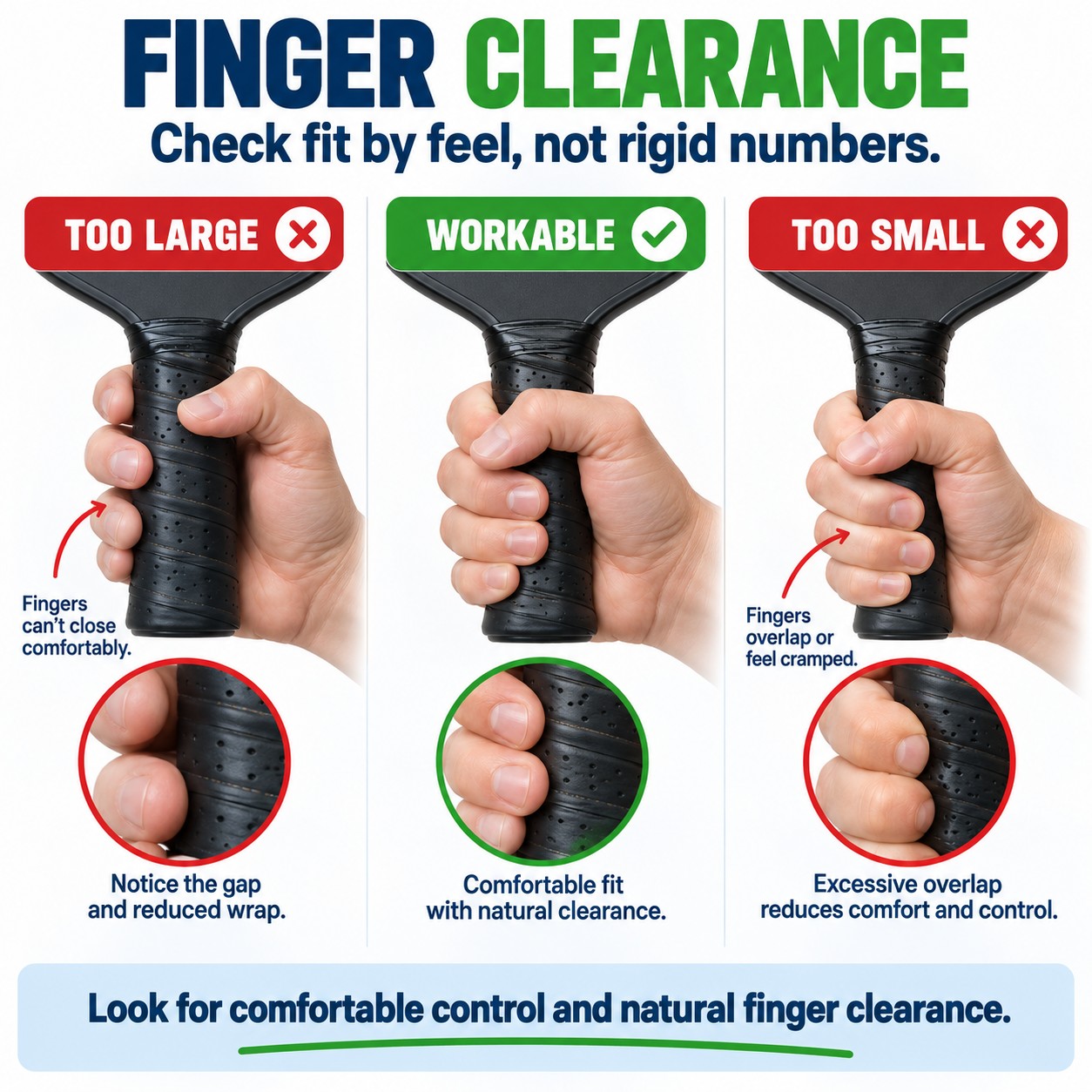
A thick replacement grip or overgrip changes circumference and can also change how much length feels usable. Players who use two overgrips, a large butt-cap flare or a very cushioned grip may need more nominal handle length to achieve the same hand placement.
Fit the Player by Hand Size and Stroke—not Skill Labels
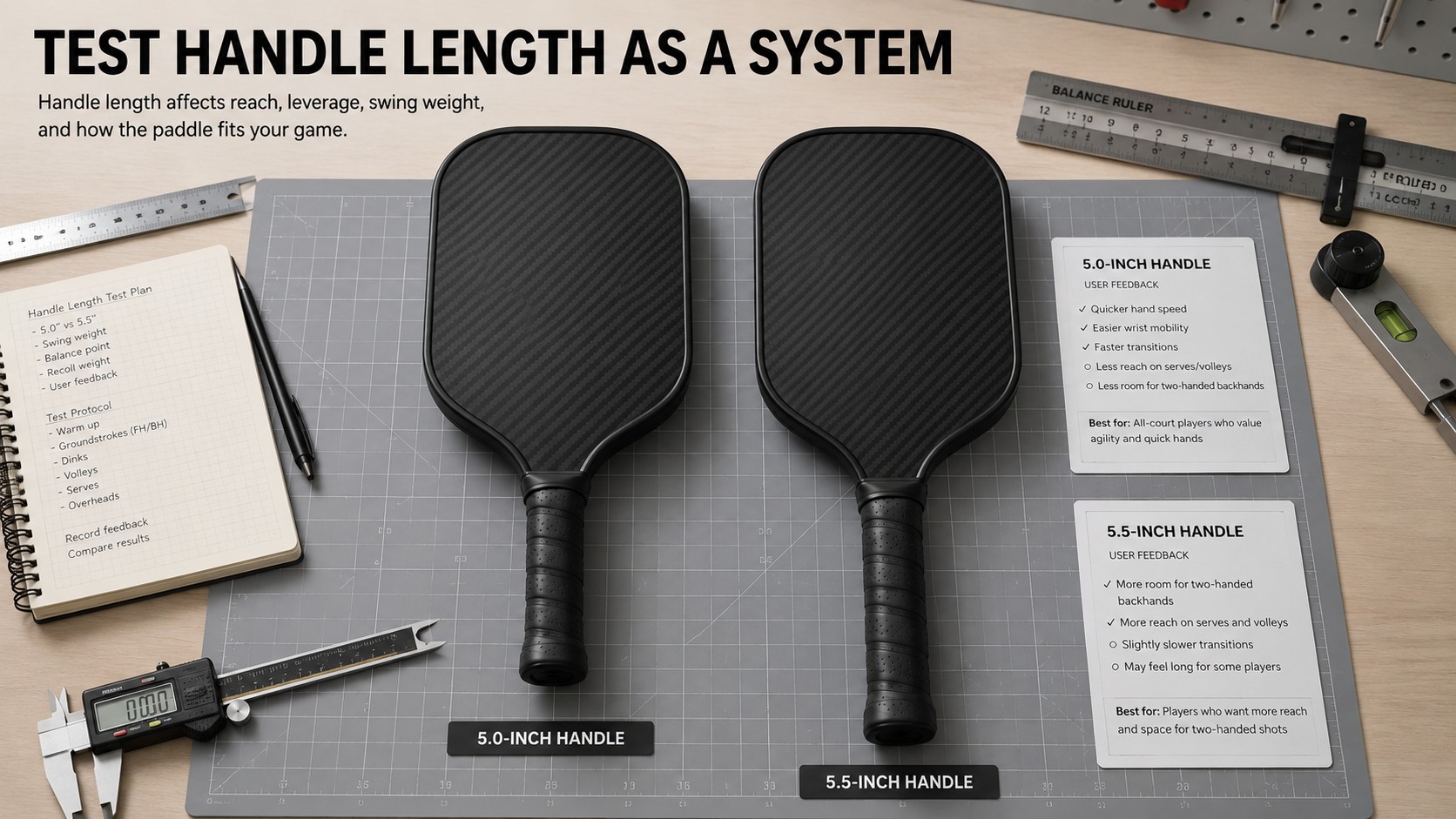
Instead of saying “5 inches is for beginners” or “5.5 inches is for advanced players,” use hand placement and stroke requirements. A beginner learning a two-handed backhand may benefit from extra space. An advanced one-handed player may prefer a compact handle and more face area.
Use paddles with similar total weight and grip circumference if possible. Hit serves, returns, blocks, drives, resets and backhands. Pay attention to whether the upper hand feels crowded, whether the paddle feels slow in hand, and whether you naturally choke up or down.
Handle-Fit Decision Matrix
| Player / Design Need | 5.0-inch Direction | 5.5-inch Direction | What to Validate |
|---|---|---|---|
| One-handed, compact handling | Often a logical starting point | Still possible | Usable grip space, face geometry, balance |
| Two-handed backhand | May feel crowded depending on hand/throat | Often more room | Upper-hand placement and throat transition |
| Large hands / thick overgrip | Can reduce usable space | Can create more flexibility | Finished circumference + usable length |
| OEM new mold | Can preserve more face length | May consume more of fixed overall geometry | Whole outline, mass distribution and target player |
Measure the Handle Before Mold Freeze
- Nominal handle length
- Usable straight grip length
- Grip circumference and build-up
- Butt-cap and flare geometry
- Throat transition
- Total paddle length
- Static weight and balance
- Target players’ one- and two-handed feedback
A small geometry choice can become expensive to change after tooling, photography and certification are already underway.
For product development, record more than one handle dimension. Useful geometry includes straight grip length, butt-cap flare width, taper start point, throat start point, grip circumference at several positions and the distance from the hand to the intended center of the hitting area.
This matters because two molds can share the same advertised handle length while creating different hand positions. A smoother throat transition may make a nominally shorter grip feel more usable for the second hand.
Choose Handle Length as Part of the Product Portfolio
A brand does not need every paddle to use the same handle. A widebody control model can prioritize face area and compact handling, while an elongated model may intentionally provide more hand room for two-handed players.
When several models share one mold family, document why the handle choice supports all of them. Otherwise tooling convenience can silently become a player-fit limitation.
Try a longer handle first if you regularly use a two-handed backhand, have larger hands, prefer more grip freedom or want extra hand space.
Try a shorter handle first if you use one hand, prefer a compact feel, want more face area within a fixed total length or naturally choke up.
If neither description clearly fits, test both. Handle length is a fit variable, not a badge of performance.
FAQ
Is 5.5 inches required for a two-handed backhand?
No. It often provides more room, but hand size, throat shape and usable grip length matter.
Does a longer handle automatically create more power?
No. Final power depends on the complete paddle and stroke.
Does a 5-inch handle give a larger sweet spot?
Not automatically. Face area and sweet-spot behavior depend on the full geometry and construction.
Should OEM buyers specify usable grip length?
Yes. Nominal handle length alone may not describe how much straight, comfortable hand space is actually available.
Can an overgrip change handle fit?
Yes. Grip thickness, butt-cap flare and wrap position can change both circumference and usable length.
The End about Mayvoci
1)Design:Over 100 paddle designs and photography service to assist start-up.
2)Professional:Focus on various of paddles manufacturing for 6 years
3)Quality:Strict quality management system to provide safety and satisfaction for customers
4)Amazon:Flexible comprehensive solution to make sure each Amazon seller is well cared.
5)Excellent Team:Experienced paddle experts & dynamic sales team give you 5-star service