
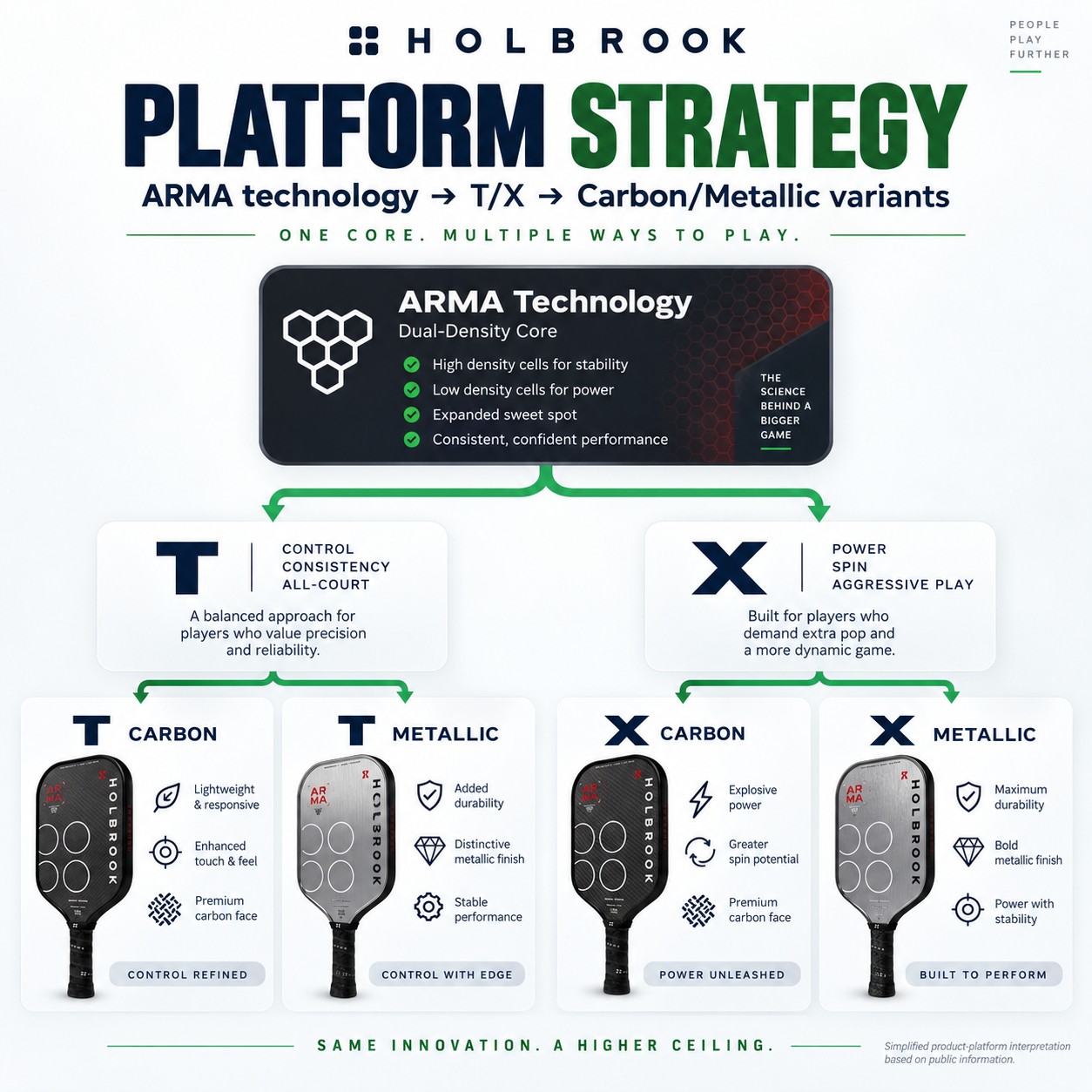
Holbrook’s ARMA series is useful because the brand makes its product story unusually explicit. Current official pages describe a patent-pending Dual-Density core, FLX-Foam and 14 mm construction on current ARMA T/X models.
The editorial challenge is to keep published facts separate from independent durability or performance conclusions.
Record Current ARMA Facts
Current Official Specs
Holbrook currently lists ARMA T and ARMA X variants at 14 mm, around 8.0 oz, with model-specific handle lengths. Current product pages also state USAP approval.
Dual-Density Core
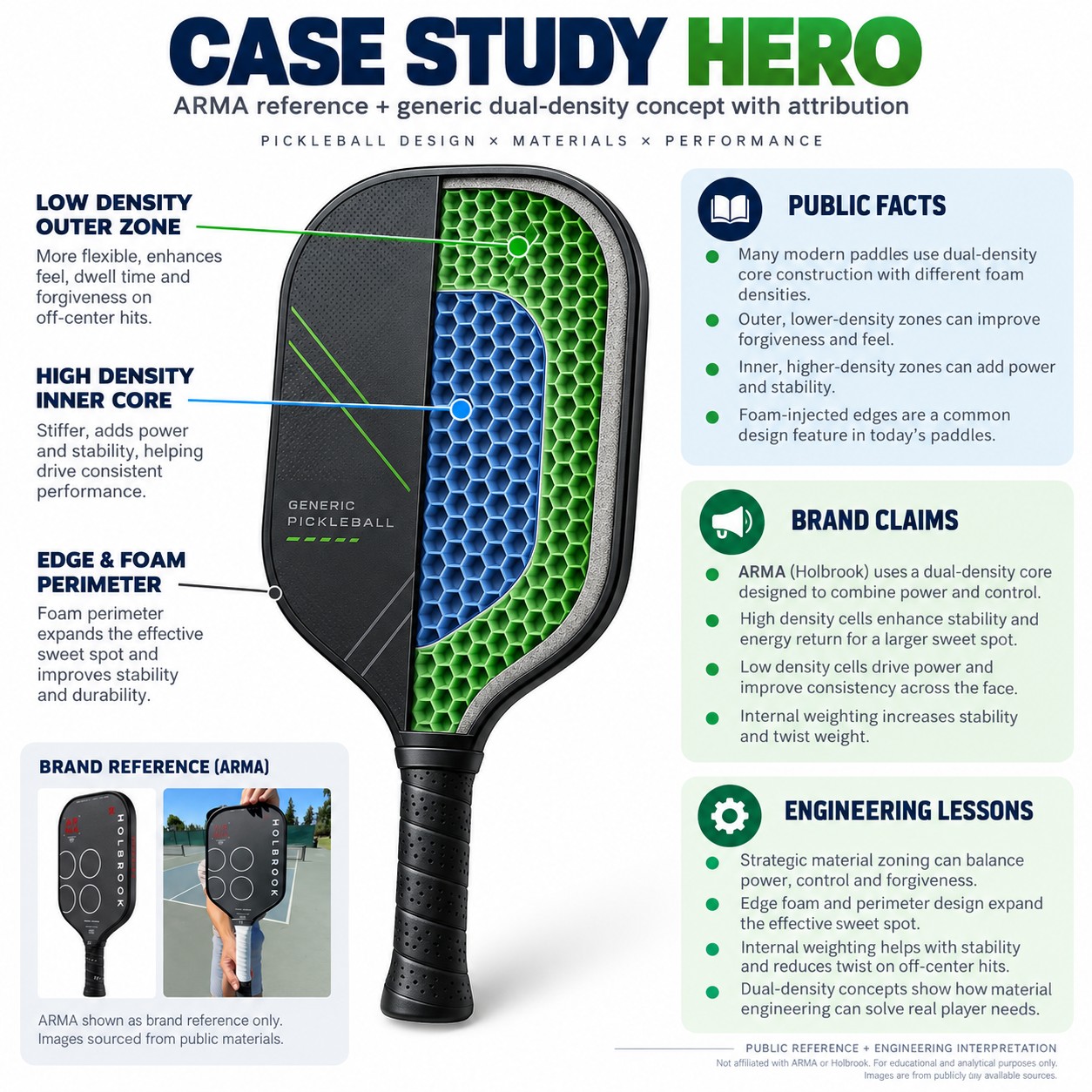
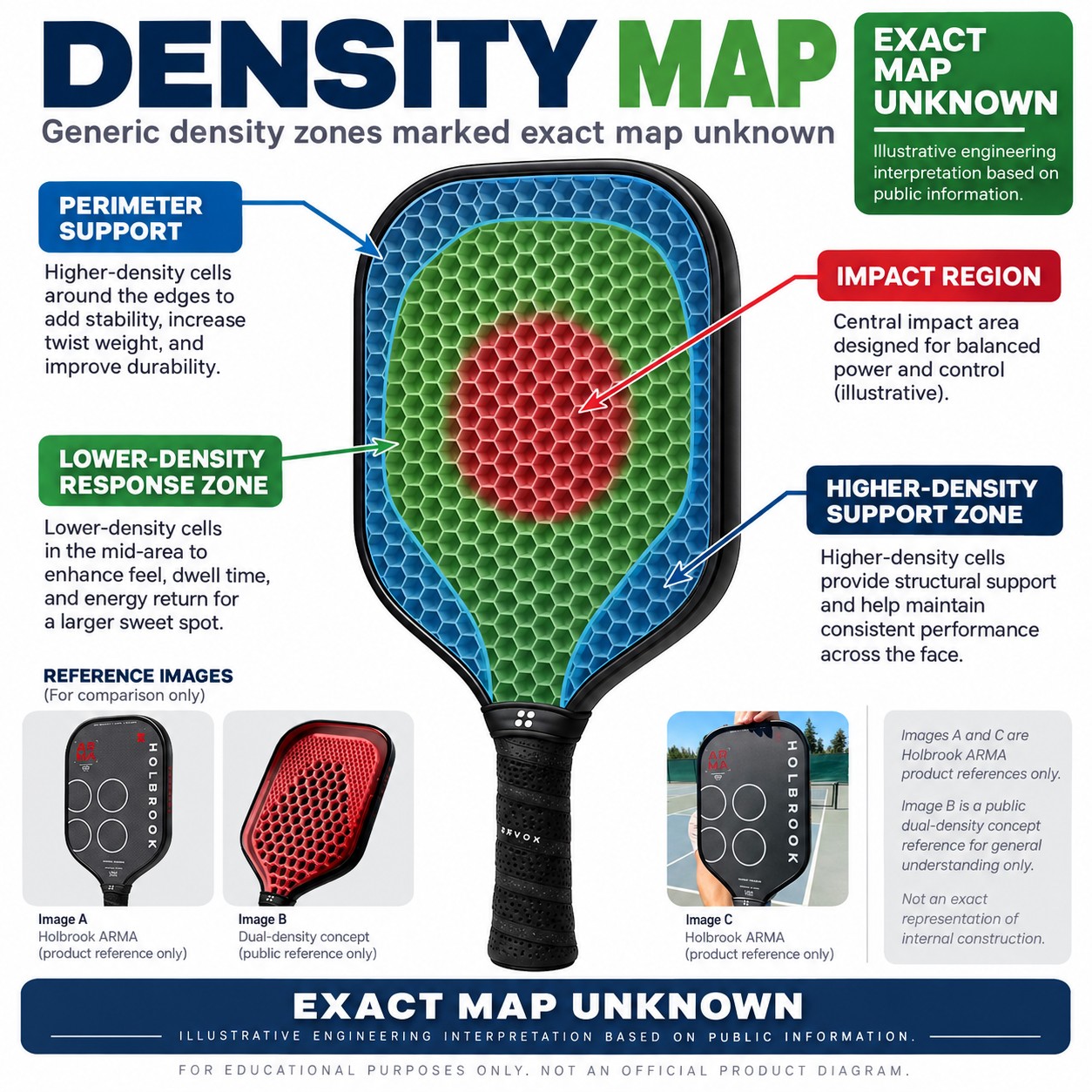
Holbrook says strategically placed high-density honeycomb improves face consistency. That is the brand’s construction explanation; a complete internal density map is not publicly disclosed.
FLX-Foam
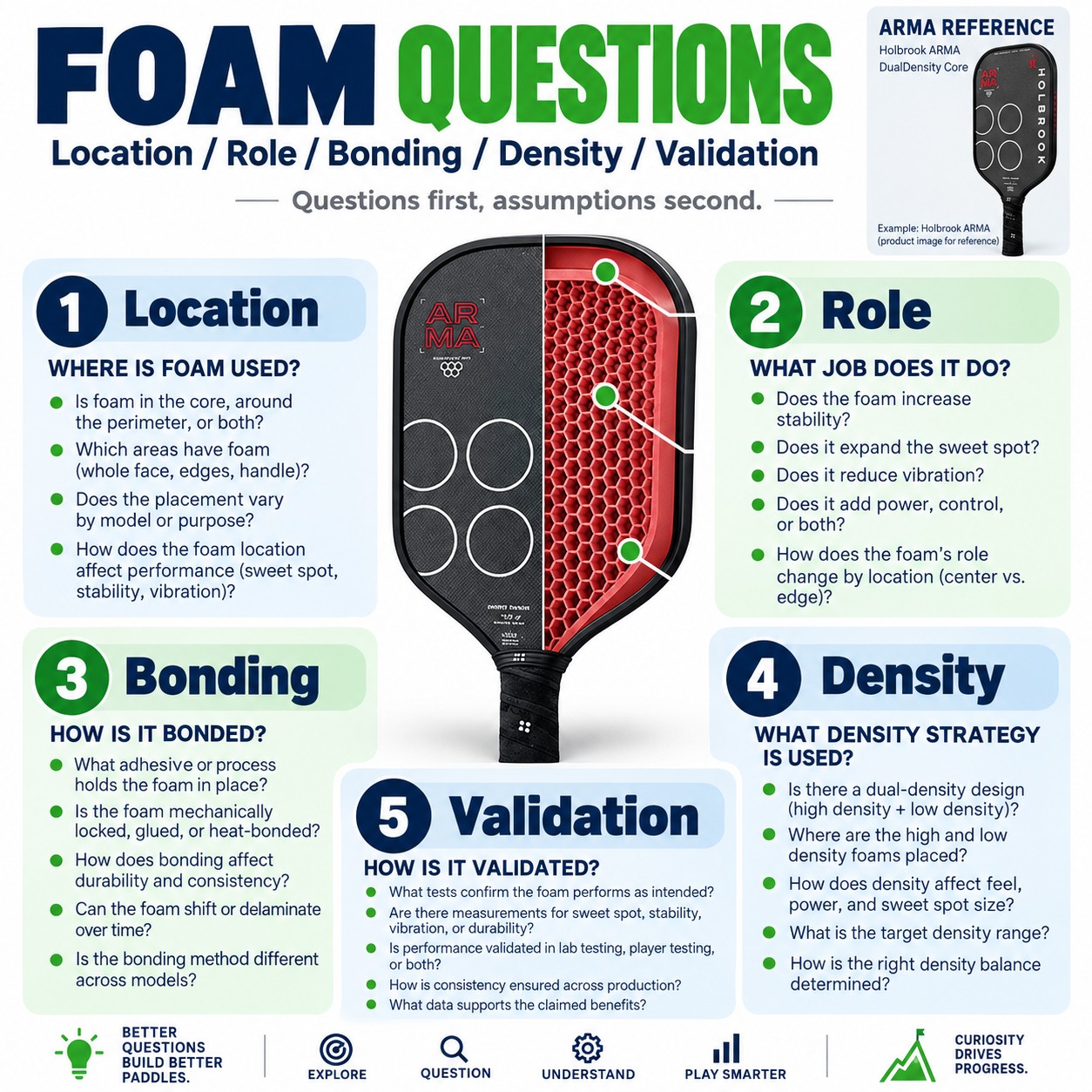
The brand describes FLX-Foam as part of the architecture. An engineering analysis should ask where the foam is located, what job it performs and how it is bonded rather than guessing.
Interpret Dual-Density and FLX-Foam Carefully
14 mm and Face Variants
Thickness supports the performance positioning but is only one variable. Holbrook also offers carbon and metallic-face variants, making exact layer definitions important.
Durability
Do not use isolated customer reviews as a durability rate. Warranty terms and field reports can be signals, but controlled lifecycle testing is needed for a stronger conclusion.
OEM Lessons
The useful lesson is platform design: a named core concept extended across shapes and face variants. Benchmark the product logic, then prototype independently with cross-section and conditioned testing.
Public Fact Versus Engineering Inference Table
For example, “14 mm” and “Dual-Density core” can be public facts when stated on the official page. “This creates a larger real sweet spot” is a brand claim until independently tested. “Regional density could alter local support” is an engineering hypothesis.
Labeling these categories makes the article far more credible.
Durability and Variant Questions
Prototype Lesson
A brand interested in regional core density can create its own controlled density map and compare it against a uniform-core baseline. Keep face, shape, surface and target mass as constant as possible.
Then inspect whether the added complexity creates a measurable benefit that survives conditioning.
Portfolio Update Rule
Holbrook may change ARMA variants over time. Recheck the official product family before every major article update and separate discontinued specifications from current models.
Do not blend old and new variants into one permanent specification table.
Practical Editorial / Decision Notes
A useful editorial device is a three-column split: public fact, brand claim and engineering hypothesis. This prevents a brand’s performance language from becoming Mayvoci’s conclusion.
If benchmarking regional core density, change the density architecture while keeping geometry, face and target mass as constant as practical, then condition the prototypes.
Build an Independent Prototype Lesson
ARMA Evidence Split
| Layer | What to Record |
|---|---|
| Official facts | 14 mm variants / current materials / approval |
| Brand description | Dual-Density / FLX-Foam |
| Unknowns | Exact density map / bonding / process |
| Validation | Controlled prototype / conditioning |
| OEM lesson | Regional support concept, independently developed |
Sources / Current-Update Notes
- Holbrook ARMA — Current official site describes ARMA with patent-pending Dual-Density core and FLX-Foam; current T/X models shown at 14 mm. Primary source
Turn the ARMA Story Into a Controlled Engineering Question
Holbrook’s published Dual-Density and FLX-Foam language raises useful questions about regional support and hybrid core design. It does not disclose a complete density map or process.
A legitimate OEM lesson is to test whether regional support improves the target job. Build an independent density/support concept, keep other variables as controlled as practical and compare multiple conditioned prototypes.
- Keep official Holbrook facts separate from hypotheses.
- Do not reproduce proprietary internal geometry.
- Use controlled density/support experiments for your own design.
Frequently Asked Questions
What does Holbrook say ARMA uses?
A patent-pending Dual-Density core and FLX-Foam.
Are current ARMA models 14 mm?
Current T/X product pages list 14 mm.
Does this article verify durability?
No.
Is metallic face the same as titanium carbon?
Do not assume; use the exact material description.
What can OEM brands learn?
Build a clear architecture platform and validate it independently.
Exploring regional core support or hybrid architecture?
Mayvoci can help structure an independent prototype matrix and validation plan around the player problem.
The End about Mayvoci
1)Design:Over 100 paddle designs and photography service to assist start-up.
2)Professional:Focus on various of paddles manufacturing for 6 years
3)Quality:Strict quality management system to provide safety and satisfaction for customers
4)Amazon:Flexible comprehensive solution to make sure each Amazon seller is well cared.
5)Excellent Team:Experienced paddle experts & dynamic sales team give you 5-star service


A really good blog and me back again.
wish you all the best
wish you best and best
Every day is a new beginning
Hahahaha You are so good